


Social learning from humans or conspecifics: differences and similarities between wolves and dogs
- PMID: 24363648
- PMCID: PMC3849518
- DOI: 10.3389/fpsyg.2013.00868
Social learning from humans or conspecifics: differences and similarities between wolves and dogs
Abstract
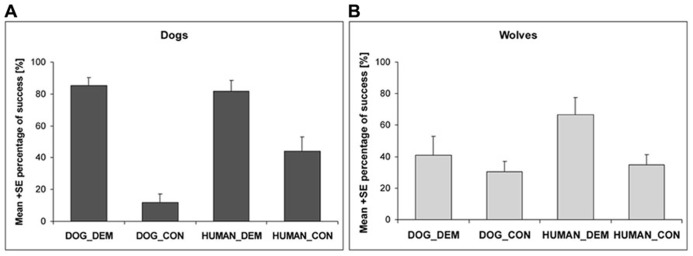
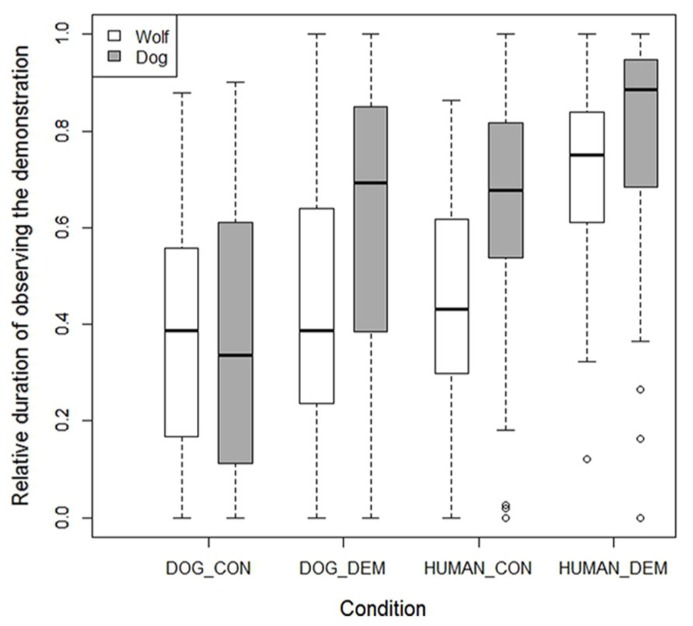
Most domestication hypotheses propose that dogs have been selected for enhanced communication and interactions with humans, including learning socially from human demonstrators. However, to what extent these skills are newly derived and to what extent they originate from wolf-wolf interactions is unclear. In order to test for the possible origins of dog social cognition, we need to compare the interactions of wolves and dogs with humans and with conspecifics. Here, we tested identically raised and kept juvenile wolves and dogs in a social learning task with human and conspecific demonstrators. Using a local enhancement task, we found that both wolves and dogs benefitted from a demonstration independent of the demonstrator species in comparison to a control, no demonstration condition. Interestingly, if the demonstrator only pretended to hide food at the target location, wolves and dogs reacted differently: while dogs differentiated between this without-food and with-food demonstration independent of the demonstrator species, wolves only did so in case of human demonstrators. We attribute this finding to wolves being more attentive toward behavioral details of the conspecific models than the dogs: although the demonstrator dogs were trained to execute the demonstration, they disliked the food reward, which might have decreased the interest of the wolves in finding the food reward. Overall, these results suggest that dogs but also wolves can use information provided by both human and conspecific demonstrators in a local enhancement task. Therefore we suggest that a more fine-scale analysis of dog and wolf social learning is needed to determine the effects of domestication.
Keywords: conspecific demonstrator; dog; domestication; human demonstrator; local enhancement; wolf.
Figures
References
-
- Asa C. S., Mech D. (1995). “A review of the sensory organs in wolves and their importance to life history,” in Ecology and Conservation of Wolves in a Changing World eds. Carbyn L. D., Fritts S. H., Seip D. R. (Edmonton: Canadian Circumpolar Institute; ) 287–291.
-
- Boitani L., Ciucci P. (1995). Comparative social ecology of feral dogs and wolves. Ethol. Ecol. Evol. 7 49–72. 10.1080/08927014.1995.9522969 - DOI
-
- Bonanni R., Cafazzo S., Valsecchi P., Natoli E. (2010a). Effect of group size, dominance rank and social bonding on leadership behaviour in free-ranging dogs. Anim. Behav. 79 981–991. 10.1016/j.anbehav.2010.02.021 - DOI
-
- Bonanni R., Valsecchi P., Natoli E. (2010b). Pattern of individual participation and cheating in conflicts between groups of free-ranging dogs. Anim. Behav. 79 957–968. 10.1016/j.anbehav.2010.01.016 - DOI
-
- Butler J. R. A., Du Toit J. T., Bingham J. (2004). Free-ranging domestic dogs (Canis familiaris) as predators and prey in rural Zimbabwe: threats of competition and disease to large wild carnivores. Biol. Conserv. 115 369–378. 10.1016/S0006-3207(03)00152-6 - DOI
Grants and funding
LinkOut - more resources
Full Text Sources
Other Literature Sources
