. 2013 Nov 23:4:25-32.
doi: 10.1016/j.fob.2013.11.003. eCollection 2013.

Ectopic overexpression of castor bean LEAFY COTYLEDON2 (LEC2) in Arabidopsis triggers the expression of genes that encode regulators of seed maturation and oil body proteins in vegetative tissues

Affiliations

Ectopic overexpression of castor bean LEAFY COTYLEDON2 (LEC2) in Arabidopsis triggers the expression of genes that encode regulators of seed maturation and oil body proteins in vegetative tissues

Hyun Uk Kim et al. FEBS Open Bio. .

Abstract

The LEAFY COTYLEDON2 (LEC2) gene plays critically important regulatory roles during both early and late embryonic development. Here, we report the identification of the LEC2 gene from the castor bean plant (Ricinus communis), and characterize the effects of its overexpression on gene regulation and lipid metabolism in transgenic Arabidopsis plants. LEC2 exists as a single-copy gene in castor bean, is expressed predominantly in embryos, and encodes a protein with a conserved B3 domain, but different N- and C-terminal domains to those found in LEC2 from Arabidopsis. Ectopic overexpression of LEC2 from castor bean under the control of the cauliflower mosaic virus (CaMV) 35S promoter in Arabidopsis plants induces the accumulation of transcripts that encodes five major transcription factors (the LEAFY COTYLEDON1 (LEC1), LEAFY COTYLEDON1-LIKE (L1L), FUSCA3 (FUS3), and ABSCISIC ACID INSENSITIVE 3 (ABI3) transcripts for seed maturation, and WRINKELED1 (WRI1) transcripts for fatty acid biosynthesis), as well as OLEOSIN transcripts for the formation of oil bodies in vegetative tissues. Transgenic Arabidopsis plants that express the LEC2 gene from castor bean show a range of dose-dependent morphological phenotypes and effects on the expression of LEC2-regulated genes during seedling establishment and vegetative growth. Expression of castor bean LEC2 in Arabidopsis increased the expression of fatty acid elongase 1 (FAE1) and induced the accumulation of triacylglycerols, especially those containing the seed-specific fatty acid, eicosenoic acid (20:1(Δ11)), in vegetative tissues.

Keywords: ABI3-VP1, abscisic acid-insensitive 3-viviparous 1; CaMV, cauliflower mosaic virus; Castor bean; DHA, docosahexaenoic acid; DIG, digoxigenin; Eicosenoic acid; FAE1, fatty acid elongase 1; GC, gas chromatography; LEAFY COTYLEDON2; ORF, open reading frame; RT-PCR, reverse transcription polymerase chain reaction; SSC, sodium chloride-sodium citrate; Seed maturation; TAG, triacylglycerol; TF, transcription factor; TLC, thin-layer chromatography; Transcription factor; Triacylglycerol; cDNA, complementary DNA.


Figures
None
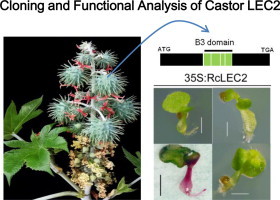
Graphical abstract
Fig. 1
Fig. 1
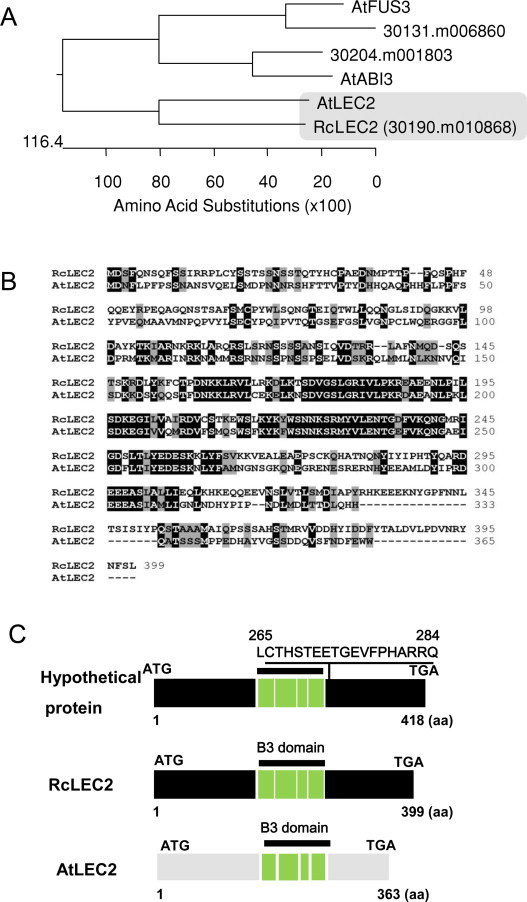
Identification and structure of LEC2 from castor bean (RcLEC2). (A) Phylogenic analysis of deduced amino acids of three Arabidopsis TFs that each contain a B3 domain (LEC2, FUS3, and ABI3) and their most homologous three genes from castor bean, 30190.m010868, 30132.m006860, and 30204.m001803, respectively. Amino acid sequences were aligned using the ClustalW method, and the tree was constructed using the program DNASTAR MegAlign (Ver. 7.2.1). (B) Amino acid alignment of LEC2 proteins from castor bean (RcLEC2) and Arabidopsis (AtLEC2). (C) Structures of cDNAs that encode LEC2 from castor bean and Arabidopsis. Hypothetical protein, XP_002509459, which is encoded by an mRNA transcribed from 30190.m010868 genomic DNA in castor bean. The hypothetical protein XP_002509459 contains a 19-aa sequence (LCTHSTEETGEVFPHARRQ, between aa residues 267 and 284) that this not found in RcLEC2.
Fig. 2
Fig. 2
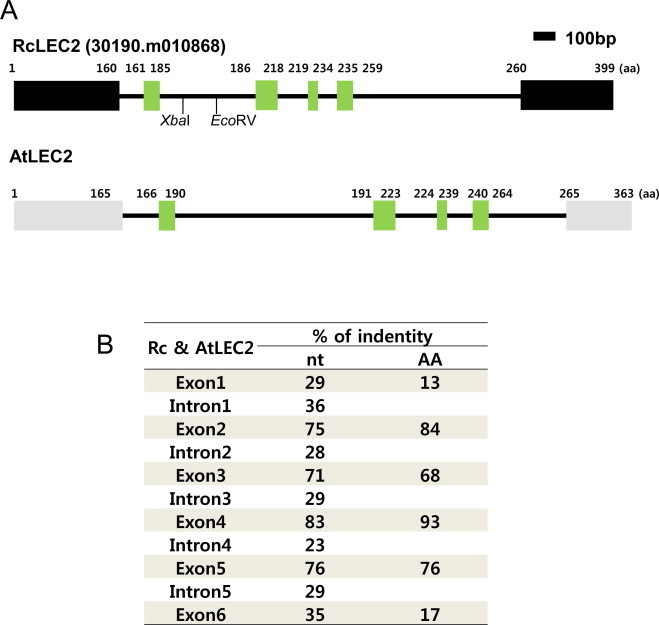
Comparison of LEC2 genes from castor bean and Arabidopsis. (A) Genomic structure of LEC2 genes from castor bean (RcLEC2) and Arabidopsis (AtLEC2). B3 DNA-binding domains are indicated by green rectangles. Sites recognized by the restriction endonucleases XbaI and EcoRV are located in the second intron of the LEC2 gene from castor bean. (B) Nucleotide (nt) and amino acid (aa) sequence identities of the exons and introns of RcLEC2 genes and AtLEC2. (For interpretation of the references to colour in this figure legend, the reader is referred to the web version of this article.)
Fig. 3
Fig. 3
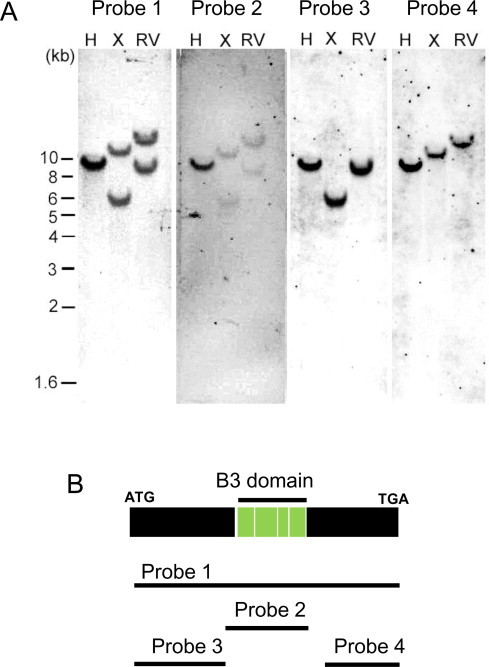
Southern blot analyses of the LEC2 gene from castor bean. (A) Results of hybridization with four LEC2 cDNA fragments hybridized to fragments of the castor bean genome digested with restriction endonucleases. H: HindIII, X: XbaI, RV: EcoRV. (B) RcLEC2 cDNA probes used for Southern blot analysis. Probes 1, 2, 3, and 4 contain the entire RcLEC2 ORF, B3 domain, N-terminal region of the RcLEC2 ORF, and C-terminal region of the RcLEC2 ORF, respectively.
Fig. 4
Fig. 4
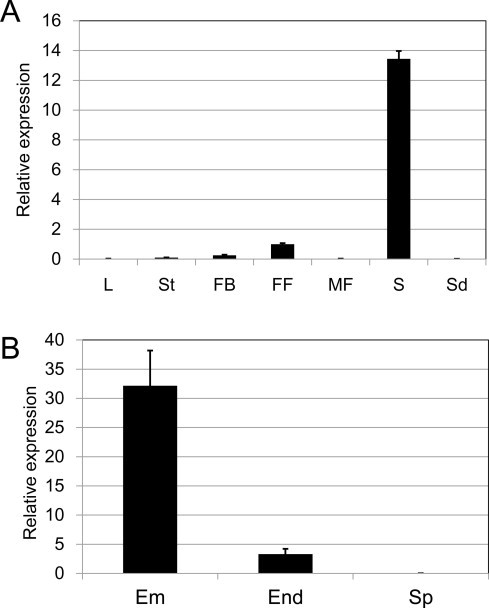
Expression patterns of the LEC2 gene in different tissues of castor bean, determined using qRT-PCR. (A) Seven different tissues were used for analysis (L: leaf, St: stem, FB: flower bud, FF: female flower, MF: male flower, S: developing seed, Sd: seedling). (B) Embryo (Em), endosperm (End), and seed pot (Sp) were dissected from developing seeds. RcLEC2 transcript level was normalized by expression level of castor RcACT2 gene. Three biological replicates showed the same expression profile. Data were averaged with biological triplicates. Data are means ± SD.
Fig. 5
Fig. 5
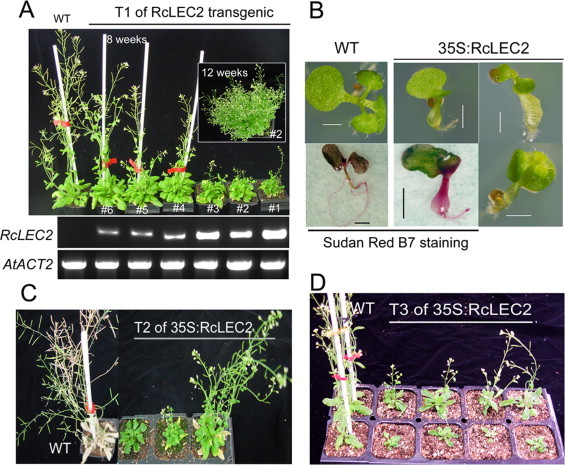
Phenotypes associated with ectopic overexpression of castor bean LEC2 in Arabidopsis transgenic plants. (A) Series of 8-week-old transgenic 35S:RcLEC2 plants (T1 generation) and levels of RcLEC2 transgene compared with that of wild-type plants (WT). Levels of RcACT2 transcript were used to normalize loading. A bushy phenotype of 12-week-old T1 transgenic plant #2 is shown in the inset. (B) Abnormal seedling phenotype in T2 transgenic plants germinated and grown in solid MS medium. The broader-than-normal hypocotyls of 35S:RcLEC2 seedlings stained strongly with Sudan Red 7B, indicating the accumulation of higher levels of oil than are found in wild-type (WT) seedlings. Scale bar in (B) represents 1 mm. (C) Phenotypes of T2 transgenic plants compared with WT plant. (D) Phenotypes of T3 transgenic plants compared with WT plants.
Fig. 6
Fig. 6
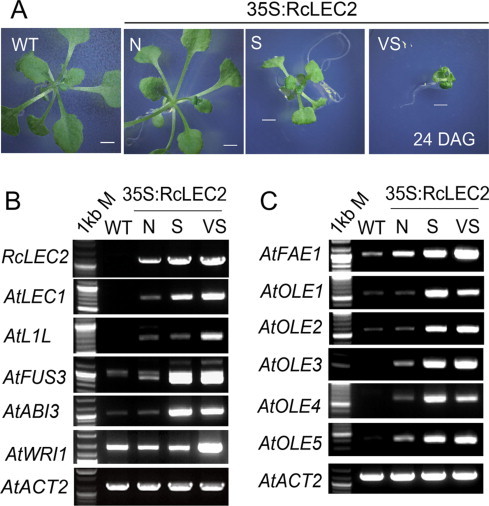
Effect of the expression level of RcLEC2 under the control of CaMV35S promoter in transgenic Arabidopsis plants (35S:RcLEC2) on the severities of their phenotypes 24 days after germination (DAG). (A) Comparison of growth rates between wild-type (WT) and 35S:RcLEC2 transgenic plants. N (normal size), S (small size), and VS (very small size) represent RcLEC2 transgenic plants with different rates of growth. Scale bars represent 1 mm. (B) Expression of RcLEC2 and five seed TF genes regulated by LEC2: LEC1 (At1g21970), L1L (At5g47670), FUS3 (At3g26790), ABI3 (At3g24650), and WRI1 (At3g54320) in rosette leaves of wild-type and transgenic 35S:RcLEC2 Arabidopsis plants. (C) Expression of FAE1 (At4g34520) and five OLEOSIN genes, OLE1 (At3g01570), OLE2 (At3g27660), OLE3 (At4g25140), OLE4 (At5g40420), and OLE5 (At5g51210) in rosette leaves of wild type and transgenic 35S:RcLEC2 Arabidopsis plants. Three biological replicates showed the same expression pattern. 1 kb M indicates 1-kb DNA size marker.
Fig. 7
Fig. 7
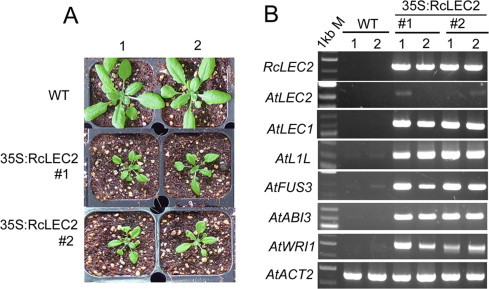
Representatives of 35S:RcLEC2 Arabidopsis transgenic plants and expression of seed master regulator TFs’ genes in rosette leaves. (A) Growth retardation phenotype in T4 generation of 35S:RcLEC2 Arabidopsis transgenic plants compared with wild-type plants on 3 weeks. (B) RT-PCR analyses from leaves of wild-type (WT) and transgenic 35S:RcLEC2 plants (T4 generation). Two different individual plants of WT and two different lines of 35S:RcLEC2 transgenic plants were used for RT-PCR. Expression of the RcLEC2 transgene does not strongly induce expression of Arabidopsis LEC2 (At1g28300) but does induce expression of Arabidopsis LEC1 (At1g21970), L1L (At5g47670), FUS3 (At3g26790), ABI3 (At3g24650), and WRI1 (At3g54320). Three biological replicates showed the same expression pattern. The Arabidopsis ACTIN2 gene, AtACT2, was used as a control. 1 kb M indicates 1-kb DNA size marker.
Fig. 8
Fig. 8
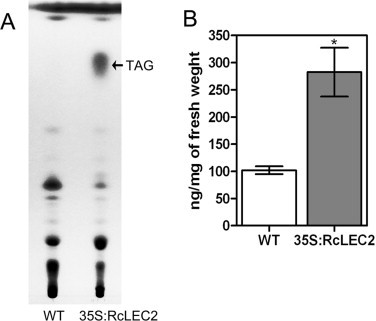
The levels of TAGs in wild-type and 35S:RcLEC2 transgenic Arabidopsis plants. (A) Thin-layer chromatography (TLC) analysis of lipids isolated from leaves of wild-type and 35S:RcLEC2 transgenic Arabidopsis plants (T4 generation). (B) Quantification of TAGs in wild-type and 35S:RcLEC2 T4 transgenic plants. The relative amounts of TAGs represent the sum of total fatty acids extracted from the TAG spot isolated by TLC compared with simultaneous loading of glyceryl triheptadecanoate as a TAG standard during analysis by gas chromatography (GC). Experiments were carried out in triplicate, and data are means ± SD. Asterisks denote statistical differences compared with wild-type plants (t-test, *P < 0.05).

References

    1. Baud S., Lepiniec L. Regulation of de novo fatty acid synthesis in maturing oilseeds of Arabidopsis. Plant Physiol. Biochem. 2009;47:448–455. - PubMed
    1. Santos-Mendoza M., Dubreucq B., Miquel M., Caboche M., Lepiniec L. LEAFY COTYLEDON 2 activation is sufficient to trigger the accumulation of oil and seed specific mRNAs in Arabidopsis leaves. FEBS Lett. 2005;579:4666–4670. - PubMed
    1. Stone S.L., Braybrook S.A., Paula S.L., Kwong L.W., Meuser J., Pelletier J., Hsieh T.F., Fischer R.L., Goldberg R.B., Harada J.J. Arabidopsis LEAFY COTYLEDON2 induces maturation traits and auxin activity: implications for somatic embryogenesis. Proc. Natl. Acad. Sci. U.S.A. 2008;105:3251–3256. - PMC - PubMed
    1. Santos-Mendoza M., Dubreucq B., Baud S., Parcy F., Caboche M., Lepiniec L. Deciphering gene regulatory networks that control seed development and maturation in Arabidopsis. Plant J. 2008;54:608–620. - PubMed
    1. Stone S.L., Kwong L.W., Yee K.M., Pelletier J., Lepiniec L., Fischer R.L., Goldberg R.B., Harada J.J. LEAFY COTYLEDON2 encodes a B3 domain transcription factor that induces embryo development. Proc. Natl. Acad. Sci. U.S.A. 2001;98:11806–11811. - PMC - PubMed