Review
. 2014;8(1):29-34.
doi: 10.4161/chan.27493. Epub 2013 Dec 23.

The bile acid-sensitive ion channel (BASIC), the ignored cousin of ASICs and ENaC

Affiliations
Review

The bile acid-sensitive ion channel (BASIC), the ignored cousin of ASICs and ENaC

Dominik Wiemuth et al. Channels (Austin). 2014.

Abstract

The DEG/ENaC gene family of ion channels is characterized by a high degree of structural similarity and an equally high degree of diversity concerning the physiological function. In humans and rodents, the DEG/ENaC family comprises 2 main subgroups: the subunits of the epithelial Na(+) channel (ENaC) and the subunits of the acid sensing ion channels (ASICs). The bile acid-sensitive channel (BASIC), previously known as BLINaC or INaC, represents a third subgroup within the DEG/ENaC family. Although BASIC was identified more than a decade ago, very little is known about its physiological function. Recent progress in the characterization of this neglected member of the DEG/ENaC family, which is summarized in this focused review, includes the discovery of surprising species differences, its pharmacological characterization, and the identification of bile acids as putative natural activators.

Keywords: ASIC; BASIC; BLINaC; DEG/ENaC; ENaC; acid-sensing ion channel; bile acid; cholangiocyte; epithelial Na+ channel.


Figures
None
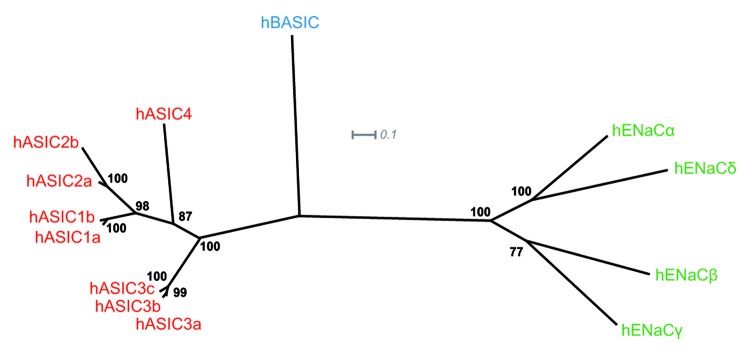
Figure 1. BASIC represents a subgroup within the human DEG/ENaC gene family of ion channels. The phylogenetic tree of human DEG/ENaC gene family members displays the genetic distances of BASIC to ASIC and ENaC subunits. Branch lengths are proportional to the evolutionary distance. Support values are indicated. Scale bar illustrates amino acid substitutions per site. The tree was created by maximum likelihood (ML) analysis with TREEPUZZLE and edited with Dendroscope3. ML analysis is based on protein alignment using ClustalX with sequences of human BASIC, ASICs, and ENaCs. Highly divergent sequences were deleted for improving alignment results. Accession numbers: hASIC1a U78180, hASIC1b HM991481, hASIC2a U50352, hASIC2b NP_899233.1, hASIC3a NP_004760, hASIC3b NP_064717; hASIC3c NP_064718, hASIC4 AJ271643, hBASIC AJ252011, αhENaC X76180, βhENaC X87159, γhENaC X87160, δhENaC U38254.

References

    1. Kellenberger S, Schild L. Epithelial sodium channel/degenerin family of ion channels: a variety of functions for a shared structure. Physiol Rev. 2002;82:735–67. - PubMed
    1. Jasti J, Furukawa H, Gonzales EB, Gouaux E. Structure of acid-sensing ion channel 1 at 1.9 A resolution and low pH. Nature. 2007;449:316–23. doi: 10.1038/nature06163. - DOI - PubMed
    1. Canessa CM, Schild L, Buell G, Thorens B, Gautschi I, Horisberger JD, Rossier BC. Amiloride-sensitive epithelial Na+ channel is made of three homologous subunits. Nature. 1994;367:463–7. doi: 10.1038/367463a0. - DOI - PubMed
    1. Driscoll M, Chalfie M. The mec-4 gene is a member of a family of Caenorhabditis elegans genes that can mutate to induce neuronal degeneration. Nature. 1991;349:588–93. doi: 10.1038/349588a0. - DOI - PubMed
    1. Wemmie JA, Chen J, Askwith CC, Hruska-Hageman AM, Price MP, Nolan BC, Yoder PG, Lamani E, Hoshi T, Freeman JH, Jr., et al. The acid-activated ion channel ASIC contributes to synaptic plasticity, learning, and memory. Neuron. 2002;34:463–77. doi: 10.1016/S0896-6273(02)00661-X. - DOI - PubMed

Publication types

Substances

LinkOut - more resources
