. 2014 Apr 27;97(8):846-53.
doi: 10.1097/01.TP.0000438024.10375.2d.

Impact of immunosuppression on recall immune responses to influenza vaccination in stable renal transplant recipients

Affiliations

Impact of immunosuppression on recall immune responses to influenza vaccination in stable renal transplant recipients

Michelle Cowan et al. Transplantation. .

Abstract

Background: The recommendation by the American Society of Transplantation for annual trivalent inactivated influenza vaccination greater than 3 to 6 months post-kidney transplantation provides a unique opportunity to test the in vivo impact of immunosuppression on recall T- and B-cell responses to influenza vaccination.

Methods: This study took advantage of recent breakthroughs in the single-cell quantification of human peripheral blood B-cell responses to prospectively evaluate both B- and T-cell responses to the seasonal (2010 and 2011) influenza vaccine in 23 stable renal transplant recipients and 22 healthy controls.

Results and conclusion: The results demonstrate that the early B-cell response to influenza vaccination, quantified by the frequency of influenza-specific antibody-secreting cells (ASC) in peripheral blood, was significantly reduced in stable transplant recipients compared to healthy controls. The magnitude of the seroresponse and the rate of seroconversion were also blunted. The influenza-specific interferon-gamma (IFNγ) T-cell response was significantly reduced in transplant recipients; however, there was no correlation between the magnitude of the influenza-specific IgG ASC and IFNγ responses. The induction of memory T- and B-cell responses to influenza vaccination supports the recommendation to vaccinate while the blunted responses demonstrate the efficacy of immunosuppression in controlling memory responses individual transplant recipients.


Conflict of interest statement

The authors declare no conflicts of interest.

Figures
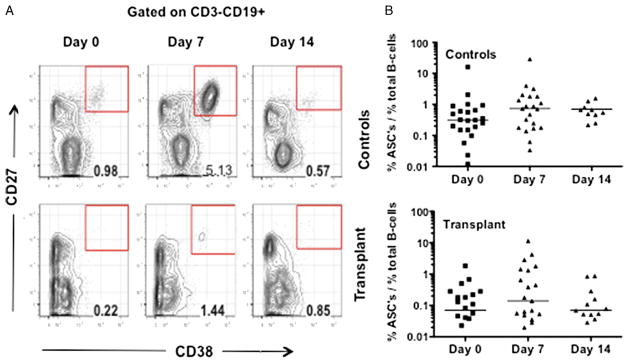
FIGURE 1
FIGURE 1
Total plasmablast response to influenza vaccination. A, gating strategy for the plasmablast (CD3−CD19+ CD27+CD38+) response to influenza vaccination. B, data are presented as percentage of total CD3−CD19+ B cells, on the indicated days post-immunization for healthy controls (N=21) and transplant recipients (N=22). Bars indicate the median, and significant differences were determined by Kruskal-Wallis test.
FIGURE 2
FIGURE 2
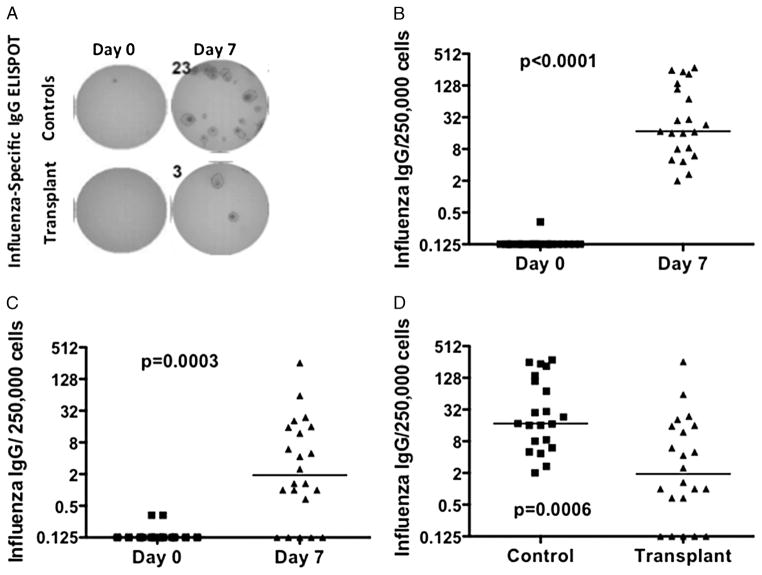
Influenza-specific ASC response to influenza vaccination. A, quantification of the frequency of influenza-specific IgG secreting cells (ASC) by ELISPOT. Data are presented as the frequency of influenza-specific ASC on day 0 and 7 for controls (B) or transplant recipients (C), or the increase (day 7 subtracted from day 0 baseline) (D). Each symbol represents data from an individual (controls N=21; transplant recipients N=22). Bars represent the median, and statistical significance was determined by Wilcoxon signed rank test (B and C) or Mann-Whitney test (D).
FIGURE 3
FIGURE 3
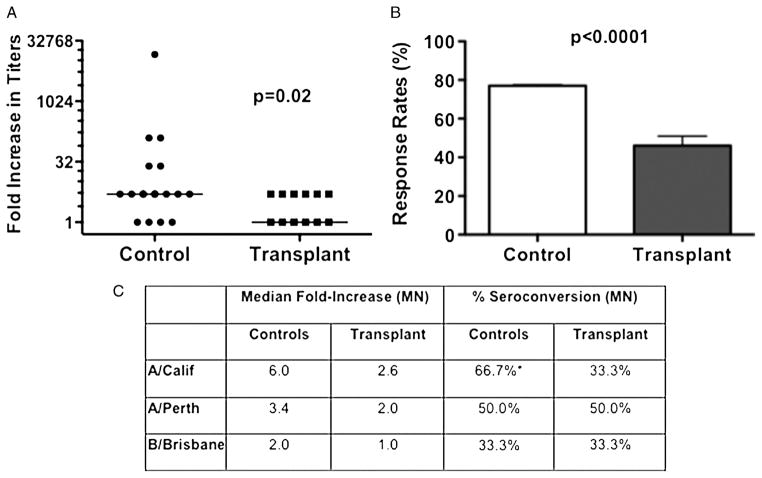
Anti-influenza IgG seroresponse and seroconversion following influenza vaccination. A, quantification of the anti-influenza IgG seroresponse by ELISA. Data represent the increase in the geometric mean titers (GMT; bar indicates median increase) from day 0 to day 14/28, with transplant patients (N=13) exhibiting significantly reduced responses compared to healthy controls (N=18). B, the response rate (%), which refers to the percentage of subjects with a 4-fold increase in titers on day 14/28 post-vaccination, was also significantly different between the two groups. C, anti-influenza titers were quantified by microneutralization (MN) assays to A/California/7/09-like (H1N1) (A/Calif), A/Perth/16/2009-like (H3N2) (A/Perth), and B/Brisbane/60/2008-like (B/Brisb) influenza virus. Data are presented as the median fold increase and percent seroconversion, which is defined as the percentage with a 4-fold increase in titers at day 28 post-vaccination. Data are from transplant patients (N=6) or controls (N=12) vaccinated in 2011. Statistical significance was determined by Mann-Whitney test (A) or unpaired t test (B) or two-way ANOVA with a Bonferroni post hoc test (C).
FIGURE 4
FIGURE 4
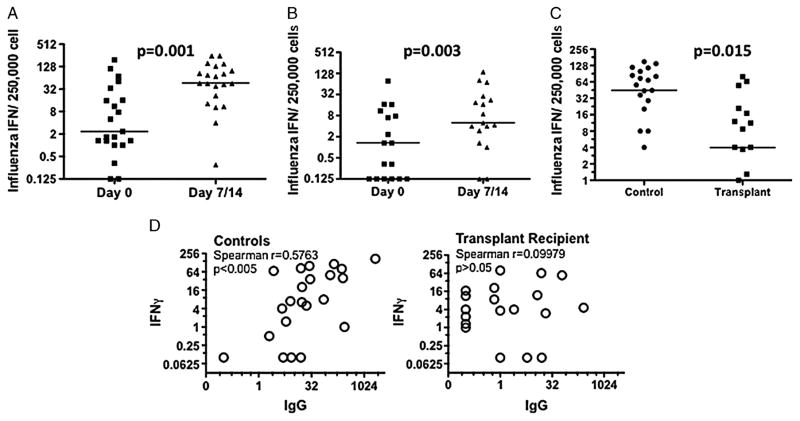
Quantification of the anti-influenza IFNγ response by ELISPOT assays on day 0 and days 7 or 14 post-influenza vaccination. Both controls (A; N=21) and transplant patients (B; N=17) had a significant response to influenza vaccine; however, the magnitude of the response was significantly decreased in transplant recipients (C). Data are presented as medians and statistical significance was determined by Wilcoxon paired rank test (A and B) and Mann-Whitney test (C). Statistically significant correlation between the influenza-specific IFNγ and IgG response (measured by ELISPOT) in healthy controls (right), but no significant correlation in transplant recipients (left).

References

    1. Avery RK. Influenza vaccines in the setting of solid-organ transplantation: are they safe? Curr Opin Infect Dis. 2012;25:464. - PubMed
    1. Danzinger-Isakov L, Kumar D. Guidelines for vaccination of solid organ transplant candidates and recipients. Am J Transplant. 2009;9(Suppl 4):S258. - PubMed
    1. Kumar D, Blumberg EA, Danziger-Isakov L, et al. Influenza vaccination in the organ transplant recipient: review and summary recommendations. Am J Transplant. 2011;11:2020. - PubMed
    1. Chon WJ, Kadambi PV, Harland RC, et al. Changing attitudes toward influenza vaccination in U.S. Kidney transplant programs over the past decade. Clin J Am Soc Nephrol. 2010;5:1637. - PMC - PubMed
    1. Perez-Romero P, Aydillo TA, Perez-Ordonez A, et al. Reduced incidence of pneumonia in influenza-vaccinated solid organ transplant recipients with influenza disease. Clin Microbiol Infect. 2012;18:E533. - PMC - PubMed

Publication types

MeSH terms