Review
. 2014 Mar;29(2):393-403.
doi: 10.1007/s10103-013-1480-5. Epub 2013 Dec 24.

Endovenous laser ablation (EVLA): a review of mechanisms, modeling outcomes, and issues for debate

Affiliations
Review

Endovenous laser ablation (EVLA): a review of mechanisms, modeling outcomes, and issues for debate

Wendy S J Malskat et al. Lasers Med Sci. 2014 Mar.

Abstract

Endovenous laser ablation (EVLA) is a commonly used and very effective minimally invasive therapy to manage leg varicosities. Yet, and despite a clinical history of 16 years, no international consensus on a best treatment protocol has been reached so far. Evidence presented in this paper supports the opinion that insufficient knowledge of the underlying physics amongst frequent users could explain this shortcoming. In this review, we will examine the possible modes of action of EVLA, hoping that better understanding of EVLA-related physics stimulates critical appraisal of claims made concerning the efficacy of EVLA devices, and may advance identifying a best possible treatment protocol. Finally, physical arguments are presented to debate on long-standing, but often unfounded, clinical opinions and habits. This includes issues such as (1) the importance of laser power versus the lack of clinical relevance of laser energy (Joule) as used in Joule per centimeter vein length, i.e., in linear endovenous energy density (LEED), and Joule per square centimeter vein wall area, (2) the predicted effectiveness of a higher power and faster pullback velocity, (3) the irrelevance of whether laser light is absorbed by hemoglobin or water, and (4) the effectiveness of reducing the vein diameter during EVLA therapy.


Figures
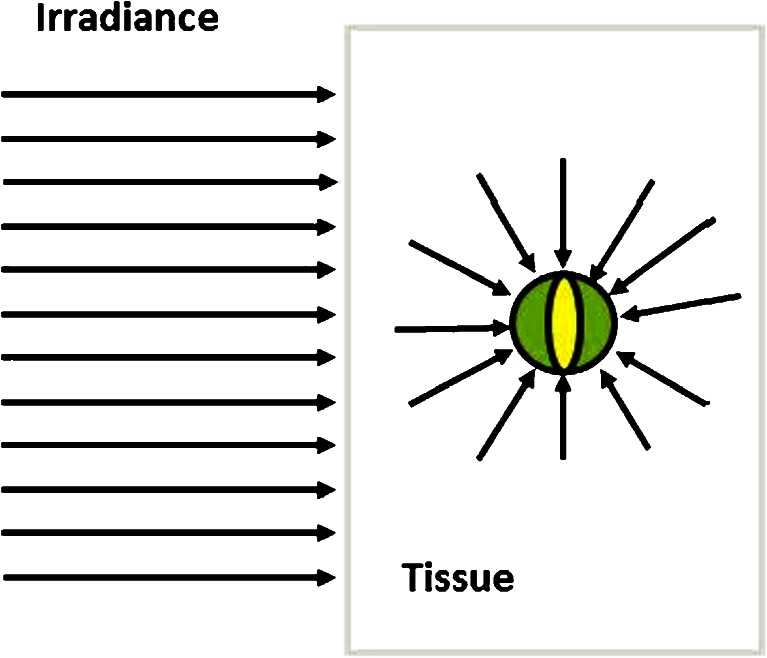
Fig. 1
Fig. 1
Definition of laser fluence rate. The tissue is irradiated by a collimated laser beam of power P incident on tissue area A, i.e., with irradiance P/A (Watt/area). The infinitesimally small volume inside the tissue, here the green sphere at tissue location r (coordinate r not shown), receives a continuous stream of collimated and diffuse photons through its surface (represented by the arrows). The fluence rate is defined as all the incoming laser power divided by the (yellow) cross-sectional area of the sphere (Watt/area)
Fig. 2
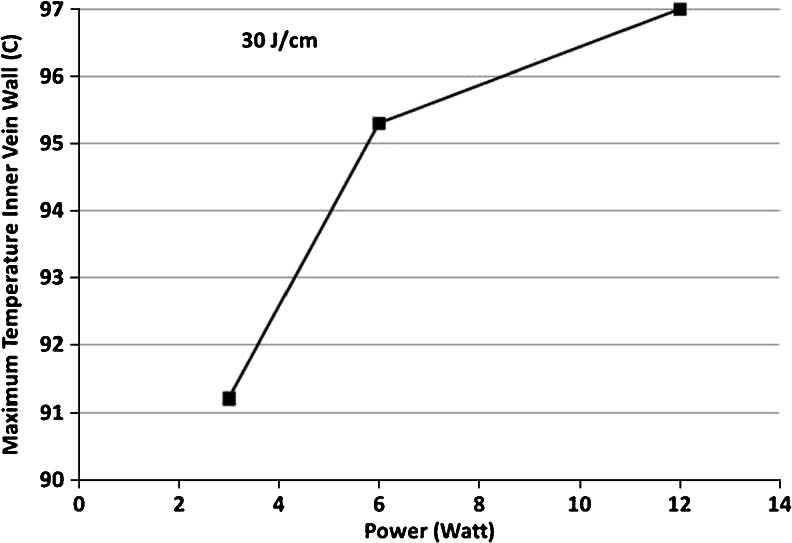
Fig. 2
Maximum temperatures at the inner vein wall at 1,470 nm at various laser powers (3, 6, 12 Watt) and pullback velocities (1, 2, 4 mm/s), at a power/velocity ratio of 30 Joule/cm, Eq. (3)
Fig. 3
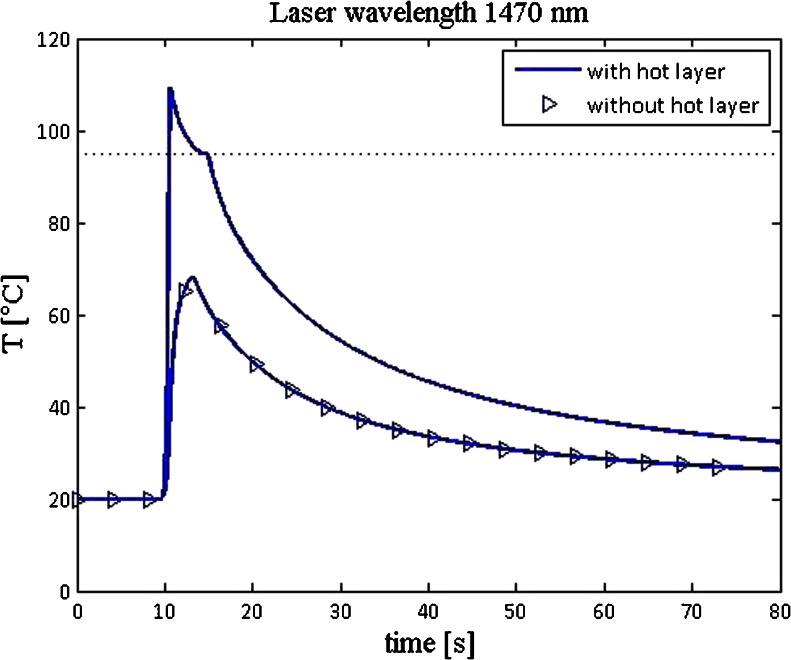
Fig. 3
Computations of vein wall temperatures in a 3 mm diameter vein, using a 0.6 mm diameter laser fiber, 15 Watt of power, and 0.2 cm/s pullback velocity, as a function of time. The computations give the temperature at a fixed inner vein wall position, 2 cm above the fiber tip's starting position at t = 0, so the tip is closest to that vein wall position at 10 s after laser switch-on and start of pullback. The computations are either with the hot tip layer included (normal line) or simulated with this layer kept at room temperature (line with symbols) (from [23])
Fig. 4
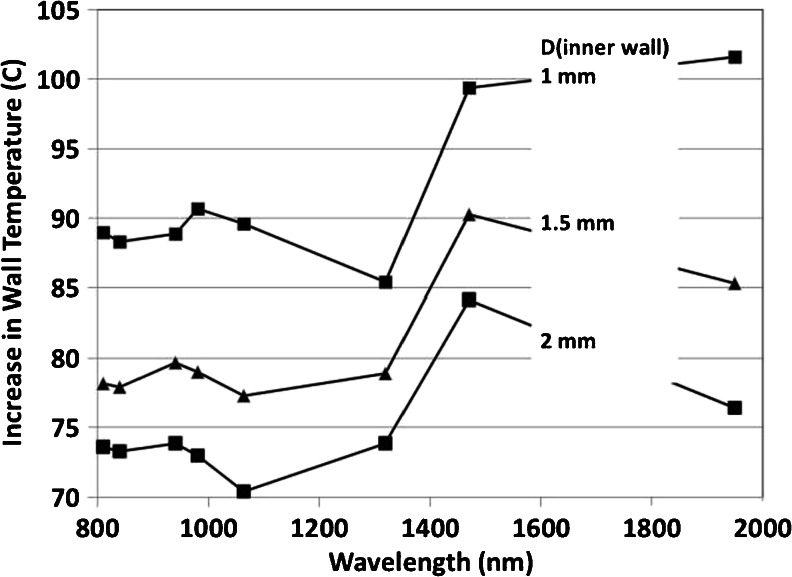
Fig. 4
Inner vein wall temperature increases versus wavelength simulated for inner vein diameters of 1, 1.5, and 2 mm, at 15 Watt, 2 mm/s
Fig. 5
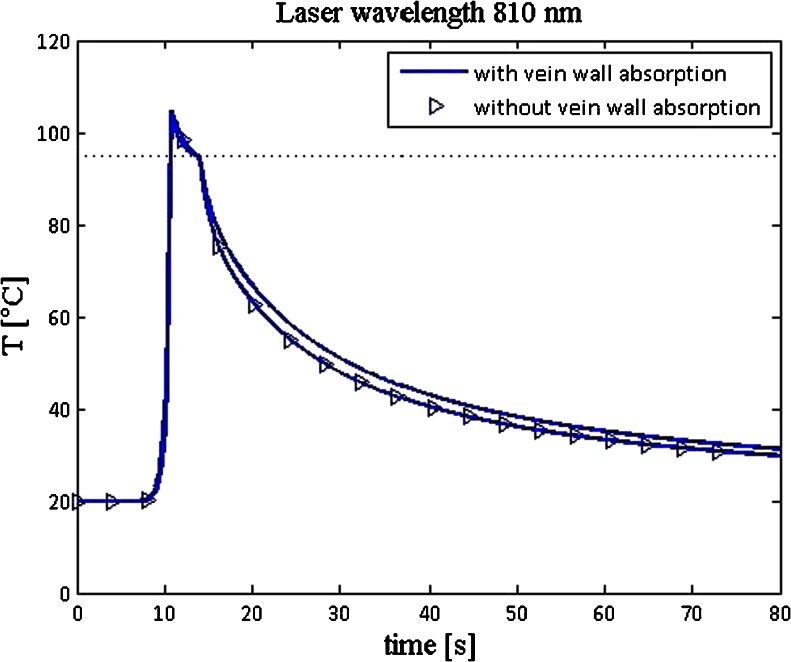
Fig. 5
Temperature profiles at the inner vein wall, 3 mm diameter, as a function of time, with vein wall absorption included (lines) and with zero vein wall absorption (lines with symbols), at 810 nm, 15 Watt, 2 mm/s (from [23])
Fig. 6
Fig. 6
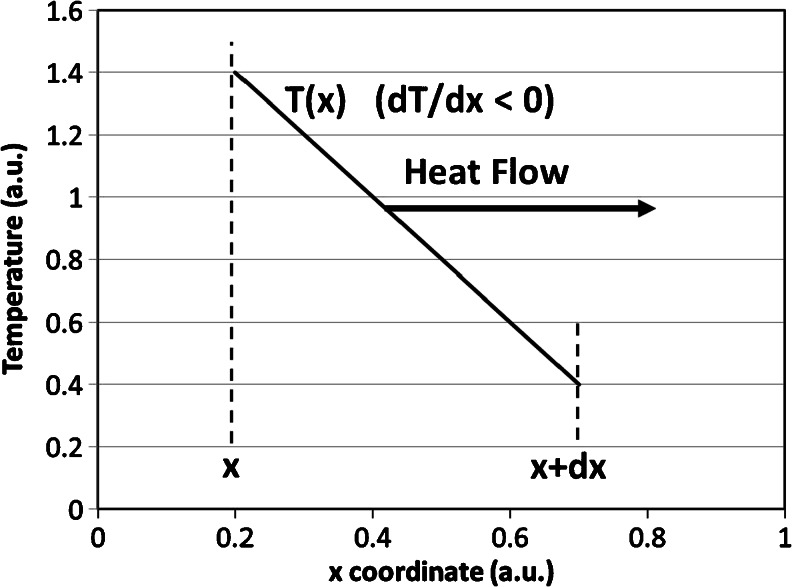
Cartoon of Fourier's law of thermal diffusion, relating the negative gradient of the temperature (T) to the heat flow (or heat flux, in Watt/area) by Eq. (4). The temperature versus x-coordinate curve is linearized between x and x + dx because dx is assumed to be infinitesimally small

References

    1. van den Bos R, Arends L, Kockaert M, Neumann M, Nijsten T. Endovenous therapies of lower extremity varicosities: a meta-analysis. J Vasc Surg. 2009;49:230–239. doi: 10.1016/j.jvs.2008.06.030. - DOI - PubMed
    1. Vuylsteke ME, Mordon SR. Endovenous laser ablation: a review of mechanisms of action. Ann Vasc Surg. 2012;26:424–433. doi: 10.1016/j.avsg.2011.05.037. - DOI - PubMed
    1. van Gemert MJC, van der Geld CWM, Bruijninckx CMA, Verdaasdonk RM, Neumann HAM (2012) Comment to Vuylsteke ME and Mordon SR. Endovenous laser ablation: a review of mechanisms of action. Ann Vasc Surg 2012;26:424-33. Ann Vasc Surg 26:881–883 - PubMed
    1. Navarro L, Navarro N, Salat CB, Gomez JF, Min RJ (2002) Endovascular laser device and treatment of varicose veins. US 6,398,777 B1; patent filed in 1999, granted in 2002
    1. Mordon SR, Wassmer B, Zemmouri J. Mathematical modeling of 980-nm and 1320-nm endovenous laser treatment. Lasers Surg Med. 2007;39:256–265. doi: 10.1002/lsm.20476. - DOI - PubMed

LinkOut - more resources