


Association between leukocyte telomere length and glioma risk: a case-control study
- PMID: 24366909
- PMCID: PMC3956352
- DOI: 10.1093/neuonc/not240
Association between leukocyte telomere length and glioma risk: a case-control study
Abstract
Background: Compelling epidemiological evidence indicates that alterations of telomere length are associated with risks of many malignancies in a tumor-specific manner, such as lung cancer, breast cancer, and non-Hodgkin's lymphoma. However, the association between leukocyte telomere length and glioma risk has not been investigated.
Methods: Relative telomere length (RTL) of peripheral blood leukocytes from 467 glioma patients and 467 healthy controls, matched by age and sex, was measured using the real-time PCR-based method in a case-control study. An unconditional multivariate logistic regression model was applied to estimate the association between RTL and glioma risk.
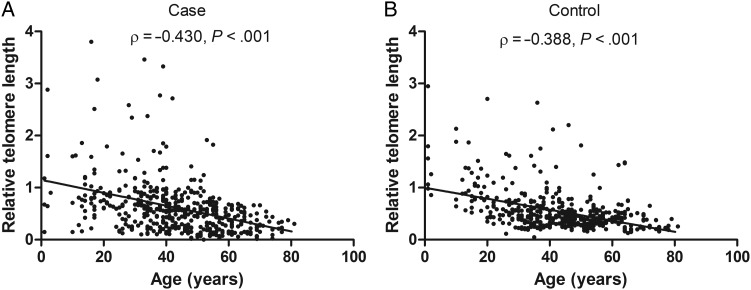
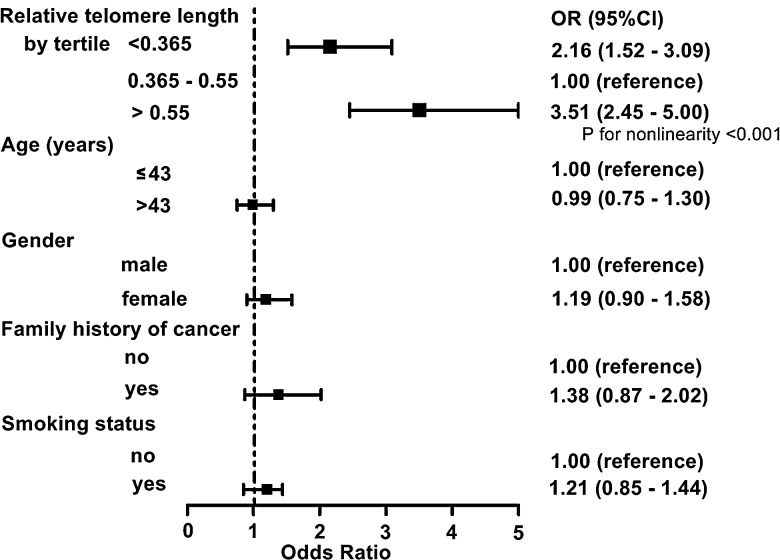
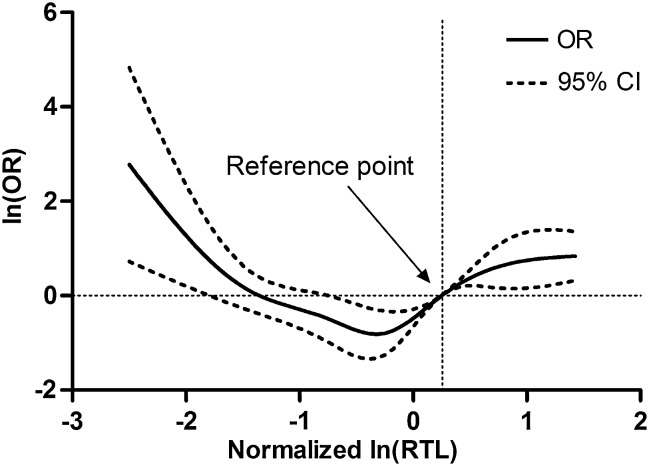
Results: Glioma patients showed notably longer RTL than controls (median, 0.555 vs 0.444; P > .04). RTL was negatively correlated with age in both cases (ρ = -0.430; P < .001) and controls (ρ = -0.388; P < .001). After adjusting for age, sex, smoking status and family history of cancer, multivariate logistic regression analysis showed that there was a U-shaped association between RTL and glioma risk (P for nonlinearity <.001). Compared with individuals in the second tertile of RTL, the odds ratios (95% CI) for participants in the first and third tertiles were 2.16 (range, 1.52-3.09) and 3.51 (range, 2.45-5.00), respectively. Stratified analysis showed that the association between RTL and glioma risk was not modulated by major host characteristics.
Conclusions: Our study demonstrates for the first time that either shorter or longer RTL in peripheral blood leukocytes is associated with increased glioma risk, which warrants further investigation in the future.
Keywords: glioma risk; logistic regression model; real-time PCR; telomere length.
Figures
References
-
- Ohgaki H. Epidemiology of brain tumors. Methods Mol Biol. 2009;472:323–342. - PubMed
-
- Wen PY, Kesari S. Malignant gliomas in adults. N Engl J Med. 2008;359(5):492–507. - PubMed
-
- Linos E, Raine T, Alonso A, Michaud D. Atopy and risk of brain tumors: a meta-analysis. J Natl Cancer Inst. 2007;99(20):1544–1550. - PubMed
Publication types
MeSH terms
LinkOut - more resources
Full Text Sources
Other Literature Sources
Medical
