. 2014 Jan 7;111(1):533-8.
doi: 10.1073/pnas.1305438111. Epub 2013 Dec 23.

Overexpression of plasma membrane H+-ATPase in guard cells promotes light-induced stomatal opening and enhances plant growth

Affiliations

Overexpression of plasma membrane H+-ATPase in guard cells promotes light-induced stomatal opening and enhances plant growth

Yin Wang et al. Proc Natl Acad Sci U S A. .

Abstract

Stomatal pores surrounded by a pair of guard cells in the plant epidermis control gas exchange between plants and the atmosphere in response to light, CO2, and the plant hormone abscisic acid. Light-induced stomatal opening is mediated by at least three key components: the blue light receptor phototropin (phot1 and phot2), plasma membrane H(+)-ATPase, and plasma membrane inward-rectifying K(+) channels. Very few attempts have been made to enhance stomatal opening with the goal of increasing photosynthesis and plant growth, even though stomatal resistance is thought to be the major limiting factor for CO2 uptake by plants. Here, we show that transgenic Arabidopsis plants overexpressing H(+)-ATPase using the strong guard cell promoter GC1 showed enhanced light-induced stomatal opening, photosynthesis, and plant growth. The transgenic plants produced larger and increased numbers of rosette leaves, with ∼42-63% greater fresh and dry weights than the wild type in the first 25 d of growth. The dry weights of total flowering stems of 45-d-old transgenic plants, including seeds, siliques, and flowers, were ∼36-41% greater than those of the wild type. In addition, stomata in the transgenic plants closed normally in response to darkness and abscisic acid. In contrast, the overexpression of phototropin or inward-rectifying K(+) channels in guard cells had no effect on these phenotypes. These results demonstrate that stomatal aperture is a limiting factor in photosynthesis and plant growth, and that manipulation of stomatal opening by overexpressing H(+)-ATPase in guard cells is useful for the promotion of plant growth.

Keywords: Arabidopsis thaliana; biomass; photosynthetic rate; stomatal conductance.


Conflict of interest statement

The authors declare no conflict of interest.

Figures
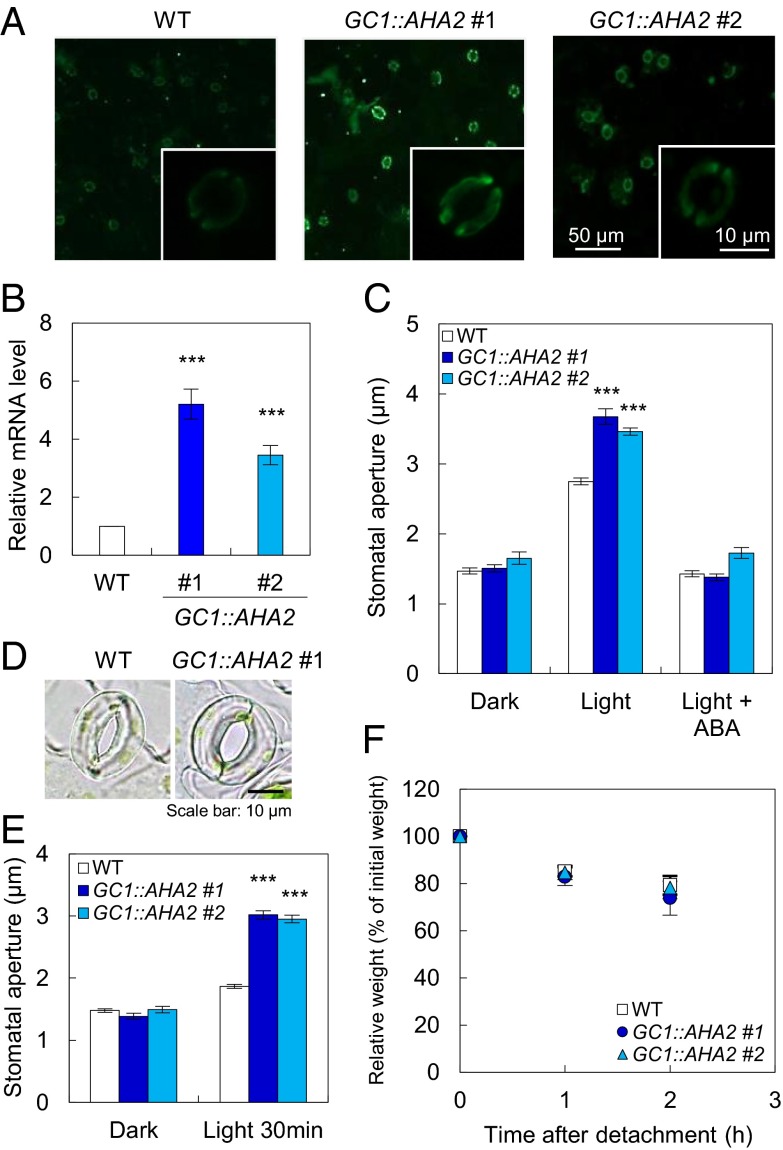
Fig. 1.
Fig. 1.
Overexpression of AHA2 using the GC1 promoter promotes stomatal opening. (A) Typical fluorescence images of immunohistochemical detection of the guard cell H+-ATPase in the Arabidopsis epidermis. (For details regarding the immunohistochemical conditions, see Materials and Methods.) (B) qPCR analysis of AHA2 expression. Error bars represent the SEM (n ≥ 6). Significant differences were detected by Student t test (***P < 0.001). (C) Stomatal apertures under 2.5 h of darkness, light (50 µmol⋅m–2⋅s–1 red light and 10 µmol⋅m–2⋅s–1 blue light), or light in the presence of 20 µM ABA. (D) Typical stomata in the epidermis illuminated with light for 30 min. Light conditions were the same as in C. (E) Stomatal apertures in darkness or after 30 min of light treatment. The light conditions were the same as in C. The stomatal aperture values in C and E are the means of measurements of 25 stomata; error bars represent the SEM. Differences in stomatal aperture were detected using Student t test (***P < 0.001). (F) Kinetics of the change in fresh weight of detached rosette leaves from 4-wk-old WT and AHA2-transgenic plants. The relative weights of the leaves are presented as a percentage of the initial weight, which was the weight of each rosette leaf immediately after detachment from the plant. Data are the mean values for seven leaves; error bars represent the SD.
Fig. 2.
Fig. 2.
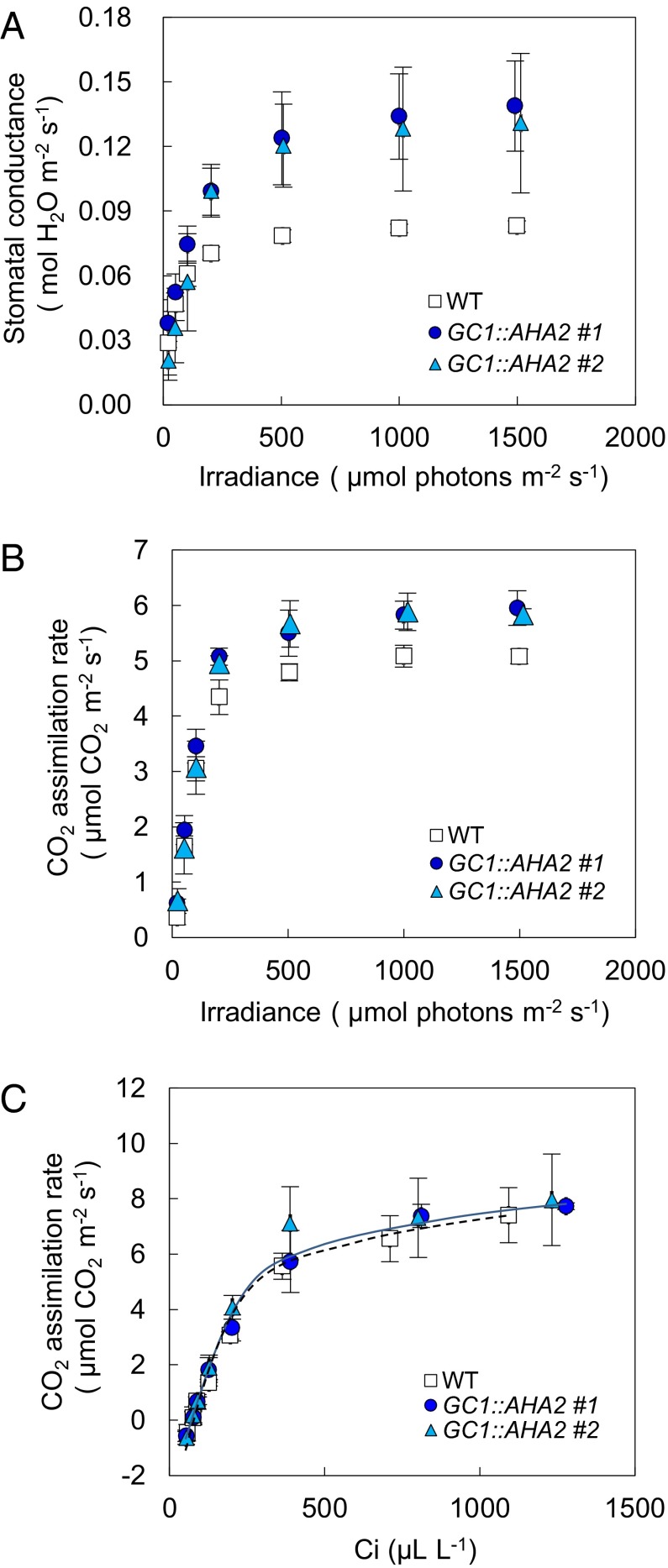
Gas-exchange properties of AHA2-transgenic plants. (A and B) Light responses of stomatal conductance (A) and the CO2 assimilation rate (B) in WT and AHA2-transgenic plants. Measurements were conducted at 380 µL⋅L–1 CO2; the leaf temperature and leaf chamber relative humidity were maintained at 24 °C and 40–50% (Pa/Pa), respectively. (C) Relationship between the CO2 assimilation rate and the intercellular CO2 concentration in WT and AHA2-transgenic plants. Measurements were conducted in white light of ∼750 µmol⋅m–2⋅s–1. The leaf temperature and relative humidity in the leaf chamber were maintained at 24 °C and 40–50% (Pa/Pa), respectively. Data are the means of measurements on three different plants; error bars represent the SD and are not shown if smaller than the symbols. White squares, WT plants; dark blue circles and light blue triangles, AHA2-transgenic plants.
Fig. 3.
Fig. 3.
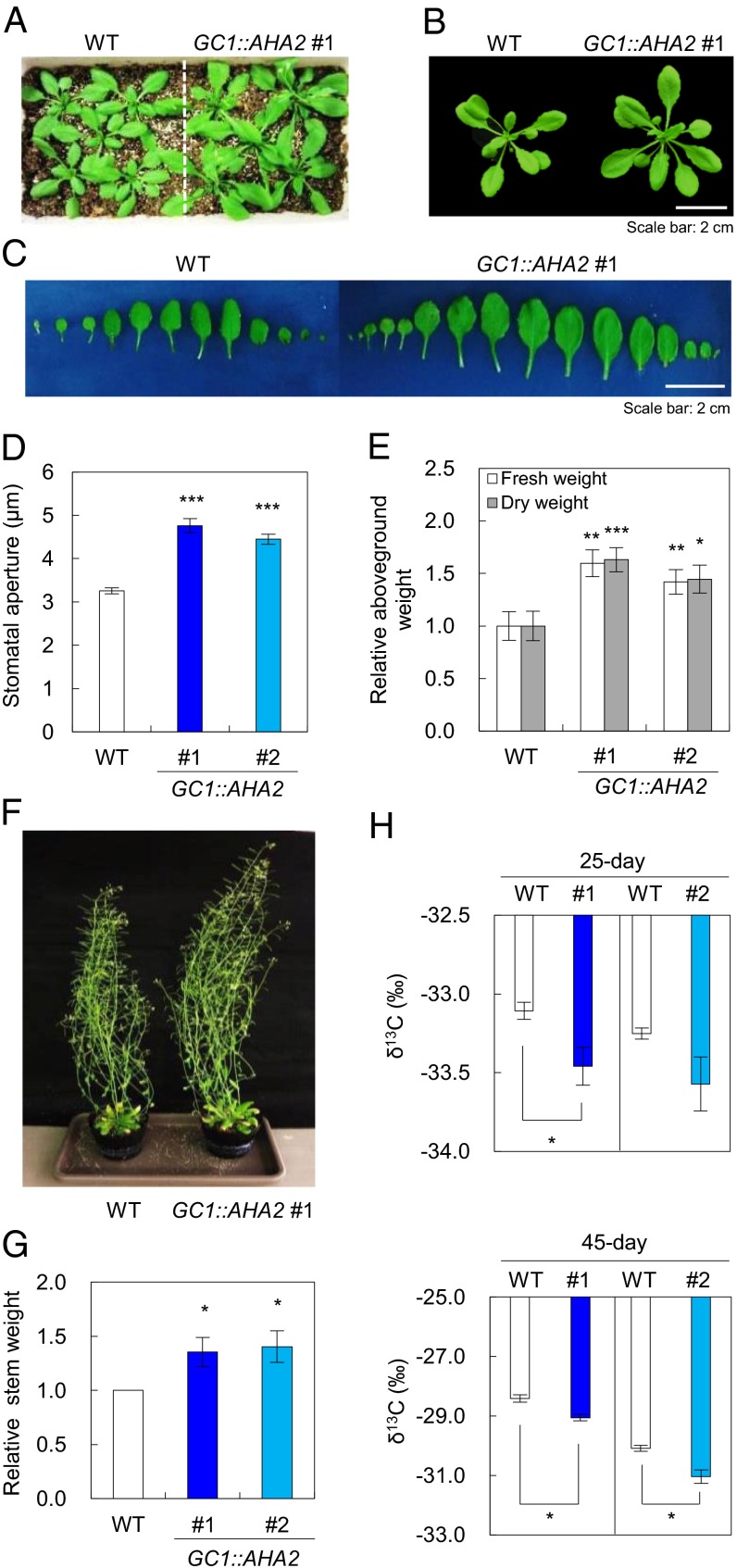
Phenotypic characterization of AHA2-transgenic plants. (A and B) Phenotypes of WT and AHA2-transgenic plants grown under high light conditions (200 µmol⋅m–2⋅s–1) for 25 d. (C) Rosette and juvenile leaves of WT and AHA2-transgenic plants grown under high light conditions. (D) Stomatal aperture under high light conditions (200 µmol⋅m–2⋅s–1) in 25-d-old plants. Error bars represent the SEM (n = 25). Significant differences in stomatal aperture were detected using Student t test (***P < 0.001). (E) Relative aboveground fresh and dry weights of 25-d-old plants. (F) Phenotypes of WT and AHA2-transgenic plants grown under high light conditions for 50 d. (G) Relative dry stem weights of 45-d-old plants. Fresh and dry weights are the means of measurements of more than five plants; error bars represent the SEM. (H) Carbon isotope ratio (δ13C) of WT and AHA2-transgenic plants at 25 d (Upper) and 45 d (Lower); #1 and #2 represent the AHA2-transgenic lines GC1::AHA2 #1 and #2, respectively. Error bars represent the SEM (n = 3–4 plants). Differences were detected by Student t test (*P < 0.05; **P < 0.005; ***P < 0.001).

References

    1. Farquhar GD, Sharkey TD. Stomatal conductance and photosynthesis. Annu Rev Plant Physiol. 1982;33:317–345.
    1. Hetherington AM, Woodward FI. The role of stomata in sensing and driving environmental change. Nature. 2003;424(6951):901–908. - PubMed
    1. Kusumi K, Hirotsuka S, Kumamaru T, Iba K. Increased leaf photosynthesis caused by elevated stomatal conductance in a rice mutant deficient in SLAC1, a guard cell anion channel protein. J Exp Bot. 2012;63(15):5635–5644. - PMC - PubMed
    1. Condon AG, Richards RA, Farquhar GD. Carbon isotope discrimination is positively correlated with grain yield and dry matter production in field-grown wheat. Crop Sci. 1987;27(5):996–1001.
    1. Roelfsema MRB, Hedrich R. In the light of stomatal opening: New insights into ‘the Watergate’. New Phytol. 2005;167(3):665–691. - PubMed

Publication types

MeSH terms