


Lapatinib: new opportunities for management of breast cancer
- PMID: 24367169
- PMCID: PMC3846530
- DOI: 10.2147/BCTT.S5929
Lapatinib: new opportunities for management of breast cancer
Abstract
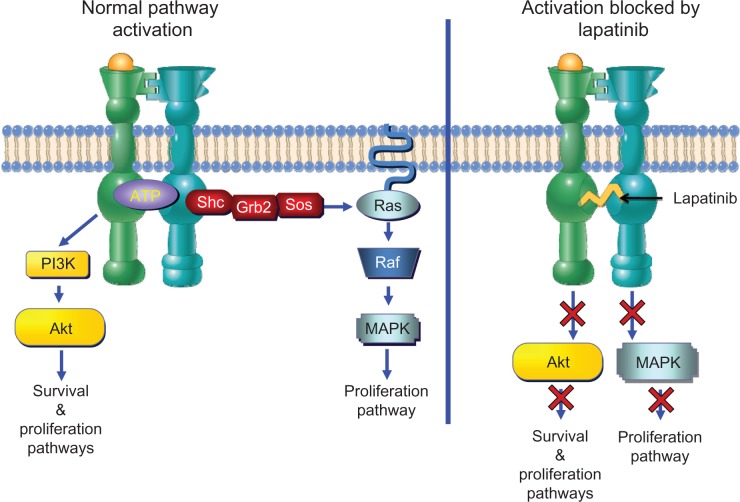
Approximately 20% of new diagnosed breast cancers overexpress the human epidermal growth factor receptor 2 (EGFR2), also known as erythroblastic leukemia viral oncogene homolog 2 (ERBB2) protein, as a consequence of ERBB2 gene amplification, resulting in a poor prognosis. Clinical outcome can be substantially improved by ERBB2-targeted therapy. Lapatinib is a potent, orally bioavailable small molecule that reversibly and selectively inhibits epidermal growth factor receptor (EGFR1 or ERBB1) and ERBB2 tyrosine kinases. Lapatinib binds the adenosine triphosphate-binding site of the receptor's intracellular domain to inhibit tumor cell growth. This review summarizes the pharmacology, pharmacokinetics, efficacy, and tolerability of lapatinib, and reviews both Food and Drug Administration-approved and investigational uses of lapatinib in breast cancer therapy. The drug is generally well tolerated in patients, with diarrhea and rashes being the most common (usually mild or moderate) adverse effects. Unlike trastuzumab, lapatinib has infrequent adverse effects on cardiac function. Lapatinib has substantial activity for advanced ERBB2-positive breast cancer, particularly in combination with capecitabine, following progression after anthracyclines, taxanes, and trastuzumab. Lapatinib combined with capecitabine yielded significant improvements in time to progression and response rate compared with capecitabine alone. This drug can also be combined with letrozole for the treatment of postmenopausal women with ERBB2-positive breast cancer, for whom hormonal therapy is indicated. Lapatinib has shown early promise in treatment of central nervous system metastasis and is being further evaluated in various clinical settings.
Keywords: ERBB family; ERBB2; breast cancer; capecitabine; lapatinib; letrozole; trastuzumab.
Figures
References
-
- Jemal A, Siegel R, Ward E, Hao Y, Xu J, Thun MJ. Cancer statistics, 2009. CA Cancer J Clin. 2009;59(4):225–249. - PubMed
-
- Chu I, Blackwell K, Chen S, Slingerland J. The dual ErbB1/ErbB2 inhibitor, lapatinib (GW572016), cooperates with tamoxifen to inhibit both cell proliferation- and estrogen-dependent gene expression in antiestrogen-resistant breast cancer. Cancer Res. 2005;65(1):18–25. - PubMed
-
- Tsutsui S, Ohno S, Murakami S, Hachitanda Y, Oda S. Prognostic value of epidermal growth factor receptor (EGFR) and its relationship to the estrogen receptor status in 1029 patients with breast cancer. Breast Cancer Res Treat. 2002;71(1):67–75. - PubMed
-
- Nicholson S, Wright C, Sainsbury JR, et al. Epidermal growth factor receptor (EGFr) as a marker for poor prognosis in node-negative breast cancer patients: Neu and tamoxifen failure. J Steroid Biochem Mol Biol. 1990;37(6):811–814. - PubMed
-
- Agrawal A, Gutteridge E, Gee JM, Nicholson RI, Robertson JF. Overview of tyrosine kinase inhibitors in clinical breast cancer. Endocr Relat Cancer. 2005;12(Suppl 1):S135–S144. - PubMed
Publication types
LinkOut - more resources
Full Text Sources
Other Literature Sources
Research Materials
Miscellaneous
