Detection of slipped-DNAs at the trinucleotide repeats of the myotonic dystrophy type I disease locus in patient tissues
- PMID: 24367268
- PMCID: PMC3868534
- DOI: 10.1371/journal.pgen.1003866
Detection of slipped-DNAs at the trinucleotide repeats of the myotonic dystrophy type I disease locus in patient tissues
Abstract
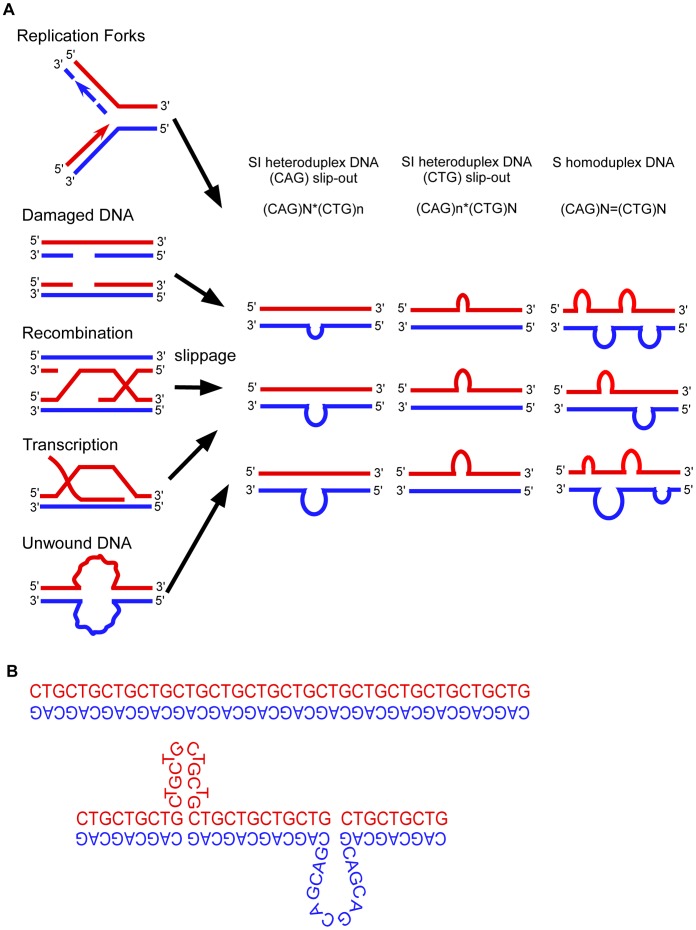
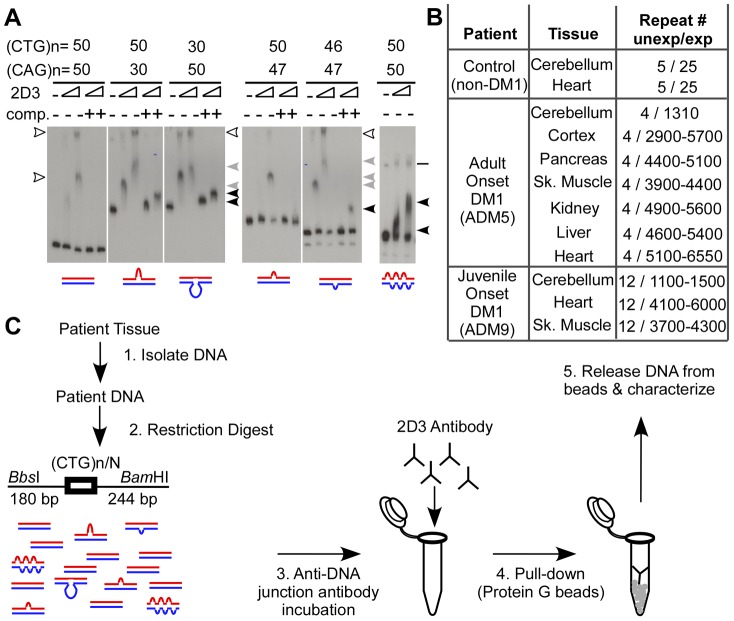
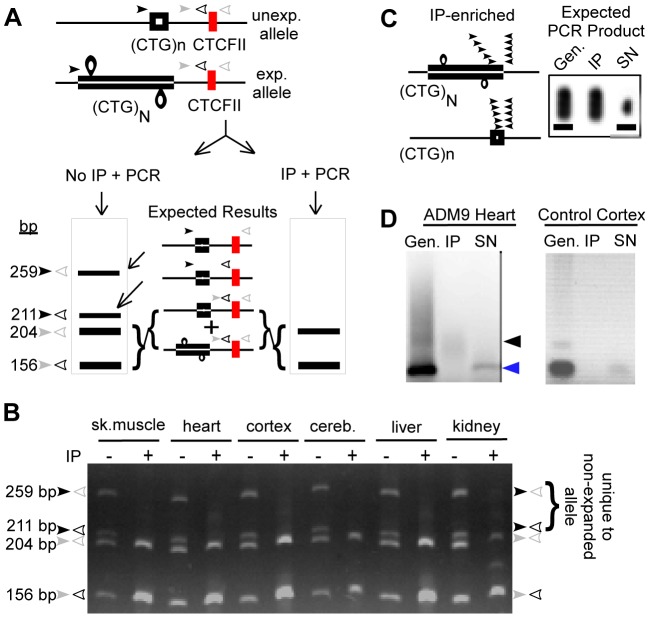
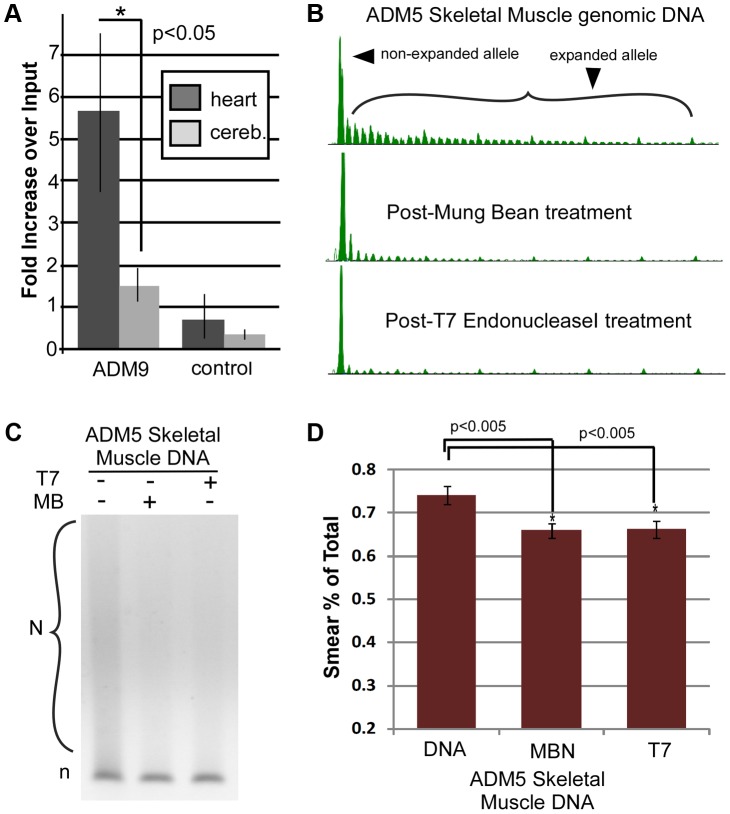
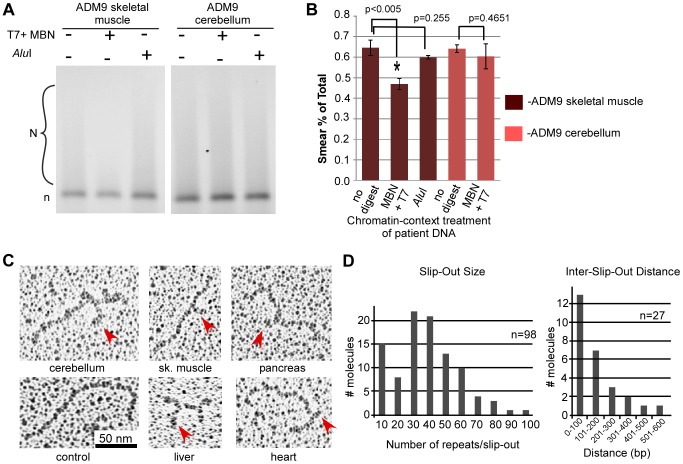
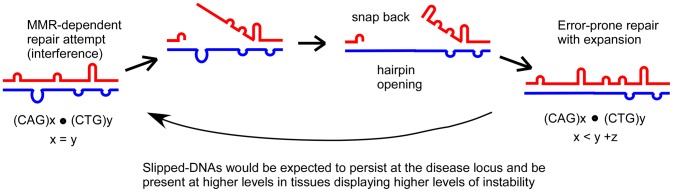
Slipped-strand DNAs, formed by out-of-register mispairing of repeat units on complementary strands, were proposed over 55 years ago as transient intermediates in repeat length mutations, hypothesized to cause at least 40 neurodegenerative diseases. While slipped-DNAs have been characterized in vitro, evidence of slipped-DNAs at an endogenous locus in biologically relevant tissues, where instability varies widely, is lacking. Here, using an anti-DNA junction antibody and immunoprecipitation, we identify slipped-DNAs at the unstable trinucleotide repeats (CTG)n•(CAG)n of the myotonic dystrophy disease locus in patient brain, heart, muscle and other tissues, where the largest expansions arise in non-mitotic tissues such as cortex and heart, and are smallest in the cerebellum. Slipped-DNAs are shown to be present on the expanded allele and in chromatinized DNA. Slipped-DNAs are present as clusters of slip-outs along a DNA, with each slip-out having 1-100 extrahelical repeats. The allelic levels of slipped-DNA containing molecules were significantly greater in the heart over the cerebellum (relative to genomic equivalents of pre-IP input DNA) of a DM1 individual; an enrichment consistent with increased allelic levels of slipped-DNA structures in tissues having greater levels of CTG instability. Surprisingly, this supports the formation of slipped-DNAs as persistent mutation products of repeat instability, and not merely as transient mutagenic intermediates. These findings further our understanding of the processes of mutation and genetic variation.
Conflict of interest statement
The authors have declared that no competing interests exist.
Figures
References
-
- Lopez Castel A, Cleary JD, Pearson CE (2010) Repeat instability as the basis for human diseases and as a potential target for therapy. Nat Rev Mol Cell Biol 11: 165–170. - PubMed
-
- Pearson CE, Nichol Edamura K, Cleary JD (2005) Repeat instability: mechanisms of dynamic mutations. Nat Rev Genet 6: 729–742. - PubMed
-
- Wang YH, Amirhaeri S, Kang S, Wells RD, Griffith JD (1994) Preferential nucleosome assembly at DNA triplet repeats from the myotonic dystrophy gene. Science 265: 669–671. - PubMed
-
- Cleary JD, Tome S, Lopez Castel A, Panigrahi GB, Foiry L, et al. (2010) Tissue- and age-specific DNA replication patterns at the CTG/CAG-expanded human myotonic dystrophy type 1 locus. Nat Struct Mol Biol 17: 1079–1087. - PubMed
Publication types
MeSH terms
Substances
Grants and funding
LinkOut - more resources
Full Text Sources
Other Literature Sources