


Cohesinopathies of a feather flock together
- PMID: 24367282
- PMCID: PMC3868590
- DOI: 10.1371/journal.pgen.1004036
Cohesinopathies of a feather flock together
Abstract
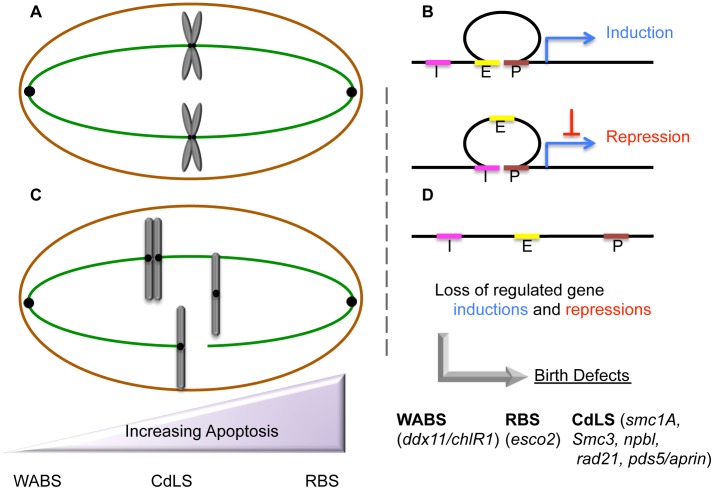
Roberts Syndrome (RBS) and Cornelia de Lange Syndrome (CdLS) are severe developmental maladies that present with nearly an identical suite of multi-spectrum birth defects. Not surprisingly, RBS and CdLS arise from mutations within a single pathway--here involving cohesion. Sister chromatid tethering reactions that comprise cohesion are required for high fidelity chromosome segregation, but cohesin tethers also regulate gene transcription, promote DNA repair, and impact DNA replication. Currently, RBS is thought to arise from elevated levels of apoptosis, mitotic failure, and limited progenitor cell proliferation, while CdLS is thought to arise, instead, from transcription dysregulation. Here, we review new information that implicates RBS gene mutations in altered transcription profiles. We propose that cohesin-dependent transcription dysregulation may extend to other developmental maladies; the diagnoses of which are complicated through multi-functional proteins that manifest a sliding scale of diverse and severe phenotypes. We further review evidence that cohesinopathies are more common than currently posited.
Conflict of interest statement
The authors have declared that no competing interests exist.
Figures
References
-
- Vega H, Waisfisz Q, Gordillo M, Sakai N, Yanagihara I, et al. (2005) Roberts syndrome is caused by mutations in ESCO2, a human homolog of yeast ECO1 that is essential for the establishment of sister chromatid cohesion. Nat Genet 37: 468–470. - PubMed
-
- Gordillo M, Vega H, Trainer AH, Hou F, Sakai N, et al. (2008) The molecular mechanism underlying Roberts syndrome involves loss of ESCO2 acetyltransferase activity. Hum Mol Genet 17: 2172–2180. - PubMed
-
- Musio A, Selicorni A, Focarelli ML, Gervasini C, Milani D, et al. (2006) X-linked Cornelia de Lange syndrome owing to SMC1L1 mutations. Nat Genet 38: 528–530. - PubMed
Publication types
MeSH terms
Substances
Supplementary concepts
Grants and funding
LinkOut - more resources
Full Text Sources
Other Literature Sources
Medical
Research Materials
