


A neuroscientific account of how vestibular disorders impair bodily self-consciousness
- PMID: 24367303
- PMCID: PMC3853866
- DOI: 10.3389/fnint.2013.00091
A neuroscientific account of how vestibular disorders impair bodily self-consciousness
Abstract
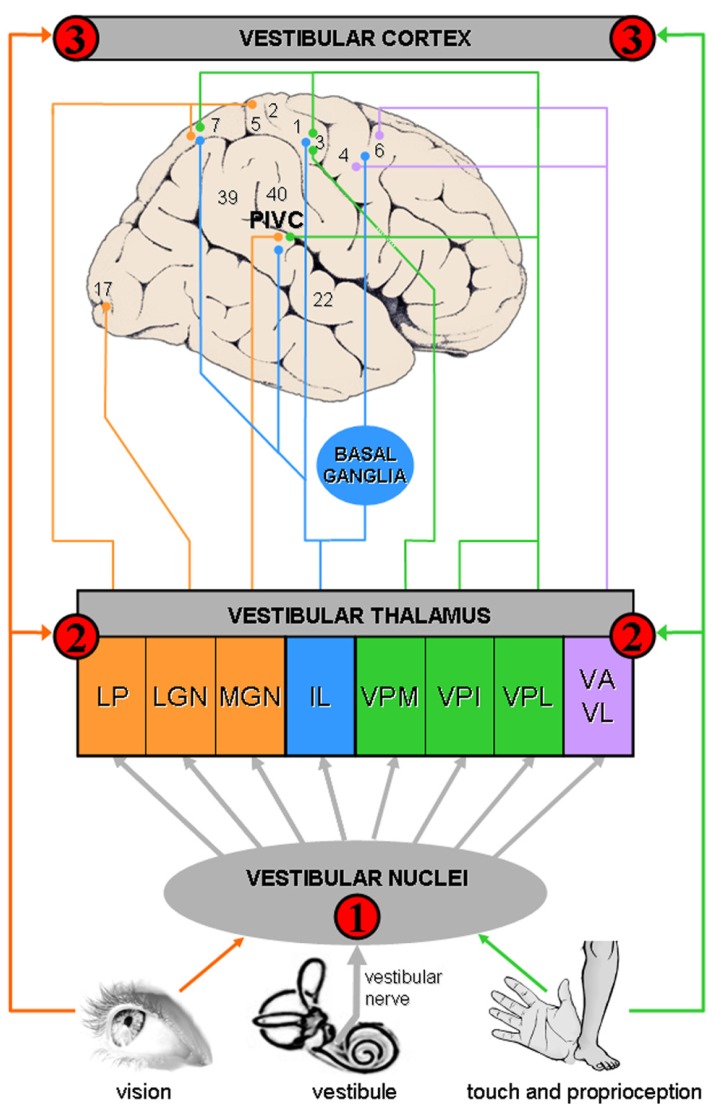
The consequences of vestibular disorders on balance, oculomotor control, and self-motion perception have been extensively described in humans and animals. More recently, vestibular disorders have been related to cognitive deficits in spatial navigation and memory tasks. Less frequently, abnormal bodily perceptions have been described in patients with vestibular disorders. Altered forms of bodily self-consciousness include distorted body image and body schema, disembodied self-location (out-of-body experience), altered sense of agency, as well as more complex experiences of dissociation and detachment from the self (depersonalization). In this article, I suggest that vestibular disorders create sensory conflict or mismatch in multisensory brain regions, producing perceptual incoherence and abnormal body and self perceptions. This hypothesis is based on recent functional mapping of the human vestibular cortex, showing vestibular projections to the primary and secondary somatosensory cortex and in several multisensory areas found to be crucial for bodily self-consciousness.
Keywords: bodily consciousness; body image; body schema; caloric vestibular stimulation; multisensory integration; touch; vestibular system.
Figures
References
-
- André J. M., Martinet N., Paysant J., Beis J. M., Le Chapelain L. (2001). Temporary phantom limbs evoked by vestibular caloric stimulation in amputees. Neuropsychiatry Neuropsychol. Behav. Neurol. 14 190–196 - PubMed
LinkOut - more resources
Full Text Sources
Other Literature Sources
