


Who was helping? The scope for female cooperative breeding in early Homo
- PMID: 24367605
- PMCID: PMC3867437
- DOI: 10.1371/journal.pone.0083667
Who was helping? The scope for female cooperative breeding in early Homo
Abstract
Derived aspects of our human life history, such as short interbirth intervals and altricial newborns, have been attributed to male provisioning of nutrient-rich meat within monogamous relationships. However, many primatologists and anthropologists have questioned the relative importance of pair-bonding and biparental care, pointing to evidence that cooperative breeding better characterizes human reproductive and child-care relationships. We present a mathematical model with empirically-informed parameter ranges showing that natural selection favors cooperation among mothers over a wide range of conditions. In contrast, our analysis provides a far more narrow range of support for selection favoring male coalition-based monogamy over more promiscuous independent males, suggesting that provisioning within monogamous relationships may fall short of explaining the evolution of Homo life history. Rather, broader cooperative networks within and between the sexes provide the primary basis for our unique life history.
Conflict of interest statement
Figures
 ,
,  ,
,  ,
,  ,
,  ,
,  ,
,  and
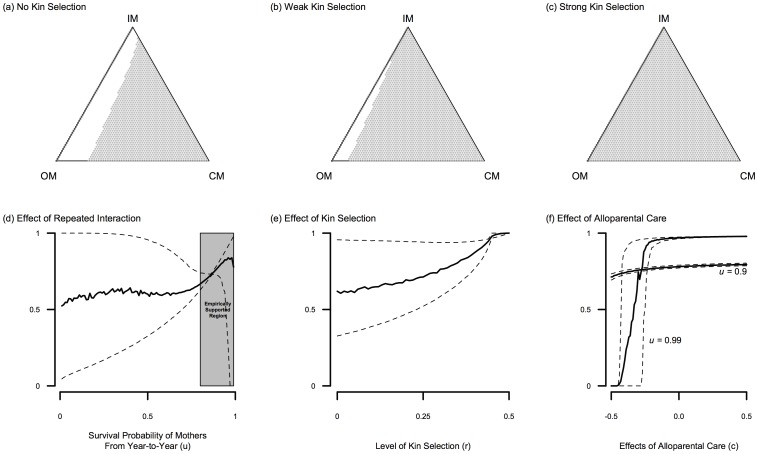
and  . However panel (a) assumes no kin selection (
 ) and panel (b) prescribes weak kin selection (
 ), and panel (c) specifies strong kin selection (
 ). The bottom row of panels describes the basin of attraction for Cooperative Mothers through stochastic simulation as a function of the repeated interaction parameter
  (panel (d)), level of kin selection (panel (e)), and the effect of alloparental care (panel (f)). The position of the unstable equilibrium between OM and CM females shown in the ternary plots above defines the basin of attraction. The dashed curves are 95% confidence bounds around the mean (solid line) computed by taking 1000 random uniform parameter values within the ranges reported in Table 1 for each value of
  ,
,  , and
, and  on the horizontal axis for panels (d)–(f), respectively.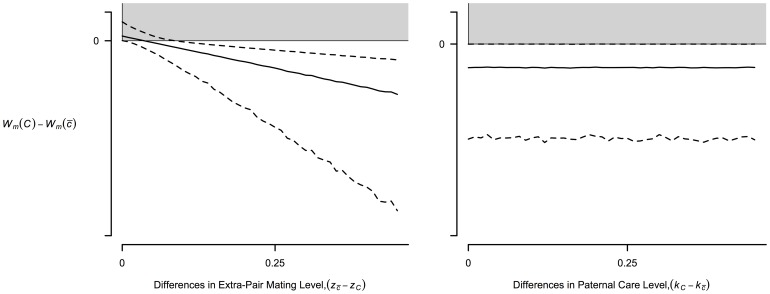
 . The right panel has the level of paternal care for Non-coalition Males set at
  . The solid line with its respective confidence intervals (dashed lines) were estimated through simulation by drawing 10,000 random parameter sets from Table 1. Gray regions highlight when Coalition Males are favored, with the corresponding white region showing when Non-coalition Males are favored. The level of kin selection (
 ) and positive assortment between Cooperative Mothers and Coalition Males (
 ) is zero.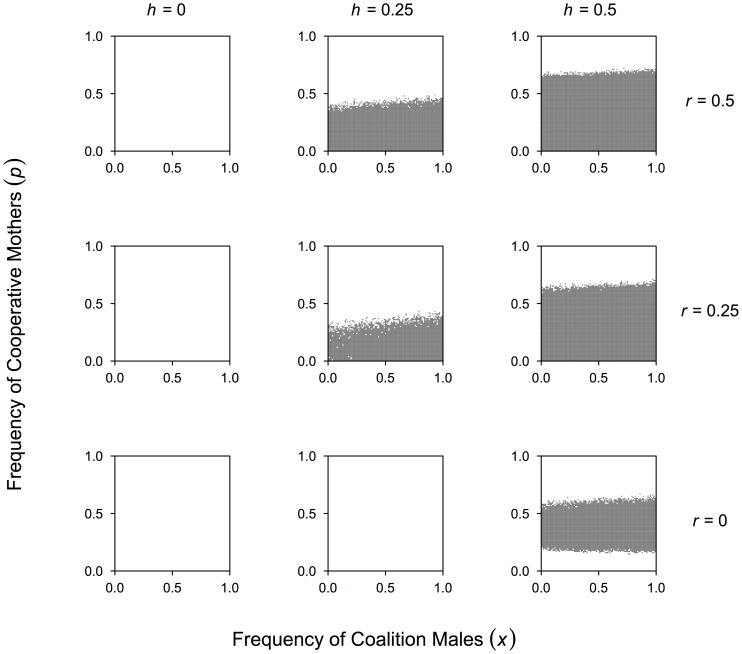
 ) and Coalition Males (
 ), 100 parameter sets were randomly drawn from ranges in Table 1 to estimate the distribution of when the fitness of Coalition Males is greater than that of Non-coalition Males (
 ). Dark regions indicate when the mean of those distributions at a specific value of
  and
and  favor Coalition Males. The level of kin selection (
 ) is the same across panel rows and the level of positive assortment between Cooperative Mothers and Coalition Males (
 ) is the same within a column of panels.
References
-
- Isler K, van Schaik C (2009) The Expensive Brain: A Framework for Explaining Evolutionary Changes in Brain Size. J. Hum. Evol. 57: 392–400. - PubMed
-
- Robson S, van Schaik C, Hawkes K (2006) The derived features of human life history. In: Paine RL, Hawkes K, editors. The Evolution of Human Life History. Santa Fe: School of American Research Press.
-
- Hrdy SB (2009) Mothers and others: the evolutionary origins of mutual understanding. Harvard University Press.
-
- Lovejoy CO (2009) Reexamining Human Origins in Light of Ardipithecus ramidus . Science 236: 74. - PubMed
MeSH terms
LinkOut - more resources
Full Text Sources
Other Literature Sources
