


Effect of interleukin-6 receptor blockade on surrogates of vascular risk in rheumatoid arthritis: MEASURE, a randomised, placebo-controlled study
- PMID: 24368514
- PMCID: PMC4392313
- DOI: 10.1136/annrheumdis-2013-204345
Effect of interleukin-6 receptor blockade on surrogates of vascular risk in rheumatoid arthritis: MEASURE, a randomised, placebo-controlled study
Abstract
Objectives: The interleukin-6 receptor (IL-6R) blocker tocilizumab (TCZ) reduces inflammatory disease activity in rheumatoid arthritis (RA) but elevates lipid concentrations in some patients. We aimed to characterise the impact of IL-6R inhibition on established and novel risk factors in active RA.
Methods: Randomised, multicentre, two-part, phase III trial (24-week double-blind, 80-week open-label), MEASURE, evaluated lipid and lipoprotein levels, high-density lipoprotein (HDL) particle composition, markers of coagulation, thrombosis and vascular function by pulse wave velocity (PWV) in 132 patients with RA who received TCZ or placebo.
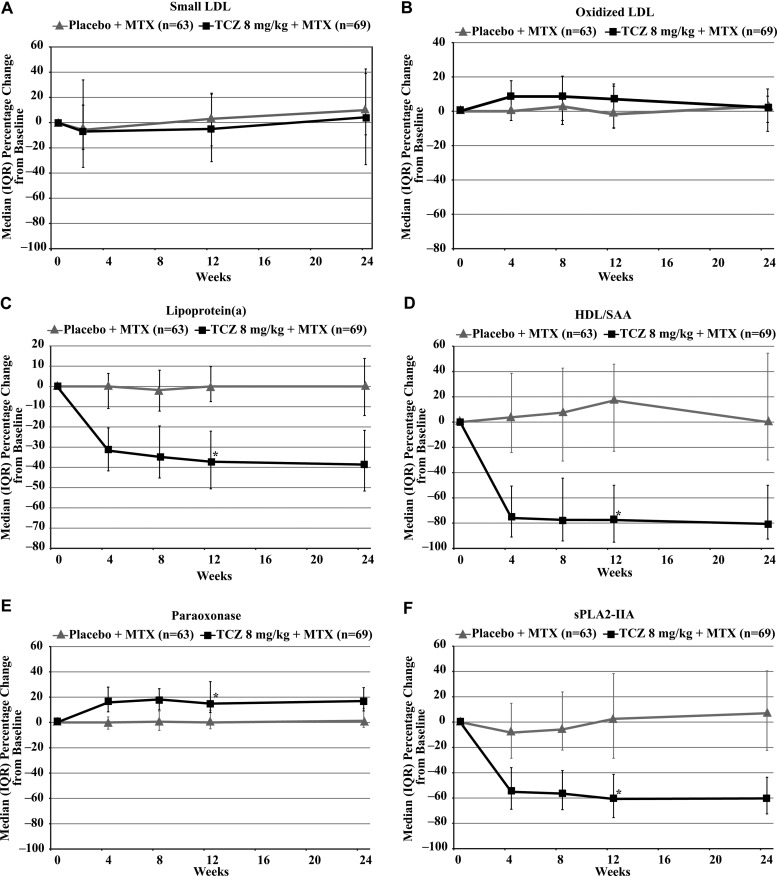
Results: Median total-cholesterol, low-density lipoprotein-cholesterol (LDL-C) and triglyceride levels increased in TCZ versus placebo recipients by week 12 (12.6% vs 1.7%, 28.1% vs 2.2%, 10.6% vs -1.9%, respectively; all p<0.01). There were no significant differences in mean small LDL, mean oxidised LDL or total HDL-C concentrations. However, HDL-associated serum amyloid A content decreased in TCZ recipients. TCZ also induced reductions (>30%) in secretory phospholipase A2-IIA, lipoprotein(a), fibrinogen and D-dimers and elevation of paraoxonase (all p<0.0001 vs placebo). The ApoB/ApoA1 ratio remained stable over time in both groups. PWV decreases were greater with placebo than TCZ at 12 weeks (adjusted mean difference 0.79 m/s (95% CI 0.22 to 1.35; p=0.0067)).
Conclusions: These data provide the first detailed evidence for the modulation of lipoprotein particles and other surrogates of vascular risk with IL-6R inhibition. When compared with placebo, TCZ induced elevations in LDL-C but altered HDL particles towards an anti-inflammatory composition and favourably modified most, but not all, measured vascular risk surrogates. The net effect of such changes for cardiovascular risk requires determination.
Keywords: Cardiovascular Disease; DMARDs (biologic); Inflammation; Lipids; Rheumatoid Arthritis.
Published by the BMJ Publishing Group Limited. For permission to use (where not already granted under a licence) please go to http://group.bmj.com/group/rights-licensing/permissions.
Figures


References
-
- Peters MJ, Symmons DP, McCarey D, et al. EULAR evidence-based recommendations for cardiovascular risk management in patients with rheumatoid arthritis and other forms of inflammatory arthritis. Ann Rheum Dis 2010;69:325–31. - PubMed
-
- Gonzalez-Gay MA, Gonzalez-Juanatey C, Lopez-Diaz MJ, et al. HLA-DRB1 and persistent chronic inflammation contribute to cardiovascular events and cardiovascular mortality in patients with rheumatoid arthritis. Arthritis Rheum 2007;57:125–32. - PubMed
-
- McKellar GE, McCarey DW, Sattar N, et al. Role for TNF in atherosclerosis? Lessons from autoimmune disease. Nat Rev Cardiol 2009;6:410–17. - PubMed
-
- Sattar N, McCarey DW, Capell H, et al. Explaining how ‘high-grade’ systemic inflammation accelerates vascular risk in rheumatoid arthritis. Circulation 2003;108:2957–63. - PubMed
-
- Hurt-Camejo E, Paredes S, Masana L, et al. Elevated levels of small, low-density lipoprotein with high affinity for arterial matrix components in patients with rheumatoid arthritis: possible contribution of phospholipase A2 to this atherogenic profile. Arthritis Rheum 2001;44:2761–67. - PubMed
Publication types
MeSH terms
Substances
LinkOut - more resources
Full Text Sources
Other Literature Sources
Medical
Research Materials
Miscellaneous
