. 2014 Feb 19;4(2):277-95.
doi: 10.1534/g3.113.009084.

Extensive differences in gene expression between symbiotic and aposymbiotic cnidarians

Affiliations

Extensive differences in gene expression between symbiotic and aposymbiotic cnidarians

Erik M Lehnert et al. G3 (Bethesda). .

Abstract

Coral reefs provide habitats for a disproportionate number of marine species relative to the small area of the oceans that they occupy. The mutualism between the cnidarian animal hosts and their intracellular dinoflagellate symbionts provides the nutritional foundation for coral growth and formation of reef structures, because algal photosynthesis can provide >90% of the total energy of the host. Disruption of this symbiosis ("coral bleaching") is occurring on a large scale due primarily to anthropogenic factors and poses a major threat to the future of coral reefs. Despite the importance of this symbiosis, the cellular mechanisms involved in its establishment, maintenance, and breakdown remain largely unknown. We report our continued development of genomic tools to study these mechanisms in Aiptasia, a small sea anemone with great promise as a model system for studies of cnidarian-dinoflagellate symbiosis. Specifically, we have generated de novo assemblies of the transcriptomes of both a clonal line of symbiotic anemones and their endogenous dinoflagellate symbionts. We then compared transcript abundances in animals with and without dinoflagellates. This analysis identified >900 differentially expressed genes and allowed us to generate testable hypotheses about the cellular functions affected by symbiosis establishment. The differentially regulated transcripts include >60 encoding proteins that may play roles in transporting various nutrients between the symbiotic partners; many more encoding proteins functioning in several metabolic pathways, providing clues regarding how the transported nutrients may be used by the partners; and several encoding proteins that may be involved in host recognition and tolerance of the dinoflagellate.

Keywords: anemone; dinoflagellate; innate immunity; metabolic compartmentation; symbiosis.


Figures
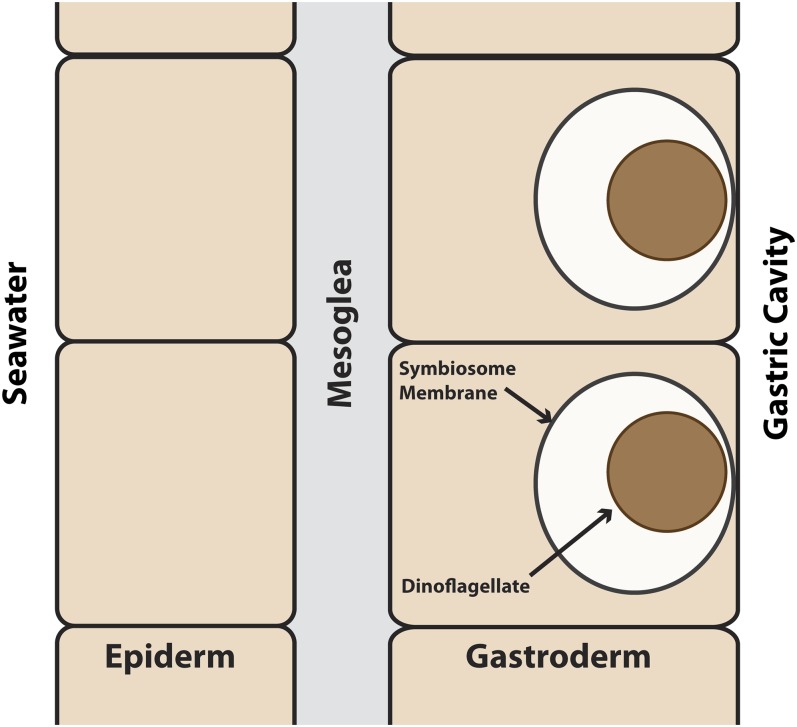
Figure 1
Figure 1
The spatial organization of cnidarian–dinoflagellate symbiosis. A simplified schematic diagram of a section of cnidarian body wall is shown; note that the drawing is not to scale (e.g., the dinoflagellate typically fills most of the symbiosome). The two major tissue layers are the epiderm, which faces the outside sea water and lacks both dinoflagellate symbionts and direct access to food in the gastric cavity, and the gastroderm, which faces the gastric cavity and may contain dinoflagellate symbionts in some of its cells. These two cell layers are separated by the largely acellular mesoglea. After phagocytosis by a host gastrodermal cell, the dinoflagellate resides within a “symbiosome” (believed to be derived from a phagosome that does not fuse with lysosomes) and transfers fixed carbon to the host.
Figure 2
Figure 2
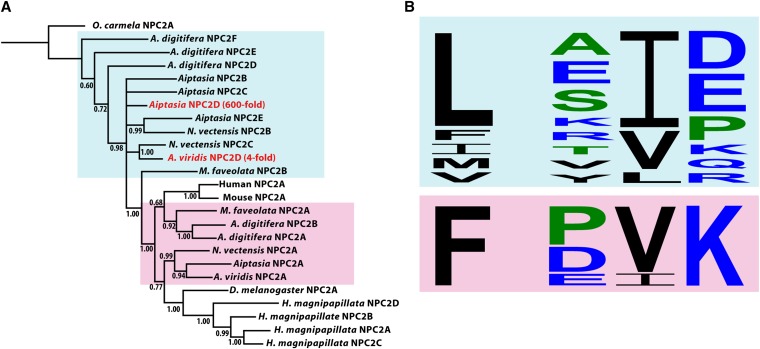
Npc2-like proteins that putatively do or do not have the ability to transport cholesterol. (A) Consensus phylogenetic tree constructed from alignments (Figure S1B) of 25 Npc2-like proteins (see Materials and Methods). Oscarella carmela, a sponge, served as the outgroup, and the single human Npc2 protein, the single mouse Npc2 protein, and one of the eight Drosophila melanogaster Npc2 proteins were included in the analysis. The cnidarian sequences included are from two corals (Acropora digitifera and Montastraea faveolata), three anemones (Aiptasia sp., Nematostella vectensis, and Anemonia viridis), and a hydrozoan (Hydra magnipapillata). The Npc2-encoding transcripts found to be upregulated in symbiotic anemones, which fall outside the clade containing the mammalian and Drosophila sequences, are shown in red with their fold-changes (Table 7, line 4; Ganot et al. 2011). Light blue and pink shading indicate the groups of anthozoan proteins in the cladogram to which the sequence displays in (B) correspond. Numbers indicated the bootstrap values for the branches indicated. (B, lower) Amino acids highly conserved in animal (including some cnidarian) Npc2 proteins and thought to be involved in cholesterol binding (see text and Figure S1A). The mammalian proteins both have the sequences F…PVK, and the Drosophila Npc2A sequence is F…PVL. (B, upper) The variety of amino acids found at the corresponding positions in members of the other protein clade. The differentially regulated Aiptasia and A. viridis Npc2D proteins both have the sequence L…SID.
Figure 3
Figure 3
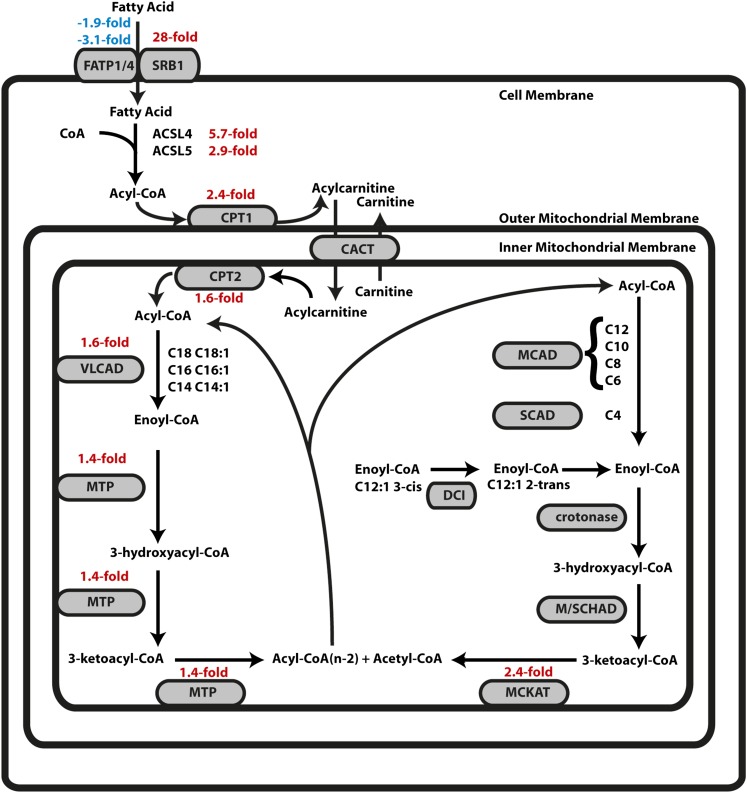
Expression changes of genes governing β-oxidation of fatty acids. The diagram (adapted from Houten and Wanders 2010) shows the localization of proteins involved in fatty-acid transport and β-oxidation in relation to the membranes of the mitochondrion and cell (as known from other animal cells). Statistically significant expression changes from RNA-Seq experiment 1 are shown when applicable; upregulation in symbiotic relative to aposymbiotic anemones is shown by positive/red numbers, and downregulation is shown by negative/blue numbers. Scavenger receptor class B member 1 (SRB1; CD36-related protein) and FATP1/4, possible fatty-acid transporters at the cell surface; ACSL4 and ACSL5, enzymes that convert free fatty acids to fatty acyl-CoA esters; CPT1, CPT2, and CACT, proteins involved in transporting fatty acyl-CoA esters across the mitochondrial membranes; VLCAD, MTP, MCAD, SCAD, M/SCHAD, and MCKAT, enzymes responsible for β-oxidation; DCI, converts fatty acids with double bonds starting at odd-numbered positions to fatty acids with double bonds starting at even-numbered positions; crotonase, hydrates double bonds that start at even-numbered positions. See Table S4, lines 14–30, for full protein names, UniProt accession numbers, and transcript numbers.
Figure 4
Figure 4
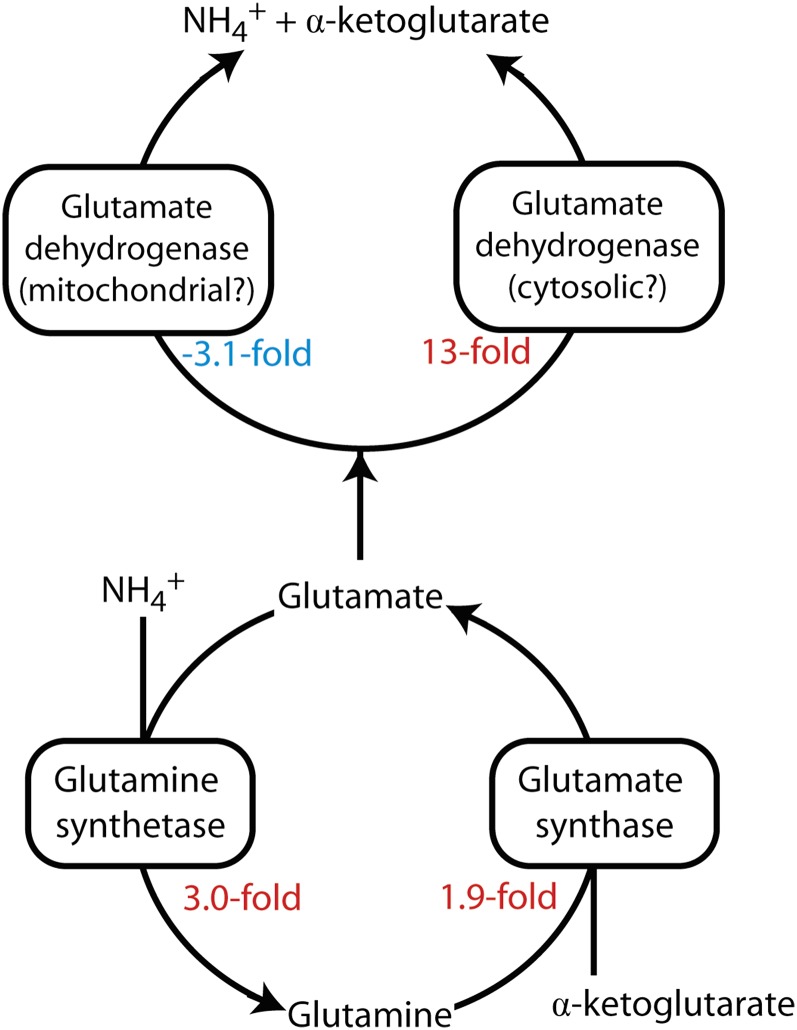
Expression changes of genes governing glutamine and glutamate metabolism. Upregulation in symbiotic relative to aposymbiotic anemones is shown by positive/red numbers, and downregulation is shown by negative/blue numbers. For UniProt and transcript numbers, see Table S5, lines 1–4. The possible localizations of the glutamate dehydrogenases are discussed in the text.
Figure 5
Figure 5
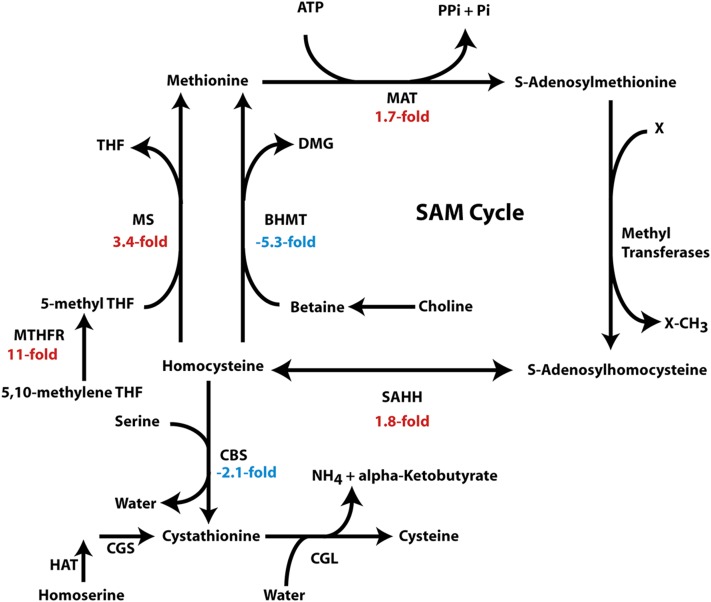
Expression changes of genes governing the metabolism of sulfur-containing amino acids and the S-adenosylmethionine (SAM) cycle. Upregulation in symbiotic relative to aposymbiotic anemones is shown by positive/red numbers, and downregulation is shown by negative/blue numbers. For full names of enzymes, UniProt accession numbers, and transcript numbers, see Table S5, lines 7, 8, 10–14, 18, and 19. THF, tetrahydrofolate; DMG, dimethylglycine.
Figure 6
Figure 6
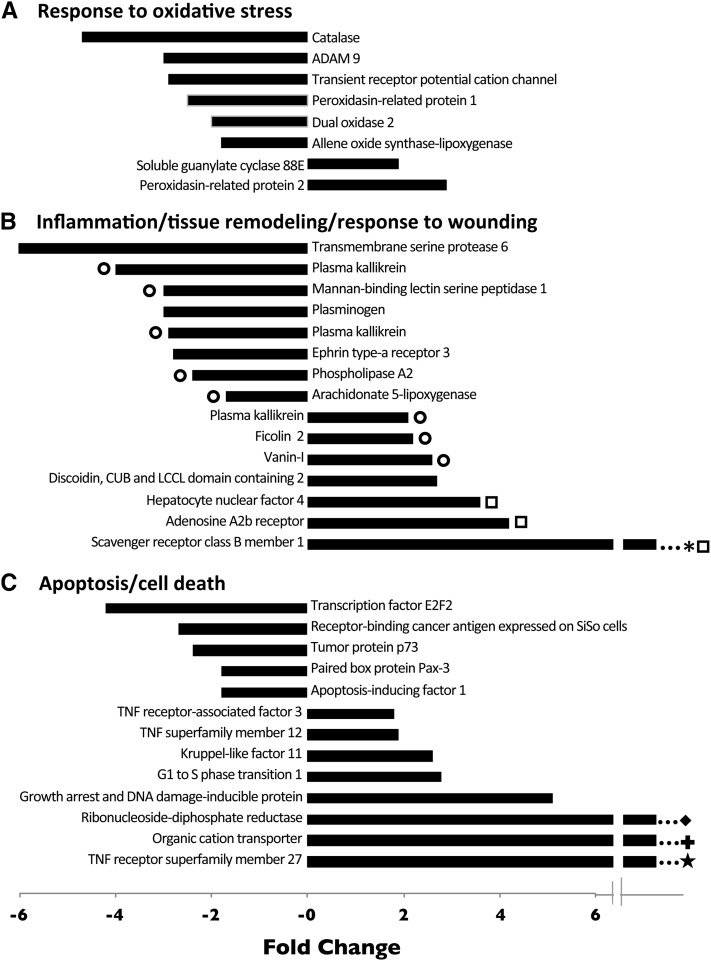
Expression changes of genes with functions that may relate to host tolerance of the symbiont. Functionally related groups of genes (by GO term assignments) that were significantly enriched among the differentially expressed genes relative to the background transcriptome were identified as described in the text. Fold-changes are shown as expression in symbiotic anemones relative to that in aposymbiotic anemones. ○, putatively pro-inflammatory; □, putatively anti-inflammatory; *, highly upregulated (28-fold in experiment 1 and detected only in symbiotic animals in experiment 2; see also Table S3, footnote b); ◆, 12-fold change; +, 44-fold change; ★, 60-fold change. For additional details, see Table S6.
Figure 7
Figure 7
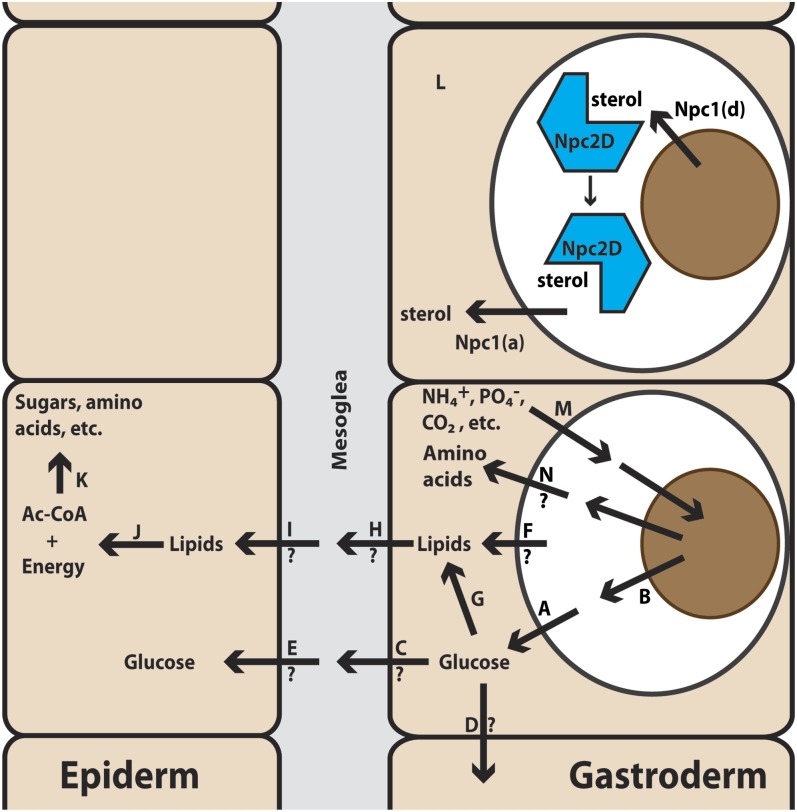
Summary of hypotheses about metabolism and metabolite transport as suggested by the gene expression data and previously available information. Letters “A” through “N” are for reference in the text. Thick arrows across membranes indicate transporters hypothesized to be present in those membranes; thick arrows within cells, metabolic pathways hypothesized to be important in those cells; thin arrow, presumed diffusion of Npc2-sterol complexes; Npc1(a), the anemone-derived Npc1-like protein described in the text; Npc1(d), a presumed but as-yet-unidentified sterol transporter produced by the dinoflagellate and present in its plasma membrane; ?, hypotheses that we consider to be more problematic. Not shown because of their potential complexity are the other changes in inorganic-nutrient transport (e.g., a damping of NH4+ and CO2 excretion across the apical plasma membranes of the gastrodermal cells) that are likely to occur upon the onset of symbiosis. All of these hypotheses should be testable through a combination of experiments including protein localization by immunofluorescence and/or cell fractionation, studies of separated gastrodermal and epidermal cell layers, sterol-binding experiments on Npc2 proteins, and others. See text for additional details.

References

    1. Adams Y., Smith S. L., Schwartz-Albiez R., Andrews K. T., 2005. Carrageenans inhibit the in vitro growth of Plasmodium falciparum and cytoadhesion to CD36. Parasitol. Res. 97: 290–294 - PubMed
    1. Ainsworth T. D., Wasmund K., Ukani L., Seneca F., Yellowlees D., et al. , 2011. Defining the tipping point. A complex cellular life/death balance in corals in response to stress. Sci. Rep. 1: 160. - PMC - PubMed
    1. Altura M. A., Stabb E., Goldman W., Apicella M., McFall-Ngai M. J., 2011. Attenuation of host NO production by MAMPs potentiates development of the host in the squid-Vibrio symbiosis. Cell. Microbiol. 13: 527–537 - PMC - PubMed
    1. Anders S., Huber W., 2010. Differential expression analysis for sequence count data. Genome Biol. 11: R106. - PMC - PubMed
    1. Areschoug T., Gordon S., 2009. Scavenger receptors: role in innate immunity and microbial pathogenesis. Cell. Microbiol. 11: 1160–1169 - PubMed

Publication types

LinkOut - more resources