Prognosis of recurrence after complete resection in early-stage non-small cell lung cancer
- PMID: 24368972
- PMCID: PMC3868693
- DOI: 10.5090/kjtcs.2013.46.6.449
Prognosis of recurrence after complete resection in early-stage non-small cell lung cancer
Abstract
Background: Tumor recurrence is the most common cause of treatment failure, even after complete resection of early-stage non-small cell lung cancer (NSCLC). In this study, we investigated the prognosis of patients with early recurrence in order to identify independent risk factors related to early recurrence.
Methods: Between February 1995 and December 2012, 242 patients who underwent surgical resection for stage I NSCLC at Dong-A University Hospital were reviewed. The factors predicting overall survival (OS) and early recurrence were investigated. We also investigated the relationship between the patterns and period of recurrence and clinicopathological factors.
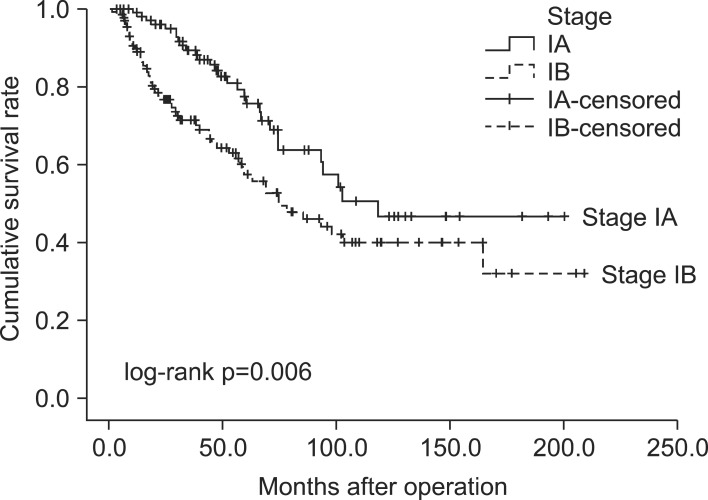
Results: For patients with stage IA and IB NSCLC, the 5-year OS rate was 75.7% and 57.3% (p=0.006), respectively. A multivariate Cox proportional hazards model demonstrated that gender (p=0.004), comorbidity number (p=0.038), resection type (p=0.002), and tumor size (p=0.022) were the statistically significant predictors of OS. Moreover, the multivariate analysis revealed that smoking history (p=0.023) and histologic grade (p=0.012) were the independent predictors of early recurrence. Additionally, only histologic grade (poor differentiation) was found to be significantly associated with a higher frequency of distant metastasis; there was no relationship between the patterns and period of recurrence and clinicopathological factors.
Conclusion: The present study demonstrated that smoking history and histologic grade were independent prognostic factors for early recurrence within two years in patients with early-stage NSCLC. Patients with these predictive factors may be good candidates for adjuvant therapy.
Keywords: Adjuvant therapy; Carcinoma, non-small cell, lung; Recurrence; Risk factors; Surgery.
Figures
References
-
- Dominioni L, Imperatori A, Rovera F, Ochetti A, Torrigiotti G, Paolucci M. Stage I nonsmall cell lung carcinoma: analysis of survival and implications for screening. Cancer. 2000;89(11 Suppl):2334–2344. - PubMed
-
- Goodgame B, Stinchcombe TE, Simon G, Wozniak A, Govindan R. Recent advances in lung cancer: summary of presentations from the 45th annual meeting of the American Society of Clinical Oncology (2009) J Thorac Oncol. 2009;4:1293–1300. - PubMed
-
- Brundage MD, Davies D, Mackillop WJ. Prognostic factors in non-small cell lung cancer: a decade of progress. Chest. 2002;122:1037–1057. - PubMed
-
- Jones DR, Daniel TM, Denlinger CE, Rundall BK, Smolkin ME, Wick MR. Stage IB nonsmall cell lung cancers: are they all the same? Ann Thorac Surg. 2006;81:1958–1962. - PubMed
LinkOut - more resources
Full Text Sources
Other Literature Sources