. 2013 Dec 26:14:919.
doi: 10.1186/1471-2164-14-919.

Proteomic changes in the base of chrysanthemum cuttings during adventitious root formation

Affiliations

Proteomic changes in the base of chrysanthemum cuttings during adventitious root formation

Ruixia Liu et al. BMC Genomics. .

Abstract

Background: A lack of competence to form adventitious roots by cuttings of Chrysanthemum (Chrysanthemum morifolium) is an obstacle for the rapid fixation of elite genotypes. We performed a proteomic analysis of cutting bases of chrysanthemum cultivar 'Jinba' during adventitious root formation (ARF) in order to identify rooting ability associated protein and/or to get further insight into the molecular mechanisms controlling adventitious rooting.

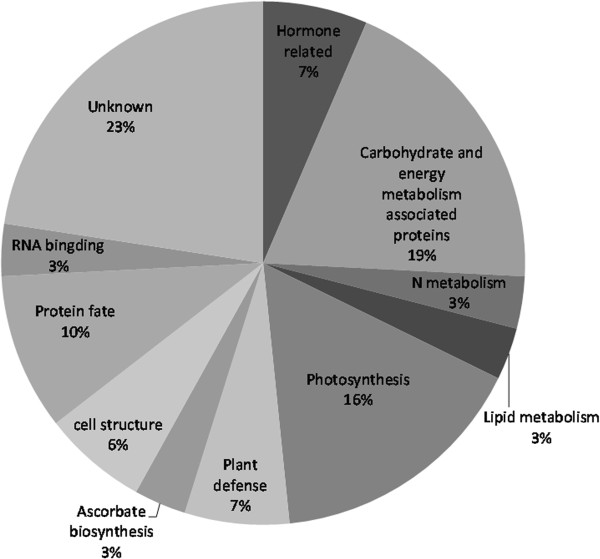
Results: The protein profiles during ARF were analyzed by comparing the 2-DE gels between 0-day-old (just severed from the stock plant) and 5-day-old cutting bases of chrysanthemum. A total of 69 differentially accumulated protein spots (two-fold change; t-test: 95% significance) were excised and analyzed using MALDI-TOF/TOF, among which 42 protein spots (assigned as 24 types of proteins and 7 unknown proteins) were confidently identified using the NCBI database. The results demonstrated that 19% proteins were related to carbohydrate and energy metabolism, 16% to photosynthesis, 10% to protein fate, 7% to plant defense, 6% to cell structure, 7% to hormone related, 3% to nitrate metabolism, 3% to lipid metabolism, 3% to ascorbate biosynthesis and 3% to RNA binding, 23% were unknown proteins. Twenty types of differentially accumulated proteins including ACC oxidase (CmACO) were further analyzed at the transcription level, most of which were in accordance with the results of 2-DE. Moreover, the protein abundance changes of CmACO are supported by western blot experiments. Ethylene evolution was higher during the ARF compared with day 0 after cutting, while silver nitrate, an inhibitor of ethylene synthesis, pretreatment delayed the ARF. It suggested that ACC oxidase plays an important role in ARF of chrysanthemum.

Conclusions: The proteomic analysis of cutting bases of chrysanthemum allowed us to identify proteins whose expression was related to ARF. We identified auxin-induced protein PCNT115 and ACC oxidase positively or negatively correlated to ARF, respectively. Several other proteins related to carbohydrate and energy metabolism, protein degradation, photosynthetic and cell structure were also correlated to ARF. The induction of protein CmACO provide a strong case for ethylene as the immediate signal for ARF. This strongly suggests that the proteins we have identified will be valuable for further insight into the molecular mechanisms controlling ARF.


Figures
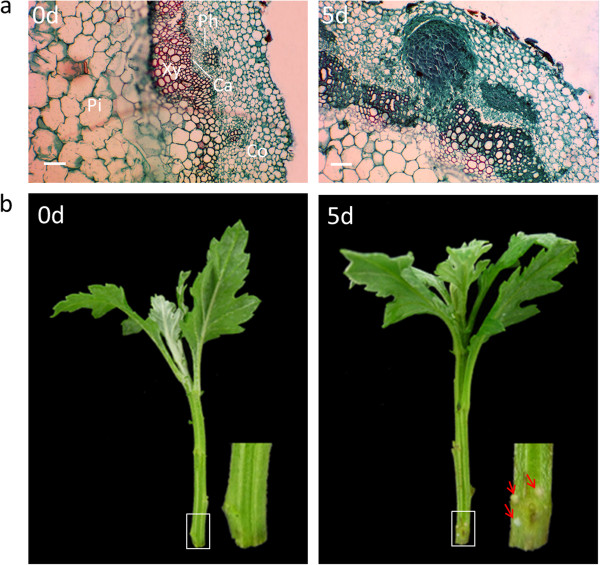
Figure 1
Figure 1
Morphological and histological properties of adventitious root primodium formation in the stem base of chrysanthemum ‘Jinba’ cuttings. Anatomy of adventitious root primodium formation (a) 0 d post excision, typical stem anatomy consists of the cortex (Co), the pith parenchyma (Pi) and a ring of vessels with phloem (Ph), cambium (Ca), and xylem (Xy) cells; 5 d after cutting, the first differentiated root primordia can be seen; Bars = 500 μm. Morphology of 0 d and 5 d cuttings (b). The arrow indicated the adventitious root, zoomed image shows the cutting position.
Figure 2
Figure 2
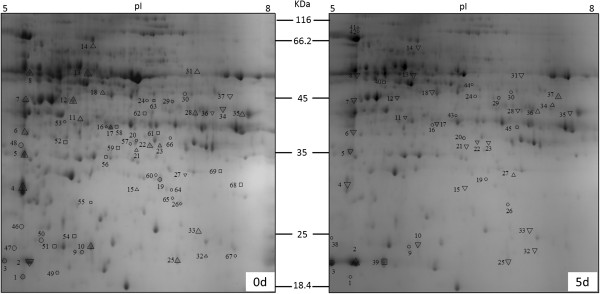
Comparative proteomic 2-DE maps of soluble proteins extracted from 0 d and 5 d chrysanthemum cutting bases. Each map depicts one representative gel (of three replicates). Proteins were separated in the first-dimension by their pIs on IPG strips pH 5–8 and in the second-dimension by their molecular masses on 12.5% SDS-polyacrylamide gels. Proteins were stained with colloidal Coomassie Blue R-350. A total of 69 protein spots showing differences between the 0 d and 5 d maps are numbered. Squares indicate spots that are only present at 0 d or 5 d. Triangles indicate spots that differed between 0 d and 5 d (up-regulated, up-pointing triangle; down-regulated, down-pointing triangle). Circles indicate spots that could not be identified by MALDI-TOF/TOF. Mass spectrometric identification of these proteins is summarized in Table 1.
Figure 3
Figure 3
The functional classification and distribution of all 42 identified proteins from cutting bases of chrysanthemum. Unknown proteins include those whose functions have not been described. This classification is based on a BLAST search and their homologies and literature.
Figure 4
Figure 4
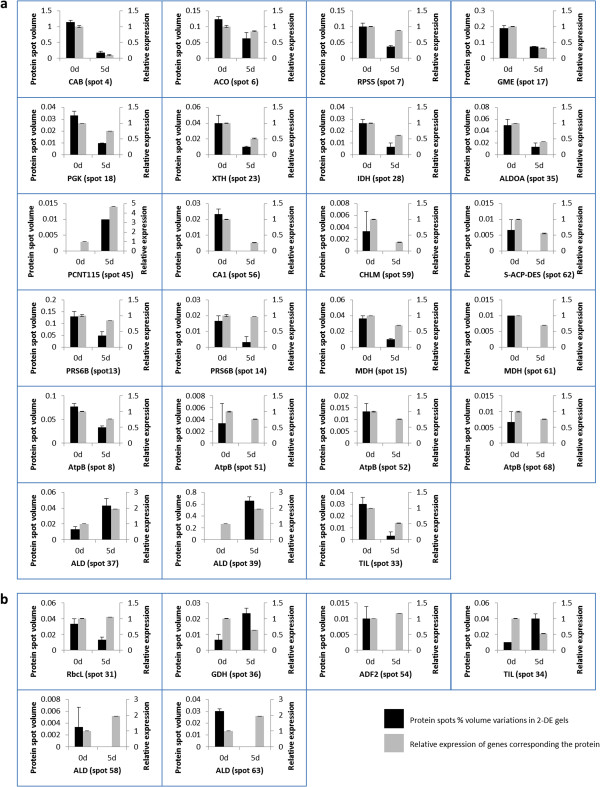
Expression of confidently identified protein and its corresponding genes. (a), relative expression of genes are corresponding to successful identified protein expression patterns; (b), relative expression of genes are different from the protein expression patterns. Each value represents the mean of three independent replicates ± SE.
Figure 5
Figure 5
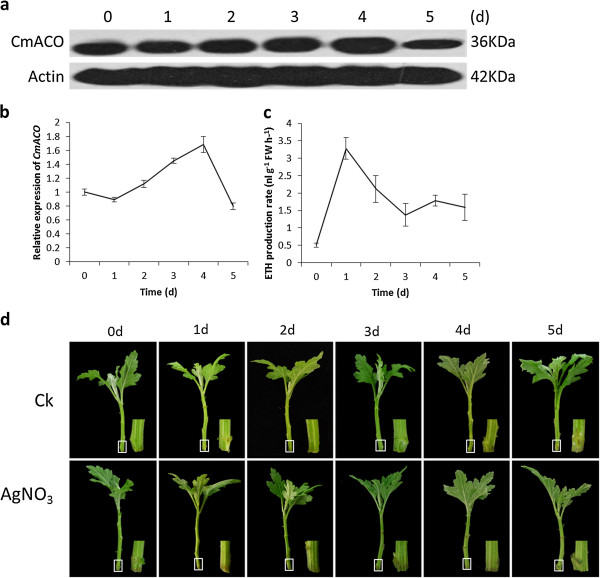
CmACO transcript and protein expression in chrysanthemum cutting bases during adventitious root formation. (a), CmACO protein expression in the cutting bases of chrysanthemum were detected by Western blotting using antiACO-monoclonal antibody; (b), CmACO transcript was analyzed by qRT-PCR. Each value represents the mean of three independent replicates ± SE. (c), ethylene production during adventitious root formation in chrysanthemum cutting bases. Each value represents the mean of three independent replicates ± SE; (d), morphological changes during adventitious root formation and AgNO3 inhibits adventitious root formation.

References

    1. Ahkami AH, Lischewski S, Haensch KT, Porfirova S, Hofmann J, Rolletschek H, Melzer M, Franken P, Hause B, Druege U. et al.Molecular physiology of adventitious root formation in Petunia hybrida cuttings: involvement of wound response and primary metabolism. New Phytol. 2009;14(3):613–625. doi: 10.1111/j.1469-8137.2008.02704.x. - DOI - PubMed
    1. Pagnussat GC, Simontacchi M, Puntarulo S, Lamattina L. Nitric oxide is required for root organogenesis. Plant Physiol. 2002;14(3):954–956. doi: 10.1104/pp.004036. - DOI - PMC - PubMed
    1. Acosta M, Oliveros-Valenzuela MR, Nicolás C, Sánchez-Bravo J. Rooting of carnation cuttings: the auxin signal. Plant Signal Behav. 2009;14(3):234–236. doi: 10.4161/psb.4.3.7912. - DOI - PMC - PubMed
    1. Sukumar P, Maloney GS, Muday GK. Localized induction of the ATP-binding cassette B19 auxin transporter enhances adventitious root formation in arabidopsis. Plant Physiol. 2013;14(3):1392–1405. doi: 10.1104/pp.113.217174. - DOI - PMC - PubMed
    1. Bai X, Todd CD, Desikan R, Yang Y, Hu X. N-3-oxo-decanoyl-L-homoserine-lactone activates auxin-induced adventitious root formation via hydrogen peroxide- and nitric oxide-dependent cyclic GMP signaling in mung bean. Plant Physiol. 2012;14(2):725–736. doi: 10.1104/pp.111.185769. - DOI - PMC - PubMed

Publication types

LinkOut - more resources