


Differential effects of fatigue on movement variability
- PMID: 24370441
- PMCID: PMC3960345
- DOI: 10.1016/j.gaitpost.2013.11.020
Differential effects of fatigue on movement variability
Abstract
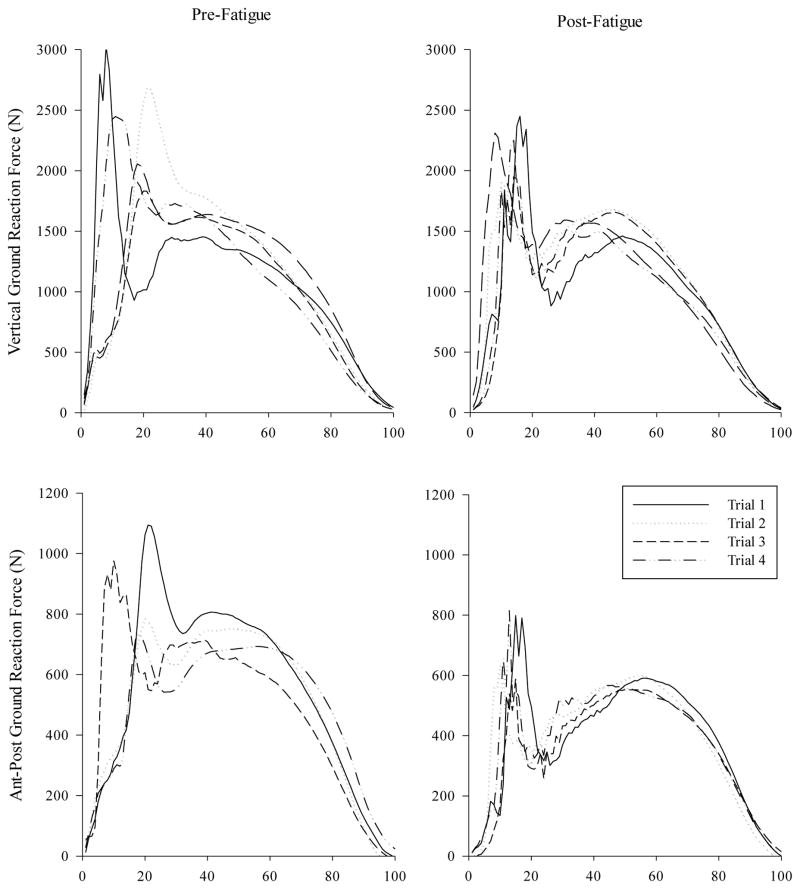
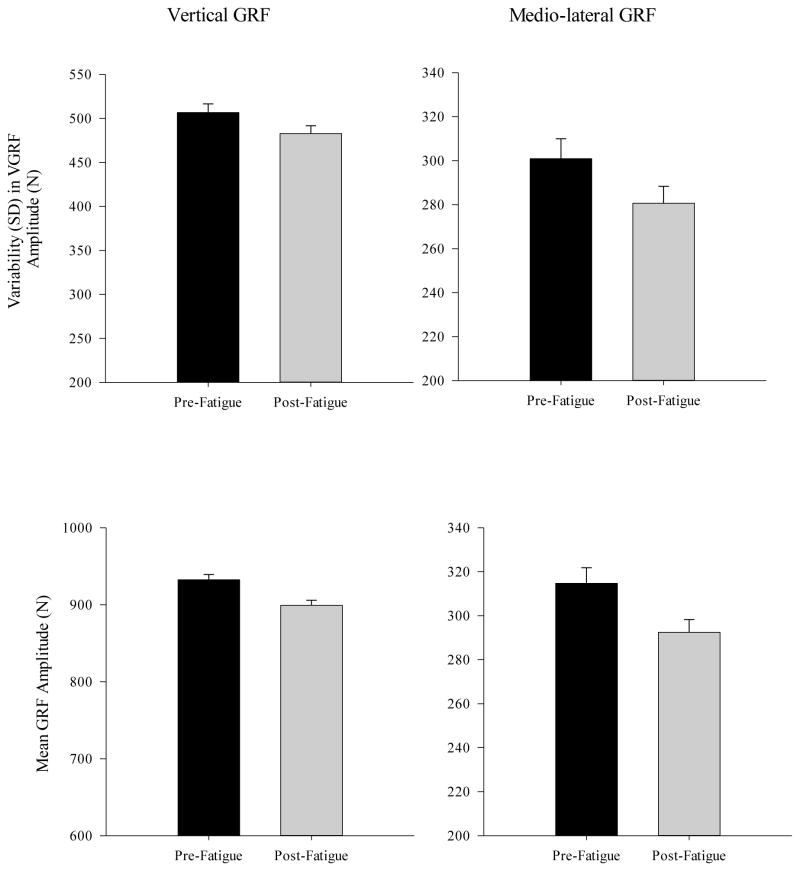
When individuals perform purposeful actions to fatigue, there is typically a general decline in their movement performance. This study was designed to investigate the effects exercise-induced fatigue has on lower limb kinetics and kinematics during a side-step cutting task. In particular, it was of interest to determine what changes could be seen in mean amplitude and all metrics of signal variability with fatigue. The results of the study revealed that post-fatigue there was an overall decrease in absolute force production as reflected by a decline in mean amplitude and variability (SD) of the ground reaction forces (GRFV and GRFML). A decrease in mean and SD of the knee moments were also observed post-exercise. Interestingly, this trend was not mirrored by similar changes in time-dependent properties of these signals. Instead, there was an increase in the SampEn values (reflecting a more variable, irregular signal) for GRF force profiles, knee kinematics and moments following the exercise-induced fatigue. These results illustrate that fatigue can have differential effects on movement variability, resulting in a both an increase and decrease in movement variability, depending on the variable selected. Thus, the impact of fatigue is not simply restricted to a decline in force producing capacity of the system but more importantly it demonstrates that the ability of the person to perform a smooth and controlled action is limited due to fatigue.
Keywords: Complexity; Gait; Lower extremity; Sample entropy.
Copyright © 2013 Elsevier B.V. All rights reserved.
Figures

References
-
- Enoka RM, Stuart DG. Neurobiology of muscle fatigue. Journal Of Applied Physiology (Bethesda, Md: 1985) 1992;72(5):1631–1648. - PubMed
-
- Gandevia SC. Spinal and supraspinal factors in human muscle fatigue. Physiological Reviews. 2001;81(4):1725–1789. - PubMed
-
- Morrison S, et al. The effects of unilateral muscle fatigue on bilateral physiological tremor. Experimental Brain Research. 2005;167:609–621. - PubMed
-
- Enoka RM, et al. Task- and age-dependent variations in steadiness. Progress In Brain Research. 1999;123:389–395. - PubMed
-
- Missenard O, Mottet D, Perrey S. Muscular fatigue increases signal-dependent noise during isometric force production. Neuroscience Letters. 2008;437(2):154–157. - PubMed
Publication types
MeSH terms
Grants and funding
LinkOut - more resources
Full Text Sources
Other Literature Sources
