


Pregnancy and post-delivery maternal weight changes and overweight in preschool children
- PMID: 24370455
- PMCID: PMC4069123
- DOI: 10.1016/j.ypmed.2013.12.018
Pregnancy and post-delivery maternal weight changes and overweight in preschool children
Abstract
Objectives: High maternal weight before and during pregnancy contributes to child obesity. To assess the additional role of weight change after delivery, we examined associations between pre- and post-pregnancy weight changes and preschooler overweight.
Sample: 4359 children from the Children and Young Adults of the 1979 National Longitudinal Survey of Youth (NLSY) born to 2816 NLSY mothers between 1979 and 2006 and followed to age 4-5years old.
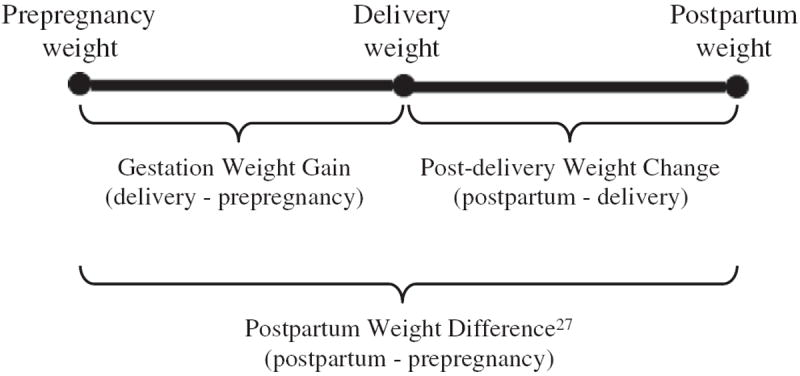
Exposures: gestational weight gain (GWG) and post-delivery maternal weight change (PDWC).
Outcome: child overweight (body mass index (BMI) ≥85th percentile).
Results: Adjusted models suggested that both increased GWG (OR: 1.08 per 5kg GWG, 95% CI: 1.01, 1.16) and excessive GWG (OR: 1.29 versus adequate GWG, 95% CI: 1.06, 1.56) were associated with preschooler overweight. Maternal weight change after delivery was also independently associated with child overweight (OR: 1.12 per 5kg PDWC, 95% CI: 1.04, 1.21). Associations were stronger among children with overweight or obese mothers.
Conclusions: Increased maternal weight gain both during and after pregnancy predicted overweight in preschool children. Our results suggest that healthy post-pregnancy weight may join normal pre-pregnancy BMI and adequate GWG as a potentially modifiable risk factor for child overweight.
Keywords: Body mass index; Child; Longitudinal studies; Mothers; Obesity; Overweight; Postpartum period; Pregnancy; Weight gain; Weight loss.
Copyright © 2013 Elsevier Inc. All rights reserved.
Conflict of interest statement
The authors have no conflicts of interest to disclose.
Figures
References
-
- Alexander GR, Himes JH, Kaufman RB, Mor J, Kogan M. A United States national reference for fetal growth. Obstet Gynecol. 1996;87:163–168. - PubMed
-
- Armitage JA, Poston L, Taylor PD. Developmental origins of obesity and the metabolic syndrome: the role of maternal obesity. Front Horm Res. 2008;36:73–84. - PubMed
-
- Baker JL, Gamborg M, Heitmann BL, Lissner L, Sorensen TI, Rasmussen KM. Breastfeeding reduces postpartum weight retention. Am J Clin Nutr. 2008;88(6):1543–1551. http://dx.doi.org/10.3945/ajcn.2008.26379. - DOI - PubMed
MeSH terms
Grants and funding
LinkOut - more resources
Full Text Sources
Other Literature Sources
Medical
