


Site-specific structural variations accompanying tubular assembly of the HIV-1 capsid protein
- PMID: 24370930
- PMCID: PMC3952194
- DOI: 10.1016/j.jmb.2013.12.021
Site-specific structural variations accompanying tubular assembly of the HIV-1 capsid protein
Abstract
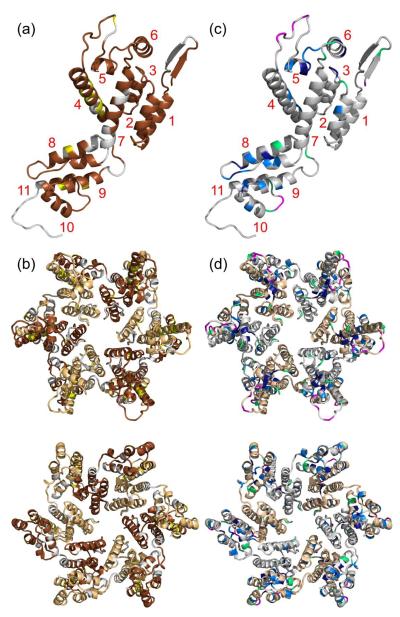
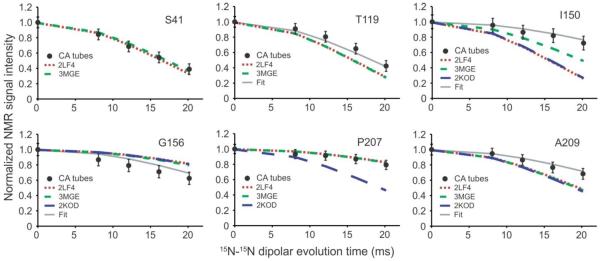
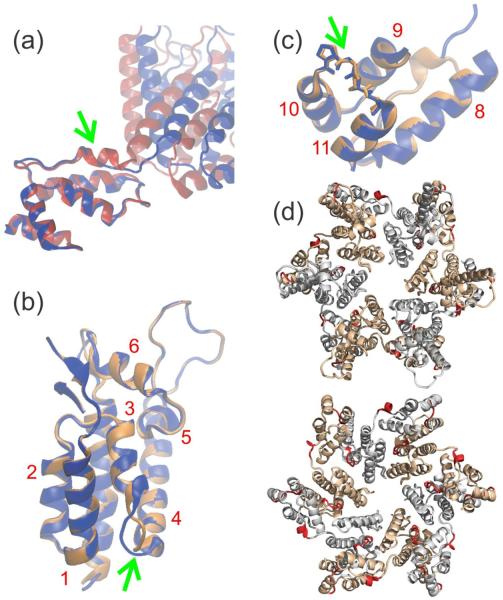
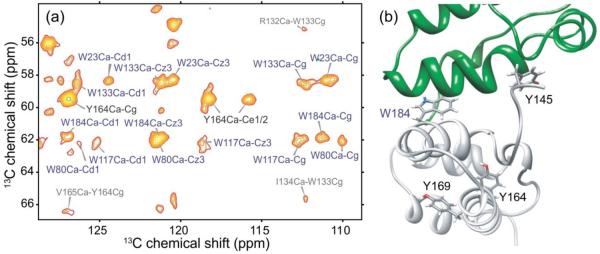
The 231-residue capsid (CA) protein of human immunodeficiency virus type 1 (HIV-1) spontaneously self-assembles into tubes with a hexagonal lattice that is believed to mimic the surface lattice of conical capsid cores within intact virions. We report the results of solid-state nuclear magnetic resonance (NMR) measurements on HIV-1 CA tubes that provide new information regarding changes in molecular structure that accompany CA self-assembly, local dynamics within CA tubes, and possible mechanisms for the generation of lattice curvature. This information is contained in site-specific assignments of signals in two- and three-dimensional solid-state NMR spectra, conformation-dependent (15)N and (13)C NMR chemical shifts, detection of highly dynamic residues under solution NMR conditions, measurements of local variations in transverse spin relaxation rates of amide (1)H nuclei, and quantitative measurements of site-specific (15)N-(15)N dipole-dipole couplings. Our data show that most of the CA sequence is conformationally ordered and relatively rigid in tubular assemblies and that structures of the N-terminal domain (NTD) and the C-terminal domain (CTD) observed in solution are largely retained. However, specific segments, including the N-terminal β-hairpin, the cyclophilin A binding loop, the inter-domain linker, segments involved in intermolecular NTD-CTD interactions, and the C-terminal tail, have substantial static or dynamical disorder in tubular assemblies. Other segments, including the 310-helical segment in CTD, undergo clear conformational changes. Structural variations associated with curvature of the CA lattice appear to be localized in the inter-domain linker and intermolecular NTD-CTD interface, while structural variations within NTD hexamers, around local 3-fold symmetry axes, and in CTD-CTD dimerization interfaces are less significant.
Keywords: AIDS; automated resonance assignment; electron microscopy; human immunodeficiency virus; solid-state NMR.
Published by Elsevier Ltd.
Figures
References
-
- Briggs JAG, Krausslich HG. The molecular architecture of HIV. J. Mol. Biol. 2011;410:491–500. - PubMed
-
- Gamble TR, Vajdos FF, Yoo SH, Worthylake DK, Houseweart M, Sundquist WI, Hill CP. Crystal structure of human cyclophilin A bound to the amino-terminal domain of HIV-1 capsid. Cell. 1996;87:1285–1294. - PubMed
-
- Momany C, Kovari LC, Prongay AJ, Keller W, Gitti RK, Lee BM, Gorbalenya AE, Tong L, McClure J, Ehrlich LS, Summers MF, Carter C, Rossmann MG. Crystal structure of dimeric HIV-1 capsid protein. Nat. Struct. Biol. 1996;3:763–770. - PubMed
-
- Gamble TR, Yoo SH, Vajdos FF, vonSchwedler UK, Worthylake DK, Wang H, McCutcheon JP, Sundquist WI, Hill CP. Structure of the carboxyl-terminal dimerization domain of the HIV-1 capsid protein. Science. 1997;278:849–853. - PubMed
Publication types
MeSH terms
Substances
Grants and funding
LinkOut - more resources
Full Text Sources
Other Literature Sources
