


Panton-Valentine leukocidin-positive Staphylococcus aureus in Ireland from 2002 to 2011: 21 clones, frequent importation of clones, temporal shifts of predominant methicillin-resistant S. aureus clones, and increasing multiresistance
- PMID: 24371244
- PMCID: PMC3957793
- DOI: 10.1128/JCM.02799-13
Panton-Valentine leukocidin-positive Staphylococcus aureus in Ireland from 2002 to 2011: 21 clones, frequent importation of clones, temporal shifts of predominant methicillin-resistant S. aureus clones, and increasing multiresistance
Abstract
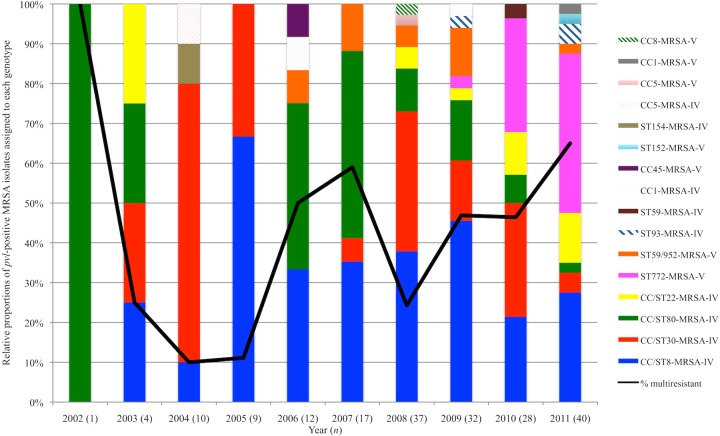
There has been a worldwide increase in community-associated (CA) methicillin-resistant Staphylococcus aureus (MRSA) infections. CA-MRSA isolates commonly produce the Panton-Valentine leukocidin toxin encoded by the pvl genes lukF-PV and lukS-PV. This study investigated the clinical and molecular epidemiologies of pvl-positive MRSA and methicillin-susceptible S. aureus (MSSA) isolates identified by the Irish National MRSA Reference Laboratory (NMRSARL) between 2002 and 2011. All pvl-positive MRSA (n=190) and MSSA (n=39) isolates underwent antibiogram-resistogram typing, spa typing, and DNA microarray profiling for multilocus sequence type, clonal complex (CC) and/or sequence type (ST), staphylococcal cassette chromosome mec type assignment, and virulence and resistance gene detection. Where available, patient demographics and clinical data were analyzed. The prevalence of pvl-positive MRSA increased from 0.2% to 8.8%, and that of pvl-positive MSSA decreased from 20% to 2.5% during the study period. The pvl-positive MRSA and MSSA isolates belonged to 16 and 5 genotypes, respectively, with CC/ST8-MRSA-IV, CC/ST30-MRSA-IV, CC/ST80-MRSA-IV, CC1/ST772-MRSA-V, CC30-MSSA, CC22-MSSA, and CC121-MSSA predominating. Temporal shifts in the predominant pvl-positive MRSA genotypes and a 6-fold increase in multiresistant pvl-positive MRSA genotypes occurred during the study period. An analysis of patient data indicated that pvl-positive S. aureus strains, especially MRSA strains, had been imported into Ireland several times. Two hospital and six family clusters of pvl-positive MRSA were identified, and 70% of the patient isolates for which information was available were from patients in the community. This study highlights the increased burden and changing molecular epidemiology of pvl-positive S. aureus in Ireland over the last decade and the contribution of international travel to the influx of genetically diverse pvl-positive S. aureus isolates into Ireland.
Figures
References
-
- Monecke S, Coombs G, Shore AC, Coleman DC, Akpaka P, Borg M, Chow H, Ip M, Jatzwauk L, Jonas D, Kadlec K, Kearns A, Laurent F, O'Brien FG, Pearson J, Ruppelt A, Schwarz S, Scicluna E, Slickers P, Tan HL, Weber S, Ehricht R. 2011. A field guide to pandemic, epidemic and sporadic clones of methicillin-resistant Staphylococcus aureus. PLoS One 6:e17936. 10.1371/journal.pone.0017936 - DOI - PMC - PubMed
-
- Vandenesch F, Naimi T, Enright MC, Lina G, Nimmo GR, Heffernan H, Liassine N, Bes M, Greenland T, Reverdy ME, Etienne J. 2003. Community-acquired methicillin-resistant Staphylococcus aureus carrying Panton-Valentine leukocidin genes: worldwide emergence. Emerg. Infect. Dis. 9:978–984. 10.3201/eid0908.030089 - DOI - PMC - PubMed
-
- Gillet Y, Issartel B, Vanhems P, Fournet JC, Lina G, Bes M, Vandenesch F, Piémont Y, Brousse N, Floret D, Etienne J. 2002. Association between Staphylococcus aureus strains carrying gene for Panton-Valentine leukocidin and highly lethal necrotising pneumonia in young immunocompetent patients. Lancet 359:753–759. 10.1016/S0140-6736(02)07877-7 - DOI - PubMed
Publication types
MeSH terms
Substances
LinkOut - more resources
Full Text Sources
Other Literature Sources
Medical
