


Visual and vestibular perceptual thresholds each demonstrate better precision at specific frequencies and also exhibit optimal integration
- PMID: 24371292
- PMCID: PMC4044428
- DOI: 10.1152/jn.00332.2013
Visual and vestibular perceptual thresholds each demonstrate better precision at specific frequencies and also exhibit optimal integration
Abstract
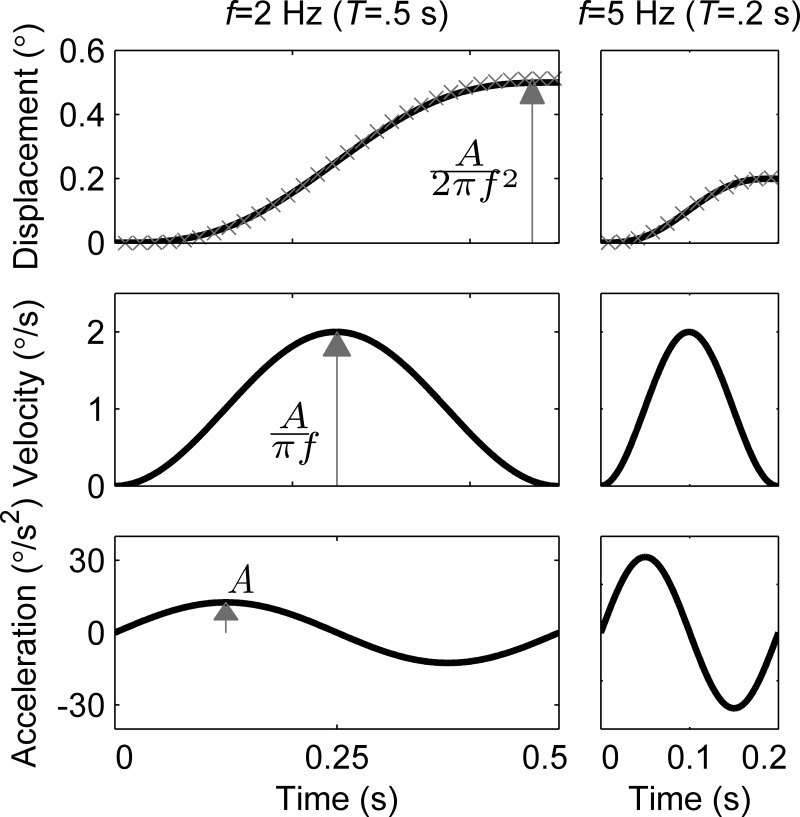
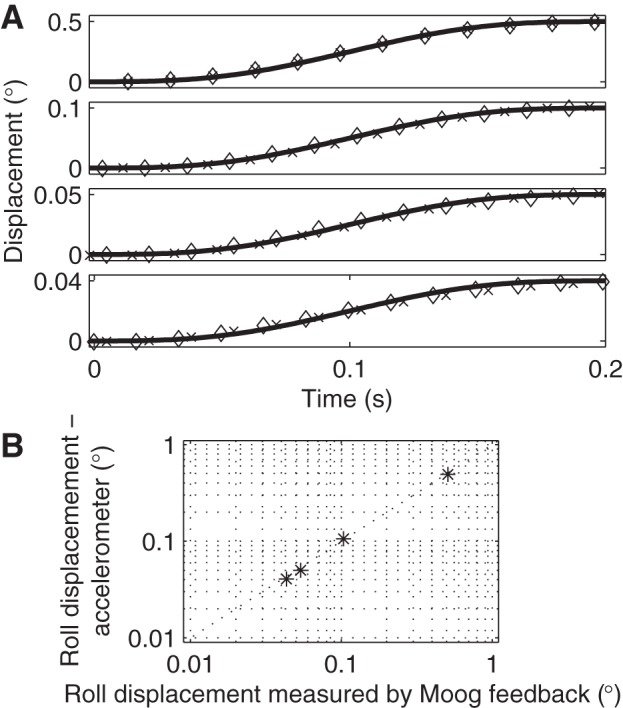
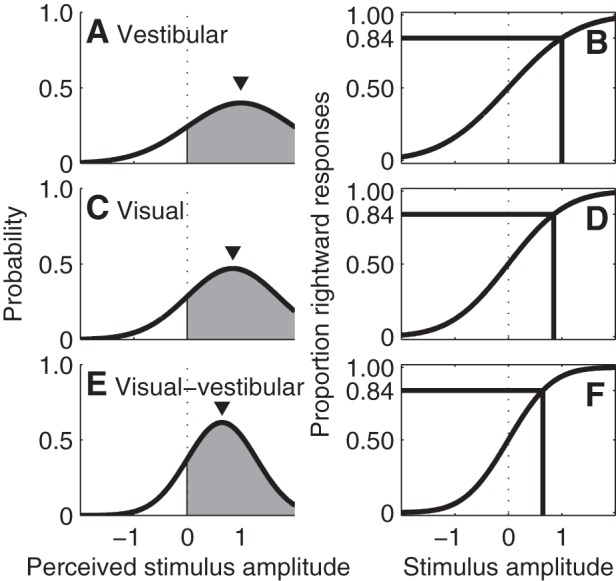
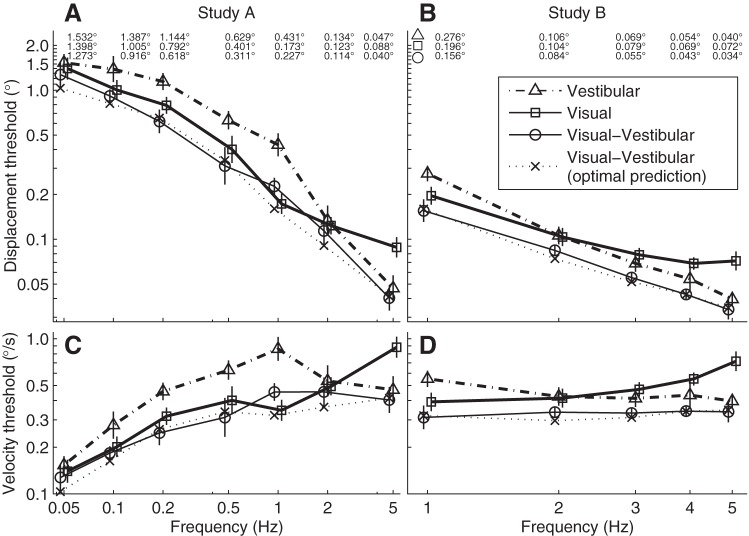
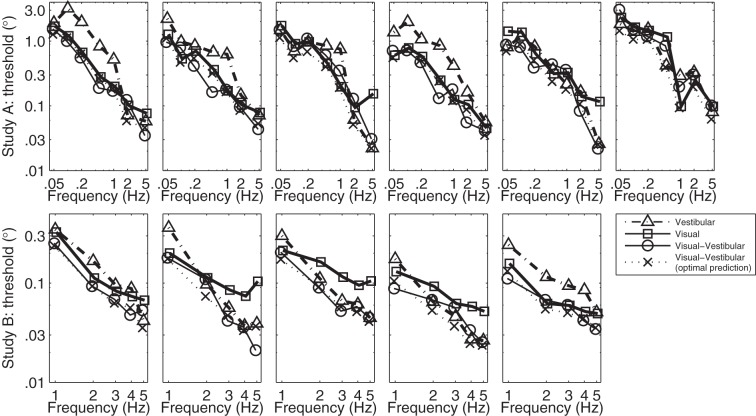
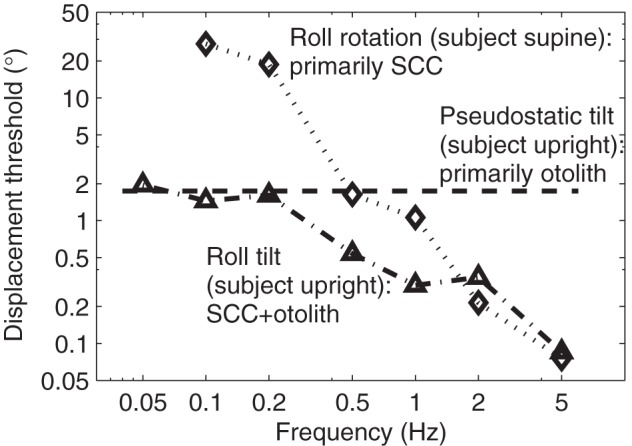
Prior studies show that visual motion perception is more precise than vestibular motion perception, but it is unclear whether this is universal or the result of specific experimental conditions. We compared visual and vestibular motion precision over a broad range of temporal frequencies by measuring thresholds for vestibular (subject motion in the dark), visual (visual scene motion) or visual-vestibular (subject motion in the light) stimuli. Specifically, thresholds were measured for motion frequencies spanning a two-decade physiological range (0.05-5 Hz) using single-cycle sinusoidal acceleration roll tilt trajectories (i.e., distinguishing left-side down from right-side down). We found that, while visual and vestibular thresholds were broadly similar between 0.05 and 5.0 Hz, each cue is significantly more precise than the other at certain frequencies. Specifically, we found that 1) visual and vestibular thresholds were indistinguishable at 0.05 Hz and 2 Hz (i.e., similarly precise); 2) visual thresholds were lower (i.e., vision more precise) than vestibular thresholds between 0.1 Hz and 1 Hz; and 3) visual thresholds were higher (i.e., vision less precise) than vestibular thresholds above 2 Hz. This shows that vestibular perception can be more precise than visual perception at physiologically relevant frequencies. We also found that sensory integration of visual and vestibular information is consistent with static Bayesian optimal integration of visual-vestibular cues. In contrast with most prior work that degraded or altered sensory cues, we demonstrated static optimal integration using natural cues.
Keywords: human; otoliths; psychophysics; roll tilt; semicircular canals; vision.
Copyright © 2014 the American Physiological Society.
Figures
References
-
- Benson AJ, Hutt EC, Brown SF. Thresholds for the perception of whole body angular movement about a vertical axis. Aviat Space Environ Med 60: 205–213, 1989 - PubMed
-
- Benson AJ, Spencer MB, Stott JR. Thresholds for the detection of the direction of whole-body, linear movement in the horizontal plane. Aviat Space Environ Med 57: 1088–1096, 1986 - PubMed
-
- Bles W, Vianney de Jong JM, de Wit G. Compensation for labyrinthine defects examined by use of a tilting room. Acta Otolaryngol (Stockh) 95: 576–579, 1983 - PubMed
-
- Bockisch CJ, Haslwanter T. Three-dimensional eye position during static roll and pitch in humans. Vision Res 41: 2127–2137, 2001 - PubMed
Publication types
MeSH terms
Grants and funding
LinkOut - more resources
Full Text Sources
Other Literature Sources
