. 2013 Aug 30:3:539-47.
doi: 10.1016/j.nicl.2013.08.012. eCollection 2013.

The effects of tetrahydrobiopterin (BH4) treatment on brain function in individuals with phenylketonuria

Affiliations

The effects of tetrahydrobiopterin (BH4) treatment on brain function in individuals with phenylketonuria

Shawn E Christ et al. Neuroimage Clin. .

Abstract

Phenylketonuria (PKU) is a rare genetic condition characterized by an absence or mutation of the PAH enzyme, which is necessary for the metabolism of the amino acid phenylalanine into tyrosine. Recently, sapropterin dihydrochloride, a synthetic form of tetrahydrobiopterin (BH4), has been introduced as a supplemental treatment to dietary phe control for PKU. Very little is known regarding BH4 treatment and its effect on brain and cognition. The present study represents the first examination of potential changes in neural activation in patients with PKU during BH4 treatment. To this end, we utilized an n-back working memory task in conjunction with functional magnetic resonance imaging (fMRI) to evaluate functional brain integrity in a sample of individuals with PKU at three timepoints: Just prior to BH4 treatment, after 4 weeks of treatment, and after 6 months of treatment. Neural activation patterns observed for the PKU treatment group were compared with those of a demographically-matched sample of healthy non-PKU individuals who were assessed at identical time intervals. Consistent with past research, baseline evaluation revealed impaired working memory and atypical brain activation in the PKU group as compared to the non-PKU group. Most importantly, BH4 treatment was associated with improvements in both working memory and brain activation, with neural changes evident earlier (4-week timepoint) than changes in working memory performance (6-month timepoint).

Keywords: Executive function; Phenylketonuria; Prefrontal cortex; Sapropterin; Working memory; fMRI.


Figures
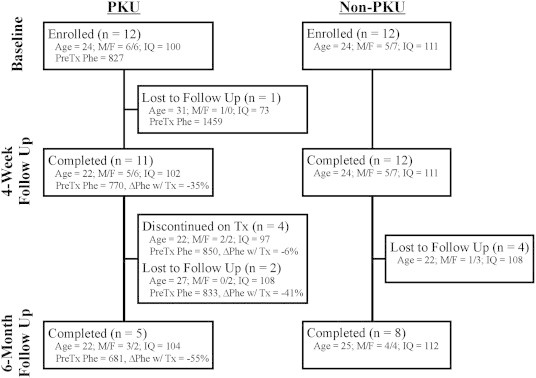
Fig. 1
Fig. 1
Participant flow diagram. Demographic information [mean age, gender, mean IQ, mean phe level for the year prior study enrollment, and mean blood phe level change (%) between the baseline and 4-week evaluations] are included for each sub-group.
Fig. 2
Fig. 2
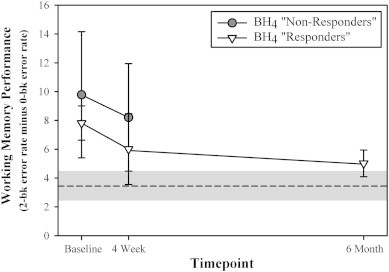
Working memory performance (as reflected as reflected by the difference score of error rate in the 2-back condition minus that in the 0-back condition) shown separately for timepoint (baseline, week 4, and 6 month) and BH4 responsiveness as determined independently at the 4-week timepoint by each participant's treating physician. [Patients deemed “non-responders” were discontinued on BH4 treatment after the 4-week trial period. “Responders” were continued on BH4 treatment and remained in the present study through the 6-month timepoint.] For comparison purposes, the mean and standard error of the behavioral performance observed for the non-PKU group are represented by a dashed line and gray shaded area, respectively.
Fig. 3
Fig. 3
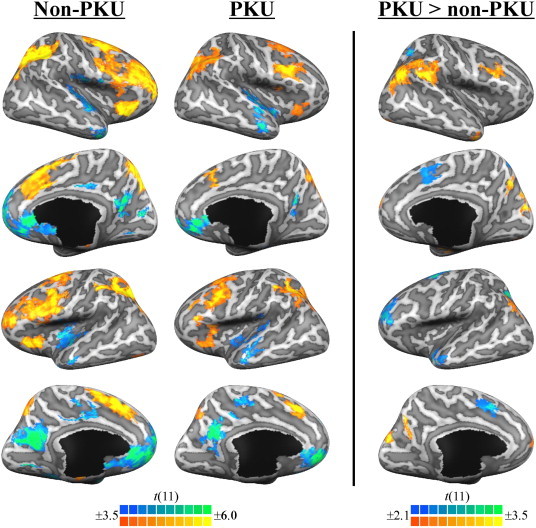
The left and center panels illustrate significant task-related (2-back minus 0-back) activity, shown separately for the non-PKU group and PKU group, respectively. The right panel illustrates regions demonstrating significant group differences in task-related activity. Results are viewed on the inflated surface of an exemplar brain. Statistical maps were thresholded at p < .005 and p < .05, respectively, for illustration purposes.
Fig. 4
Fig. 4
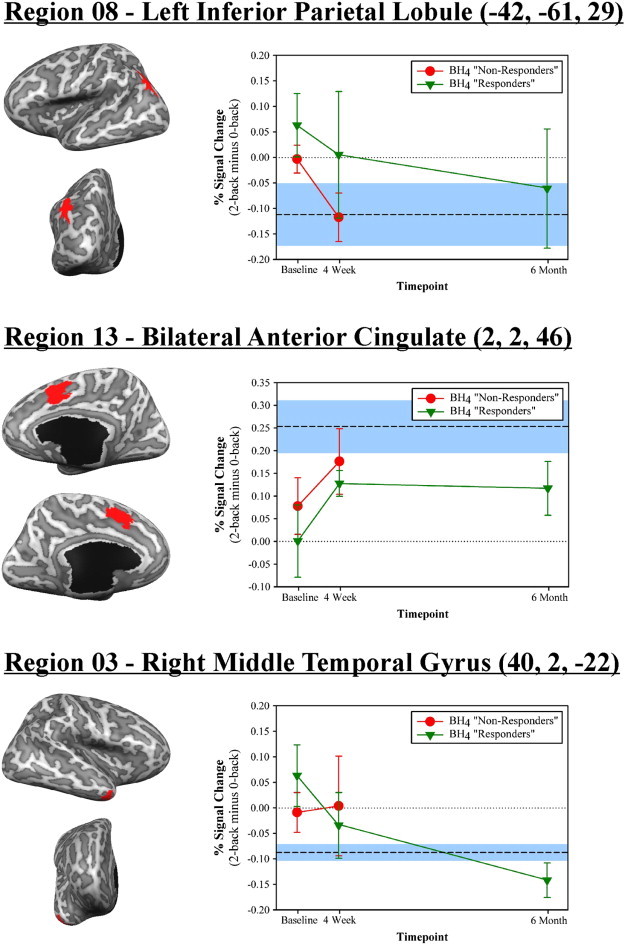
The pattern of activation for three ROIs that demonstrated significant changes in activation over time with BH4 treatment. The upper and middle panels illustrate regions in left inferior parietal lobule (region 08) and bilateral anterior cingulate cortex (region 13) that showed significant changes between baseline and 4-week evaluation (p < .05 in all instances). The bottom panel illustrates a region in right middle temporal gyrus (region 03) that showed significant changes between baseline and 6-month evaluation. Data is graphed separately for timepoint (baseline, week 4, and 6 month) and BH4 responsiveness (responder vs. non-responder) as determined independently at the 4-week timepoint by each participant's treating physician. For comparison purposes, the mean and standard error of the activation levels observed for the non-PKU group are represented by a dashed line and blue shaded area, respectively.

References

    1. Anderson P.J., Leuzzi V. White matter pathology in phenylketonuria. Mol. Genet. Metab. 2010;99(Suppl. 1):S3–S9. - PubMed
    1. Antenor-Dorsey J.A.V., Hershey T., Rutlin J., Shimony J.S., McKinstry R.C., Grange D.K., White D.A. White matter integrity and executive abilities in individuals with phenylketonuria. Mol. Genet. Metab. 2013;109:125–131. - PMC - PubMed
    1. Banerjee P., Grange D.K., Steiner R.D., White D.A. Executive strategic processing during verbal fluency performance in children with phenylketonuria. Child Neuropsychol. 2011;17:105–117. - PMC - PubMed
    1. Bélanger-Quintana A., Burlina A., Harding C.O., Muntau A.C. Up to date knowledge on different treatment strategies for phenylketonuria. Mol. Genet. Metab. 2011;104:S19–S25. (Suppl.) - PMC - PubMed
    1. Bottiglieri T., Hyland K., Laundy M., Godfrey P., Carney M.W., Toone B.K., Reynolds E.H. Folate deficiency, biopterin and monoamine metabolism in depression. Psychol. Med. 1992;22:871–876. - PubMed

LinkOut - more resources