


Abnormal blood-brain barrier permeability in normal appearing white matter in multiple sclerosis investigated by MRI
- PMID: 24371801
- PMCID: PMC3872721
- DOI: 10.1016/j.nicl.2013.12.001
Abnormal blood-brain barrier permeability in normal appearing white matter in multiple sclerosis investigated by MRI
Abstract
Objectives: To investigate whether blood-brain barrier (BBB) permeability is disrupted in normal appearing white matter in MS patients, when compared to healthy controls and whether it is correlated with MS clinical characteristics.
Methods: Dynamic contrast-enhanced MRI was used to measure BBB permeability in 27 patients with MS and compared to 24 matched healthy controls.
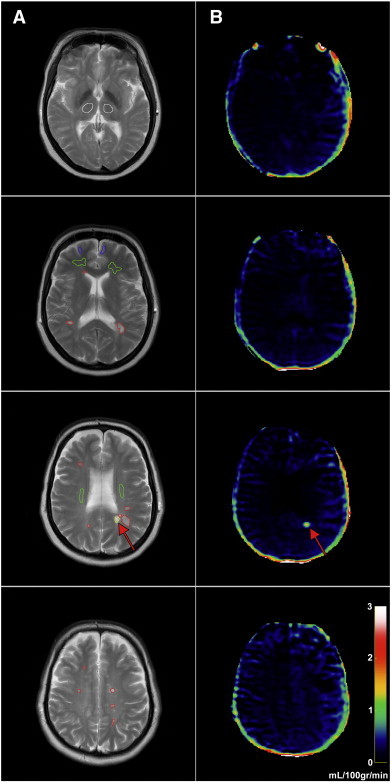
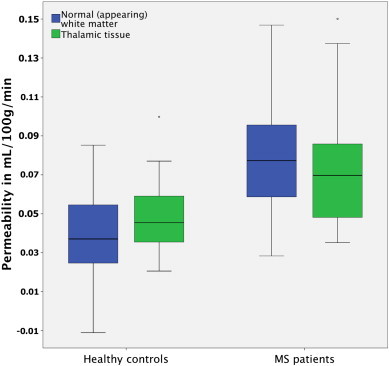
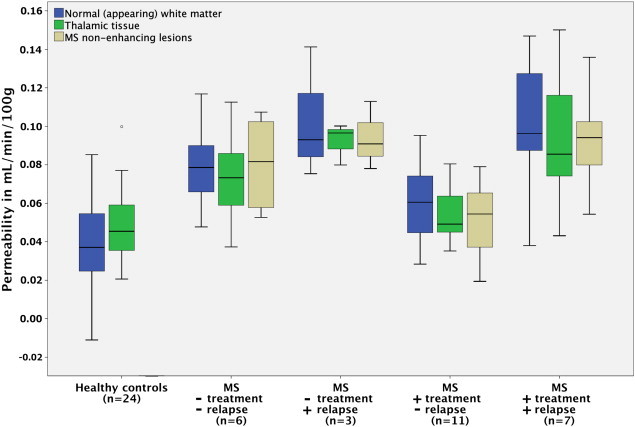
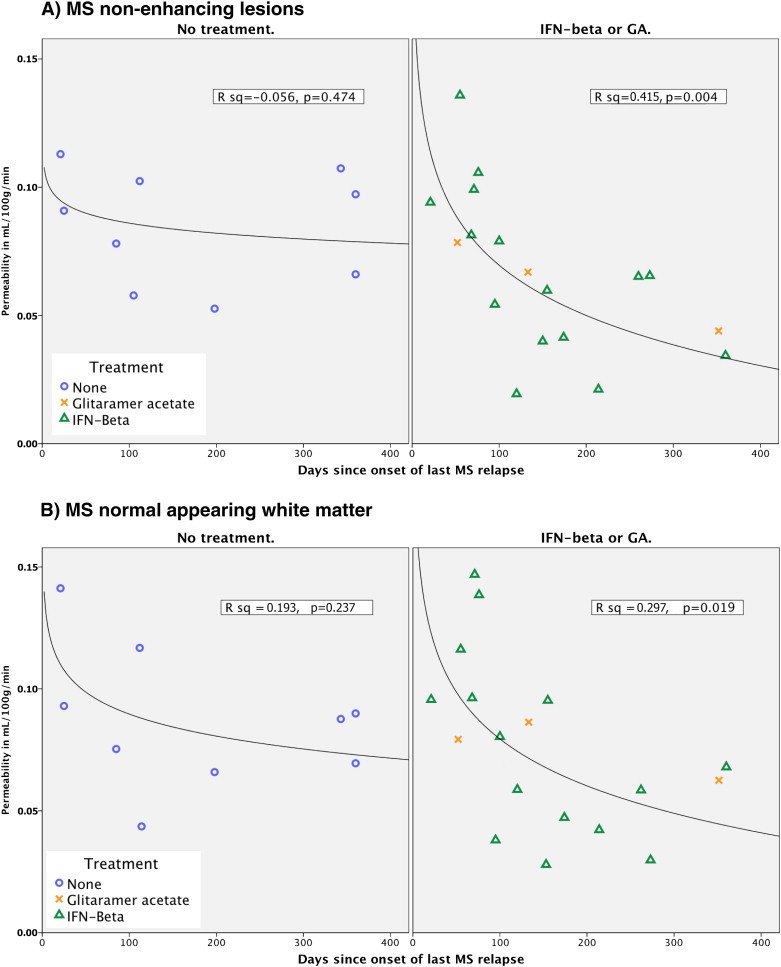
Results: Permeability measured as K(trans) was significantly higher in periventricular normal appearing white matter (NAWM) and thalamic gray matter in MS patients when compared to healthy controls, with periventricular NAWM showing the most pronounced difference. Recent relapse coincided with significantly higher permeability in periventricular NAWM, thalamic gray matter, and MS lesions. Immunomodulatory treatment and recent relapse were significant predictors of permeability in MS lesions and periventricular NAWM. Our results suggest that after an MS relapse permeability gradually decreases, possibly an effect of immunomodulatory treatment.
Conclusions: Our results emphasize the importance of BBB pathology in MS, which we find to be most prominent in the periventricular NAWM, an area prone to development of MS lesions. Both the facts that recent relapse appears to cause widespread BBB disruption and that immunomodulatory treatment seems to attenuate this effect indicate that BBB permeability is intricately linked to the presence of MS relapse activity. This may reveal further insights into the pathophysiology of MS.
Keywords: Blood–brain barrier; DCE MRI; Disease modifying therapy; MRI; Multiple sclerosis; Perfusion MRI.
Figures

References
-
- Casiraghi C., Dorovini-Zis K., Horwitz M.S. Epstein–Barr virus infection of human brain microvessel endothelial cells: a novel role in multiple sclerosis. J. Neuroimmunol. 2011;230:173–177. - PubMed
-
- Correale J., Fiol M., Gilmore W. The risk of relapses in multiple sclerosis during systemic infections. Neurology. 2006;67:652–659. - PubMed
-
- De Stefano N. In vivo evidence for axonal dysfunction remote from focal cerebral demyelination of the type seen in multiple sclerosis. Brain. 1999;122:1933–1939. - PubMed
-
- Elong Ngono A., Pettré S., Salou M., Bahbouhi B., Soulillou J.-P., Brouard S., Laplaud D.-A. Frequency of circulating autoreactive T cells committed to myelin determinants in relapsing–remitting multiple sclerosis patients. Clin. Immunol. 2012;144:117–126. - PubMed
-
- Filippi M.M., Rocca M.A.M., Martino G.G., Horsfield M.A.M., Comi G.G. Magnetization transfer changes in the normal appearing white matter precede the appearance of enhancing lesions in patients with multiple sclerosis. Ann. Neurol. 1998;43:809–814. - PubMed
Publication types
MeSH terms
Substances
LinkOut - more resources
Full Text Sources
Other Literature Sources
Medical
