


Significant expression of a Chinese scorpion peptide, BmK1, in Escherichia coli through promoter engineering and gene dosage strategy
- PMID: 24372571
- PMCID: PMC4269186
- DOI: 10.1002/bab.1194
Significant expression of a Chinese scorpion peptide, BmK1, in Escherichia coli through promoter engineering and gene dosage strategy
Abstract
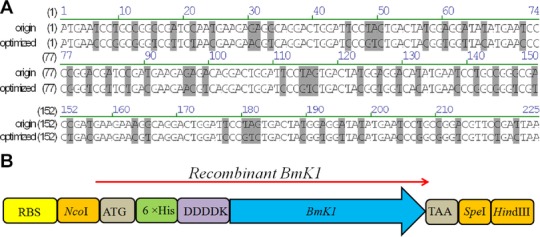
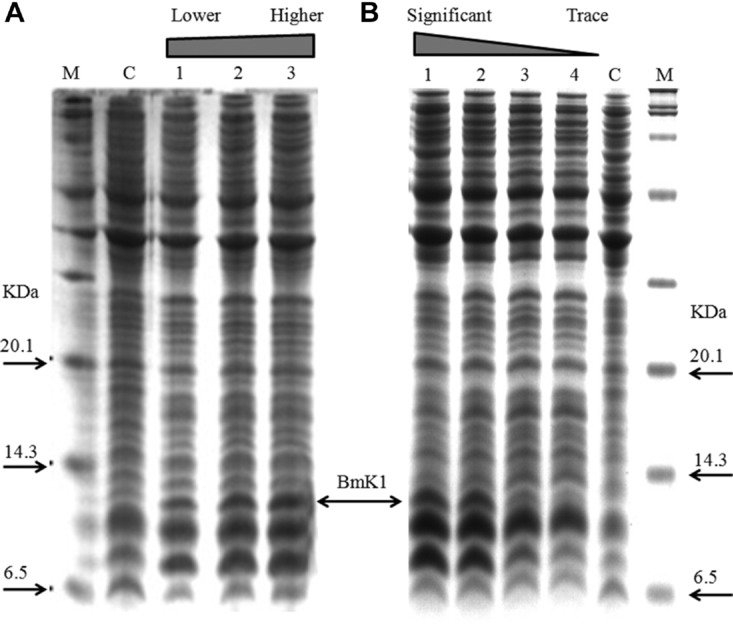
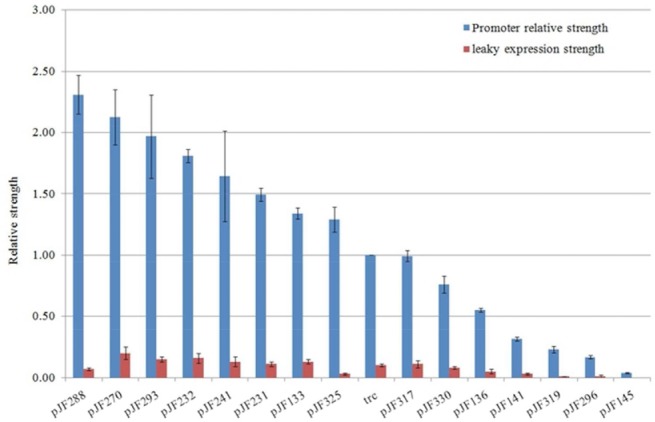
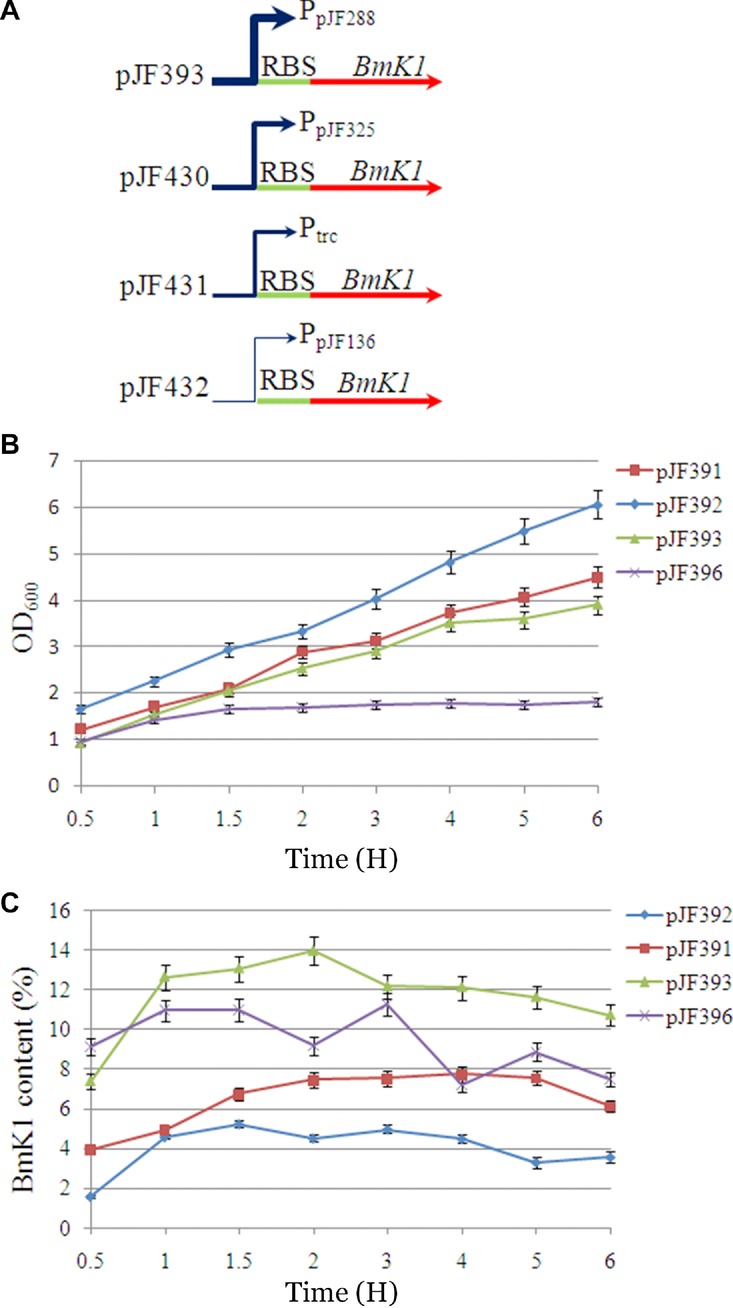
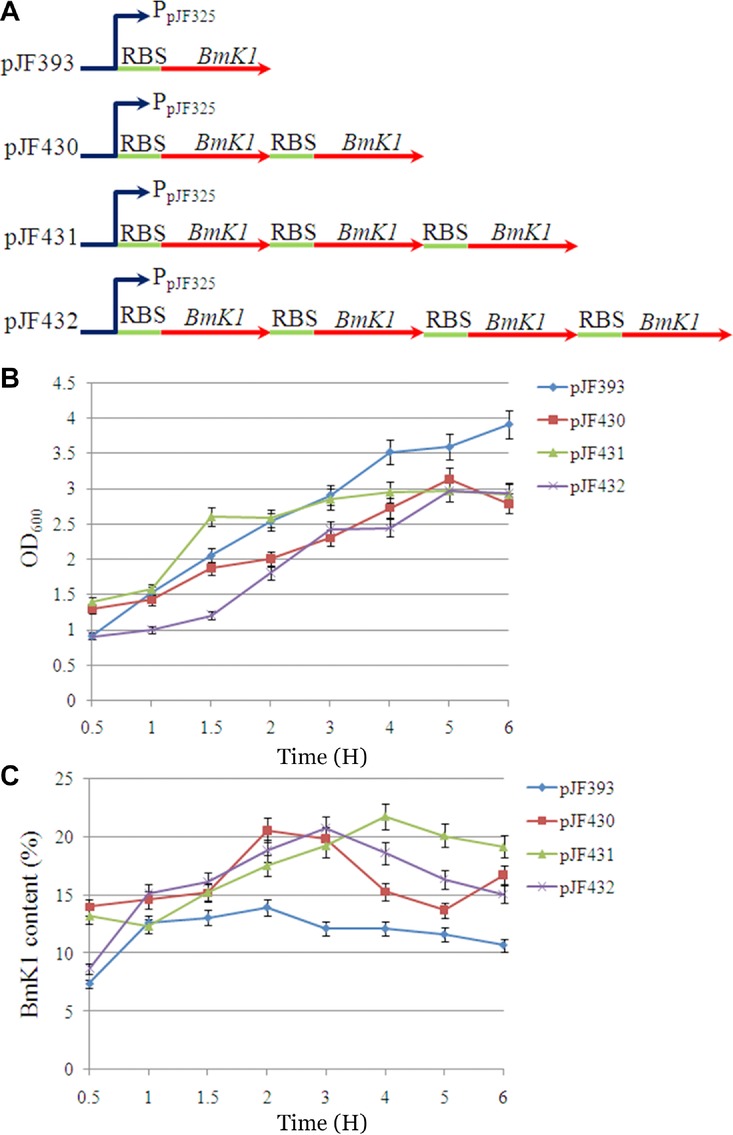
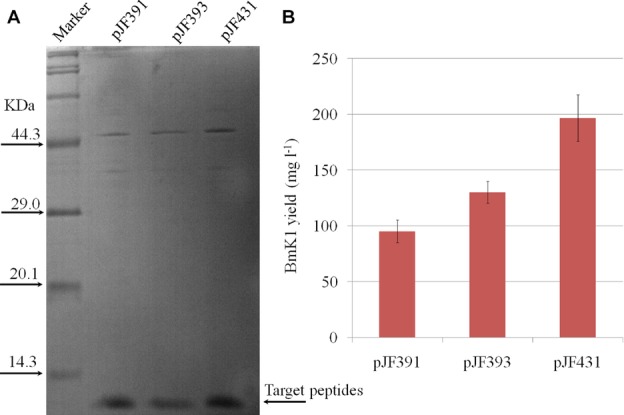
Heterologous expression is an efficient alternative to conventional extraction to produce a specific Buthus martensii Karsch (BmK) peptide. In this work, BmK1 was successfully expressed in Escherichia coli after genetic codon optimization, but BmK1 content was <6% of total cellular protein. To improve BmK1 expression, a trc promoter library with a wide relative strength was constructed, and three promoters, PpJF136 (0.55), PpJF325 (1.29), and PpJF288 (2.31), were selected to control BmK1 expression. A higher BmK1 expression (>13.9% of total protein) was obtained using a stronger promoter, PpJF325 . Furthermore, a maximum BmK1 content (>21.7% of total protein) was obtained by combining promoter PpJF325 and three copies of the BmK1 gene. The yield of the purified BmK1 achieved 196.74 mg L(-1) in E. coli BL21(DE3) pJF431, which was improved 2.09-fold compared with the control. This was the highest reported production of scorpion peptides in E. coli.
Keywords: BmK1; copy number; heterologous expression; promoter engineering; scorpion venom.
© 2013 The Authors. Biotechnology and Applied Biochemistry published by Wiley Periodicals, Inc. on behalf of the International Union of Biochemistry and Molecular Biology, Inc.
Figures
References
-
- Fan S, Sun Z, Jiang D, Dai C, Ma Y, Zhao Z, Liu H, Wu Y, Cao Z. Li W. Cancer Lett. 2010;291:158–166. - PubMed
-
- Fu YJ, An N, Chan KG, Wu YB, Zheng SH. Liang AH. Biotechnol. Lett. 2011;33:1309–1317. - PubMed
-
- Chen J, Tan ZY, Zhao R, Feng XH, Shi J. Ji YH. Neurosci. Lett. 2005;390:66–71. - PubMed
-
- Wang Y, Wang L, Cui Y, Song YB, Liu YF, Zhang R, Wu CF. Zhang JH. Biomed. Chromatogr. 2011;25:801–807. - PubMed
-
- Hao CJ, Xu CG, Wang W, Chai BF. Liang AH. Biotechnol. Lett. 2005;27:1929–1934. - PubMed
MeSH terms
Substances
LinkOut - more resources
Full Text Sources
Other Literature Sources
Miscellaneous
