. 2014 Mar;77(5):713-26.
doi: 10.1111/tpj.12420. Epub 2014 Feb 12.

p-Coumaroyl-CoA:monolignol transferase (PMT) acts specifically in the lignin biosynthetic pathway in Brachypodium distachyon

Affiliations
Free PMC article

p-Coumaroyl-CoA:monolignol transferase (PMT) acts specifically in the lignin biosynthetic pathway in Brachypodium distachyon

Deborah L Petrik et al. Plant J. 2014 Mar.
Free PMC article

Abstract

Grass lignins contain substantial amounts of p-coumarate (pCA) that acylate the side-chains of the phenylpropanoid polymer backbone. An acyltransferase, named p-coumaroyl-CoA:monolignol transferase (OsPMT), that could acylate monolignols with pCA in vitro was recently identified from rice. In planta, such monolignol-pCA conjugates become incorporated into lignin via oxidative radical coupling, thereby generating the observed pCA appendages; however p-coumarates also acylate arabinoxylans in grasses. To test the authenticity of PMT as a lignin biosynthetic pathway enzyme, we examined Brachypodium distachyon plants with altered BdPMT gene function. Using newly developed cell wall analytical methods, we determined that the transferase was involved specifically in monolignol acylation. A sodium azide-generated Bdpmt-1 missense mutant had no (<0.5%) residual pCA on lignin, and BdPMT RNAi plants had levels as low as 10% of wild-type, whereas the amounts of pCA acylating arabinosyl units on arabinoxylans in these PMT mutant plants remained unchanged. pCA acylation of lignin from BdPMT-overexpressing plants was found to be more than three-fold higher than that of wild-type, but again the level on arabinosyl units remained unchanged. Taken together, these data are consistent with a defined role for grass PMT genes in encoding BAHD (BEAT, AHCT, HCBT, and DAT) acyltransferases that specifically acylate monolignols with pCA and produce monolignol p-coumarate conjugates that are used for lignification in planta.

Keywords: BAHD acyltransferase; Brachypodium distachyon; DFRC method; NMR; biomass; grass; lignin; lignin acylation; thioacidolysis.


Figures

Figure 1
Figure 1
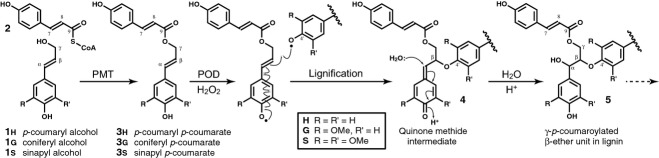
Pathway for the acylation of monolignols 1 by p-coumarate, via its CoA derivative 2, to form monolignol p-coumarate conjugates 3, and an example (using the favored β–O–4-coupling, following rearomatization of the quinone methide intermediate 4) of how the monolignol moiety undergoes radical coupling reactions during lignification resulting in lignin units such as 5 in which p-coumarate acylates the γ-position of lignin unit side-chains; monolignol p-coumarate conjugates 3 can also β–5-couple (with a G or H unit) or β–β-couple with a monolignol 1 or another monolignol p-coumarate 3. Further lignification via coupling with additional monomers can etherify the phenolic unit of 5, via either 5–β- (when the phenolic ring is H or G) or 4–O–β-coupling.
Figure 2
Figure 2
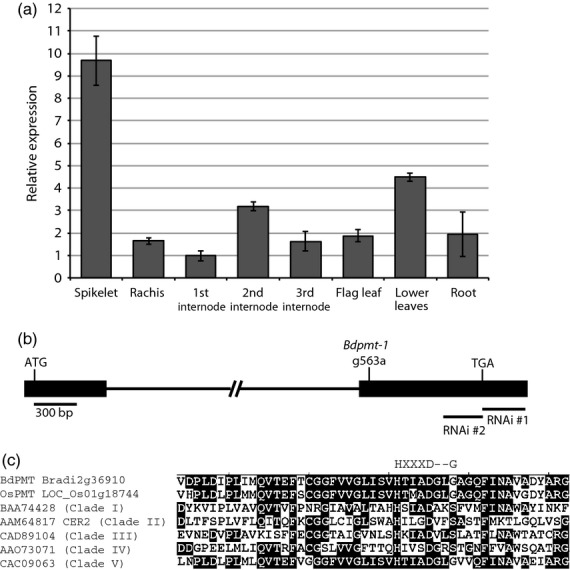
BdPMT expression levels, locations of mutations, and sequence homologies. (a) BdPMT transcript levels in WT Brachypodium tissues, as determined by qRT-PCR. Columns represent means (n = 3), bars, standard deviations. Means were normalized to the first internode mean transcript level value, which was set to one. (b) Diagram of the BdPMT gene Bradi2g36910 (drawn to scale; 300 bp scale bar). Solid rectangles represent the two exons, connected by a 4009 bp intron. Labeled are relative locations of translational start/stop codons, Bdpmt-1 transition mutation, and the RNAi constructs. (c) Alignment of BdPMT polypeptide sequences containing the HXXXD motif with sequences from BAHD acyltransferases representing each of the five clades as delineated by phylogenetic analysis (D'Auria, 2006). Consensus amino acids are boxed in black. The HXXXD motif is delineated along with the position of the G that was mutated in the Bdpmt-1 mutant allele. References for the acyltransferases (delineated by accession numbers) are in D'Auria (2006).
Figure 3
Figure 3
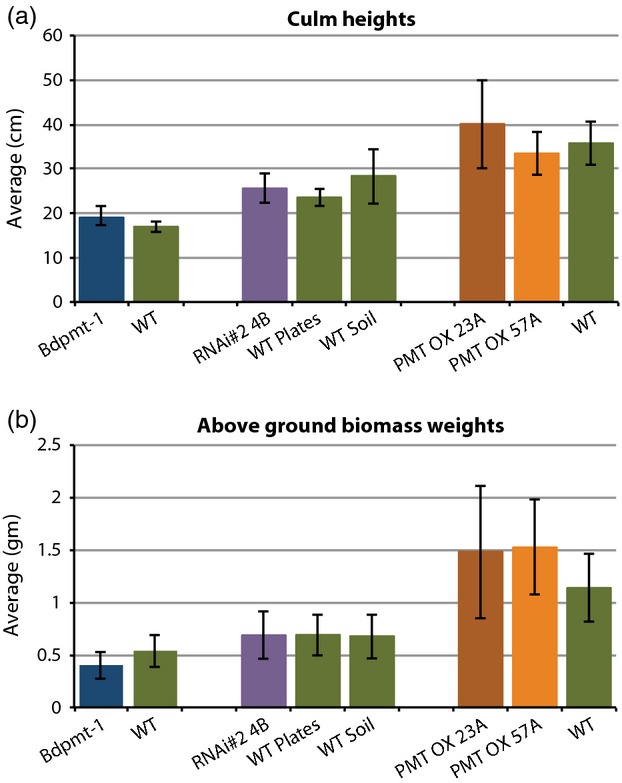
Comparisons of tallest culm heights (a) and total above-ground biomass weights (b) of senesced mutant and wild type (WT) plants grown under long days. Columns represent means ± standard deviations. Samples grouped together in the graphs represent plants grown side by side. Note that subtle growth chamber and/or epigenetic differences affect Brachypodium average plant growth, so only plants grown side by side and having similar seed histories should be compared with each other. 11 < n < 63.
Figure 4
Figure 4
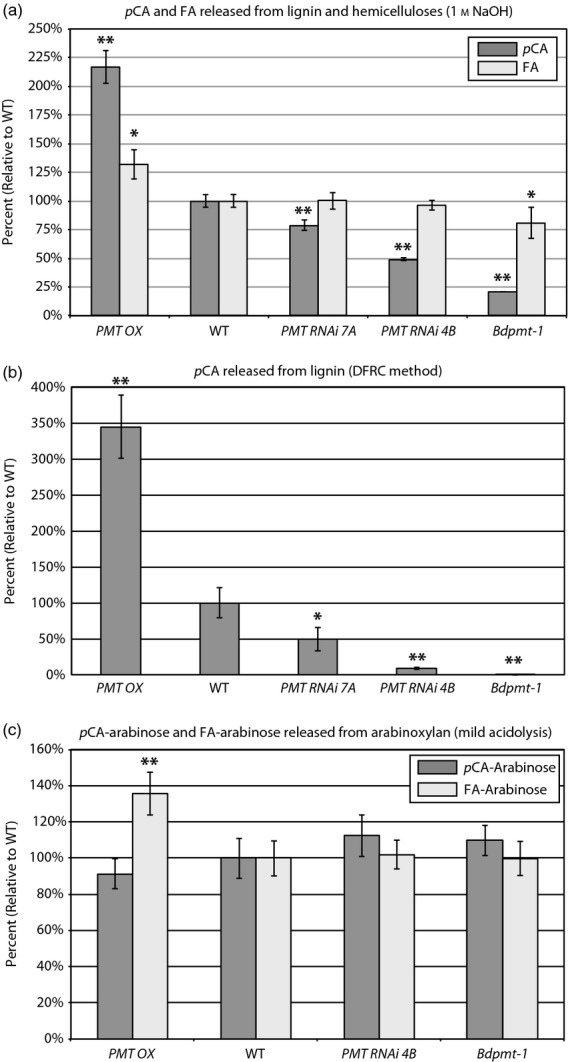
Graphs showing the amounts of pCA, FA, pCA-Arabinose, and FA-arabinose released from senesced stem biomass lignin and hemicelluloses (a), lignin only (b), or arabinoxylan only (c), using the treatments denoted in the graph titles. Columns represent mean percents relative to wild type (WT), with mean WT amounts normalized to 100%. Bars denote standard deviations. Asterisks denote statistically significant differences compared with WT plants that were grown alongside, as determined by Student's t-tests, where * represents P < 0.02 and ** represents P < 1 × 10−4. PMT OX denotes plants from transgenic BdPMT OX lines 23A, 57A, 64A, and 79A. See Tables S2 and S3 for actual values, n ≥ 3.
Figure 5
Figure 5
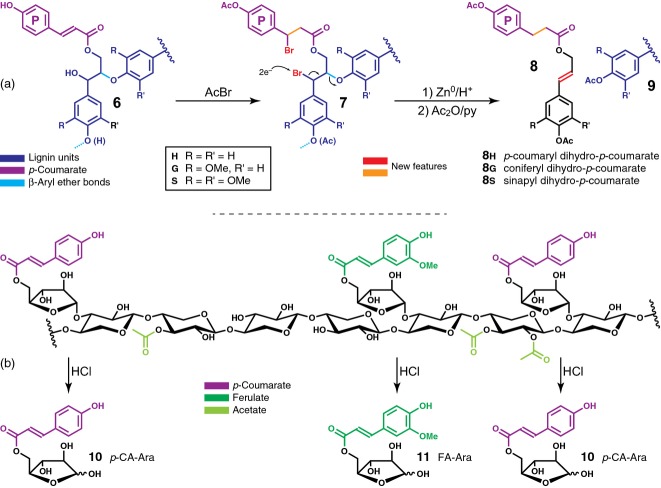
Schematic for analytical methods used to delineate between hydroxycinnamates, p-coumarate and ferulate, on lignin versus on polysaccharides. (a) The derivatization following by reductive cleavage (DFRC) method cleaves lignin ethers while leaving the γ-esters intact, releasing quantifiable, lignin-diagnostic acylated units, the monolignol dihydro-p-coumarate ester conjugates 8. (b) Mild hydrolysis cleaves arabinose units from arabinoxylans and, at least in large part, leaves esters intact, therefore releasing 5-O-p-coumaroyl arabinose 10 and 5-O-feruloyl arabinose 11. Free p-coumaric and ferulic acids are also released and detected/quantitated; the p-coumarate may derive from either its ester on lignin or arabinoxylan, but compounds 10 and 11 are specifically derived from acylated arabinoxylan.
Figure 6
Figure 6
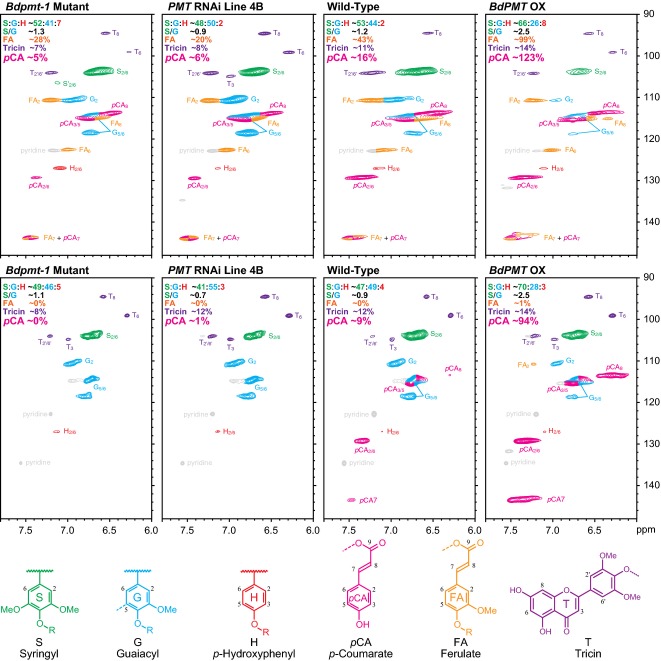
Solution-state HSQC NMR of ball-milled plant cell walls (top row) and cellulolytic enzyme lignin (CEL) treatment (bottom row) in DMSO-d6/pyridine-d5.From left to right are the Bdpmt-1 mutant, BdPMT downregulated line 4B (PMT RNAi line 4B), wild-type and BdPMT overexpressed (BdPMT OX). Sample peaks have been color-coded according to the lignin substructures below the plots. The percentages and ratios reported for each spectrum are integrals relative to total H+G+S aromatic units.
Figure 7
Figure 7
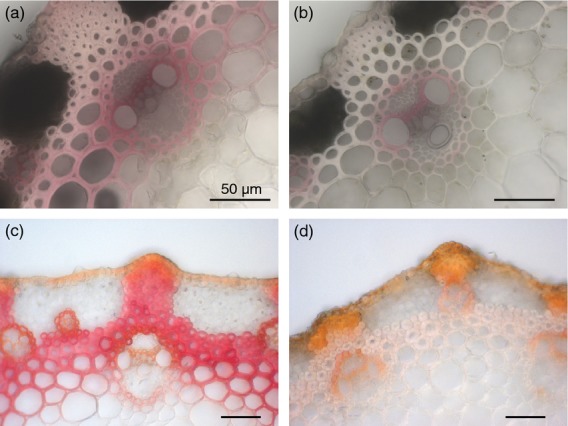
Stem section staining to visualize lignin levels and/or composition. BdPMT OX stem sections (b,d) have considerably lighter phloroglucinol (a,b) and Mäule Reagent (c,d) staining compared with wild type (WT) (a,c), which is consistent with relatively less cell wall lignin. Scale bars represent 50 μm.
Figure 8
Figure 8
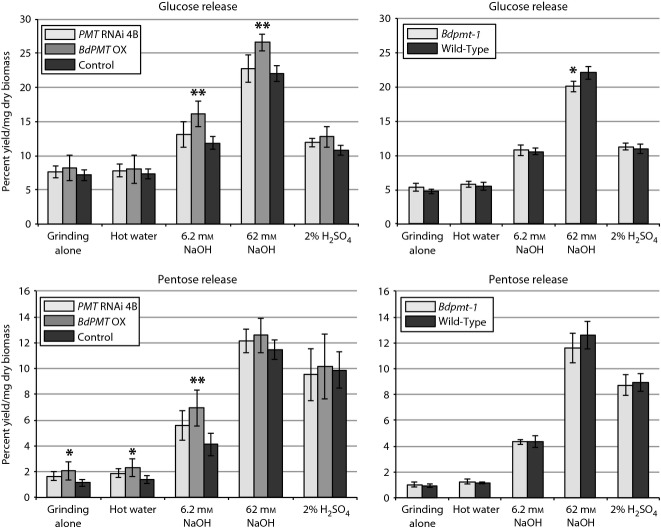
Digestibility of stem biomass, comparing BdPMT OX and BdPMT RNAi line 4B to transgenic control plants (UBIprom:GUS), and Bdpmt-1 to wild-type.The average amounts of glucose (top two charts; non-cell wall glucose subtracted from totals) and pentose sugars (bottom two charts) released per mg of senesced ground biomass using the various pretreatments along with enzyme hydrolysis are shown. Vertical bars represent standard deviations. Asterisks represent Student's t-test (*P < 0.03; **P < 0.005). n = five biological replicates and three technical replicates.

References

    1. Bartley LE, Peck ML, Kim SR, et al. Overexpression of a BAHD acyltransferase, OsAt10, alters rice cell wall hydroxycinnamic acid content and saccharification. Plant Physiol. 2013;161:1615–1633. - PMC - PubMed
    1. Bayer A, Ma XY, Stockigt J. Acetyltransfer in natural product biosynthesis - functional cloning and molecular analysis of vinorine synthase. Bioorg. Med. Chem. 2004;12:2787–2795. - PubMed
    1. Berthet S, Demont-Caulet N, Pollet B, et al. Disruption of LACCASE4 and 17 results in tissue-specific alterations to lignification of Arabidopsis thaliana stems. Plant Cell. 2011;23:1124–1137. - PMC - PubMed
    1. Betts MJ, Russell RB. Amino acid properties and consequences of substitutions. In: Barnes MR, Gray IC, editors. Bioinformatics for Geneticists. Chichester, UK: John Wiley and Sons; 2003. pp. 289–316.
    1. Boerjan W, Ralph J, Baucher M. Lignin biosynthesis. Ann. Rev. Plant Biol. 2003;54:519–549. - PubMed

Publication types

MeSH terms