


Serum adipokine concentrations in dogs with naturally occurring pituitary-dependent hyperadrenocorticism
- PMID: 24372863
- PMCID: PMC4857983
- DOI: 10.1111/jvim.12270
Serum adipokine concentrations in dogs with naturally occurring pituitary-dependent hyperadrenocorticism
Abstract
Background: An excess of intra-abdominal fat is observed frequently in dogs with hyperadrenocorticism (HAC). Adipokine dysregulation is a possible cause of complications related to visceral obesity, but little information is available on adipokine in dogs with naturally occurring HAC.
Objectives: To examine the differences in the circulating adipokines concentrations in overweight dogs with and without pituitary-dependent HAC (PDH).
Animals: Thirty healthy dogs and 15 client-owned dogs with PDH.
Methods: Case-controlled observational study, which enrolled 15 overweight dogs diagnosed with PDH and 30 otherwise healthy dogs of similar body condition score. Nine of 15 dogs with PDH were treated with low-dose trilostane twice daily and reassessed after treatment.
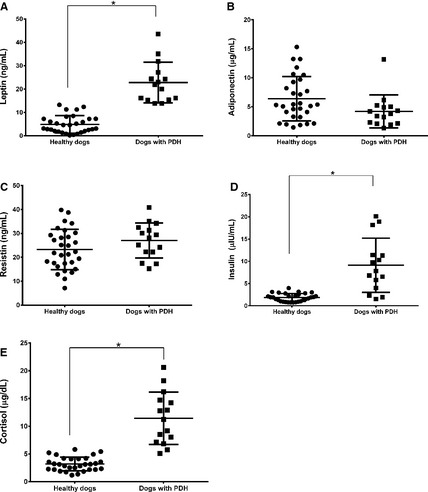
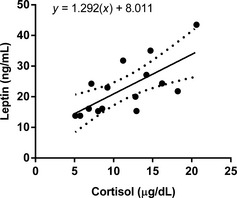
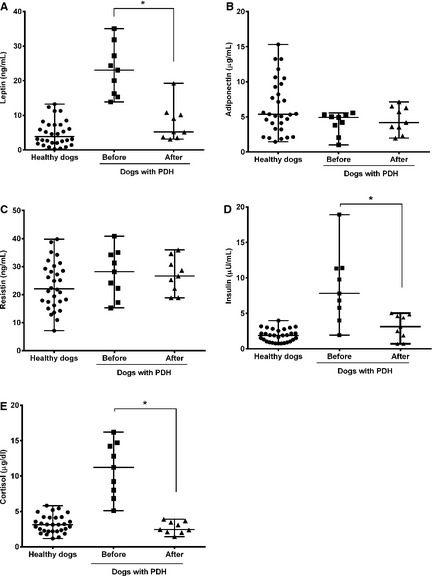
Results: The serum leptin (P < .0001) and insulin (P < .0001) concentrations were significantly higher in the PDH group (leptin, 22.8 ± 8.8 [mean ± SD]; insulin, 9.1 ± 6.1) than the healthy group (leptin, 4.9 ± 3.7; insulin, 1.9 ± 0.9). However, there were no significant differences in the adiponectin, resistin, tumor necrosis factor (TNF)-α, interleukin (IL)-1β, IL-6, IL-10, and IL-18 levels between the 2 groups. In the PDH group, the serum cortisol concentrations had a linear association with the leptin concentrations, and there were significant decreases in the leptin (P = .0039) and insulin (P = .0039) levels after trilostane treatment. However, the leptin and insulin levels remained higher after trilostane treatment than in healthy control dogs with similar body condition score.
Conclusions and clinical importance: Hypercortisolemia in dogs with PDH might upregulate the circulating leptin levels. However, a large population-based study will be necessary to determine whether the upregulation of leptin is involved directly with the complications caused by HAC.
Keywords: Adiponectin; Canine; Cortisol; Cushing's disease; Leptin.
Copyright © 2013 by the American College of Veterinary Internal Medicine.
Figures
References
-
- Feldman EC. Distinguishing dogs with functioning adrenocortical tumors from dogs with pituitary‐dependent hyperadrenocorticism. J Am Vet Med Assoc 1983;183:195–200. - PubMed
-
- Reusch CE, Feldman EC. Canine hyperadrenocorticism due to adrenocortical neoplasia. Pretreatment evaluation of 41 dogs. J Vet Intern Med 1991;5:3–10. - PubMed
-
- Guptill L, Scott‐Moncrieff JC, Widmer WR. Diagnosis of canine hyperadrenocorticism. Vet Clin North Am Small Anim Pract 1997;27:215–235. - PubMed
-
- Feldman EC, Nelson RW, Feldman MS. Use of low‐ and high‐dose dexamethasone tests for distinguishing pituitary‐dependent from adrenal tumor hyperadrenocorticism in dogs. J Am Vet Med Assoc 1996;209:772–775. - PubMed
Publication types
MeSH terms
Substances
LinkOut - more resources
Full Text Sources
Other Literature Sources
Miscellaneous
