


Synthesis of new potent agonistic analogs of growth hormone-releasing hormone (GHRH) and evaluation of their endocrine and cardiac activities
- PMID: 24373935
- PMCID: PMC4745889
- DOI: 10.1016/j.peptides.2013.12.010
Synthesis of new potent agonistic analogs of growth hormone-releasing hormone (GHRH) and evaluation of their endocrine and cardiac activities
Abstract
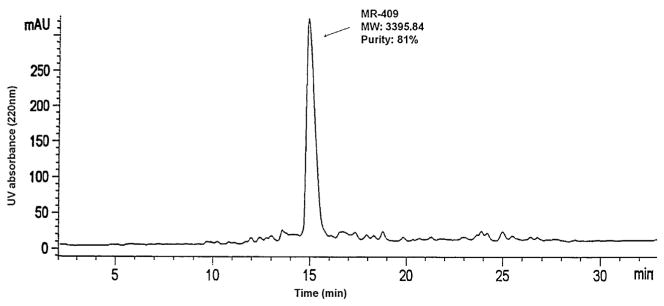
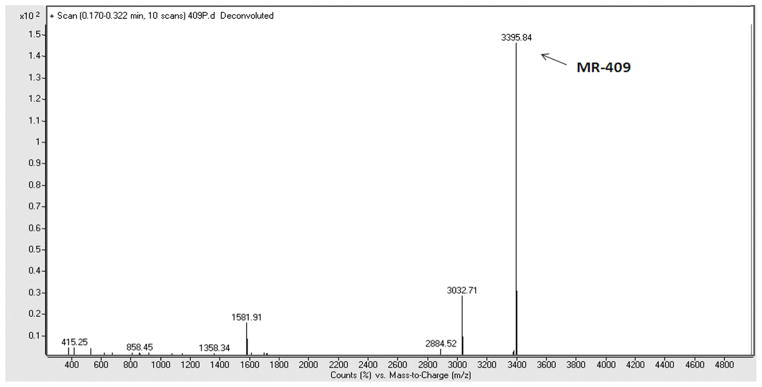
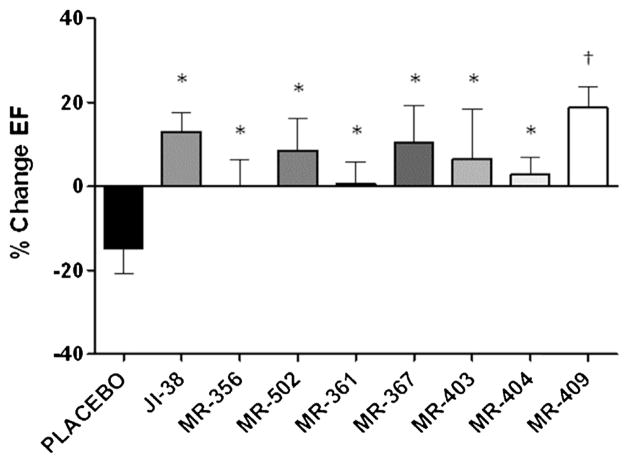
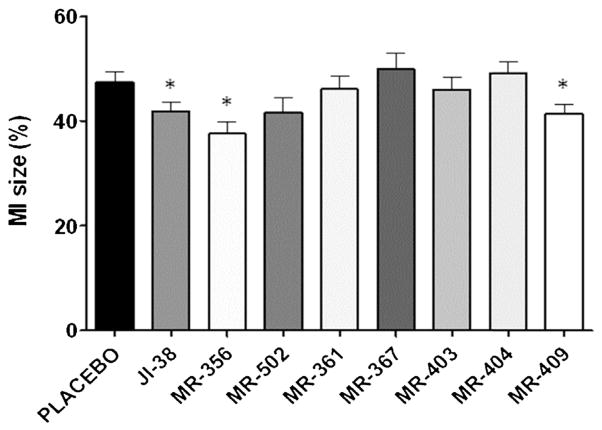
In view of the recent findings of stimulatory effects of GHRH analogs, JI-34, JI-36 and JI-38, on cardiomyocytes, pancreatic islets and wound healing, three series of new analogs of GHRH(1-29) have been synthesized and evaluated biologically in an endeavor to produce more potent compounds. "Agmatine analogs", MR-356 (N-Me-Tyr(1)-JI-38), MR-361(N-Me-Tyr(1), D-Ala(2)-JI-38) and MR-367(N-Me-Tyr(1), D-Ala(2), Asn(8)-JI-38), in which Dat in JI-38 is replaced by N-Me-Tyr(1), showed improved relative potencies on GH release upon subcutaneous administration in vivo and binding in vitro. Modification with N-Me-Tyr(1) and Arg(29)-NHCH3 as in MR-403 (N-Me-Tyr(1), D-Ala(2), Arg(29)-NHCH3-JI-38), MR-406 (N-Me-Tyr(1), Arg(29)-NHCH3-JI-38) and MR-409 (N-Me-Tyr(1), D-Ala(2), Asn(8), Arg(29)-NHCH3-JI-38), and MR-410 (N-Me-Tyr(1), D-Ala(2), Thr(8), Arg(29)-NHCH3-JI-38) resulted in dramatically increased endocrine activities. These appear to be the most potent GHRH agonistic analogs so far developed. Analogs with Apa(30)-NH2 such as MR-326 (N-Me-Tyr(1), D-Ala(2), Arg(29), Apa(30)-NH2-JI-38), and with Gab(30)-NH2, as MR-502 (D-Ala(2), 5F-Phe(6), Ser(28), Arg(29),Gab(30)-NH2-JI-38) also exhibited much higher potency than JI-38 upon i.v. administration. The relationship between the GH-releasing potency and the analog structure is discussed. Fourteen GHRH agonists with the highest endocrine potencies were subjected to cardiologic tests. MR-409 and MR-356 exhibited higher potency than JI-38 in activating myocardial repair in rats with induced myocardial infarction. As the previous class of analogs, exemplified by JI-38, had shown promising results in multiple fields including cardiology, diabetes and wound healing, our new, more potent, GHRH agonists should manifest additional efficacy for possible medical applications.
Keywords: Cardioprotection; hGHRH agonist; hGHRH(1–29); s.c. administration.
Published by Elsevier Inc.
Conflict of interest statement
Norman L. Block and Joshua M. Hare are members of the Board of Directors of the biotechnology company, Biscayne Pharmaceuticals. Renzhi Cai, Andrew V. Schally, and Marta Zarandi are listed as coinventors in the patent on GHRH agonists, assigned to the University of Miami and VA. Other authors declare no conflict of interest.
Figures
References
-
- Barron JL, Coy DH, Millar RP. Growth hormone responses to growth hormone-releasing hormone (1–29)-NH2 and a D-Ala2 analog in normal men. Peptides. 1985;6:575–7. - PubMed
-
- Böhlen P, Esch F, Brazeau P, Ling N, Guillemin R. Isolation and characterization of the porcine hypothalamic growth hormone releasing factor. Biochem Biophys Res Commun. 1983;116:726–34. - PubMed
-
- Böhlen P, Wehrenberg WB, Esch F, Ling N, Brazeau P, Guillemin R. Rat hypothal-amic growth hormone-releasing factor: isolation, sequence analysis and total synthesis. Biochem Biophys Res Commun. 1984;125:1005–12. - PubMed
-
- Boulanger L, Lazure C, Lefrançois L, Gaudreau P. Proteolytic degradation of rat growth hormone-releasing factor(1–29) amide in rat pituitary and hypothalamus. Brain Res. 1993;616:39–47. - PubMed
-
- Brazeau P, Böhlen P, Esch F, Ling N, Wehrenberg WB, Guillemin R. Growth hormone-releasing factor from ovine and caprine hypothalamus: isolation, sequence analysis and total synthesis. Biochem Biophys Res Commun. 1984;125:606–14. - PubMed
Publication types
MeSH terms
Substances
Grants and funding
LinkOut - more resources
Full Text Sources
Other Literature Sources
Molecular Biology Databases
Research Materials
