Review
. 2014 Feb:102:106-18.
doi: 10.1016/j.antiviral.2013.12.005. Epub 2013 Dec 25.

Antiviral strategies for hepatitis E virus

Affiliations
Review

Antiviral strategies for hepatitis E virus

Yannick Debing et al. Antiviral Res. 2014 Feb.

Abstract

The hepatitis E virus is a common cause of acute hepatitis. Contrary to hepatitis B and C, hepatitis E is mostly a mild infection, although it has a high mortality in pregnant women and can evolve to chronicity in immunocompromised patients. Ribavirin and pegylated interferon-α are the only available therapies, but both have side effects that are not acceptable for prophylaxis or treatment of mild infections. In addition, these drugs cannot be used for all patient types (e.g. in case of pregnancy, specific organ transplants or co-morbidities) and in resource-poor settings. Hence there is an urgent need for better antiviral treatments that are efficacious and safe, also during pregnancy. In this review, a concise introduction to the virus and disease is provided, followed by a discussion of the available assay systems and potential molecular targets (viral proteins and host factors) for the development of inhibitors of HEV replication. Finally, directions for future research are presented.

Keywords: Antiviral therapy; Hepatitis E virus; Host factor; Inhibitor; Interferon; Ribavirin.


Figures

Fig. 1
Fig. 1
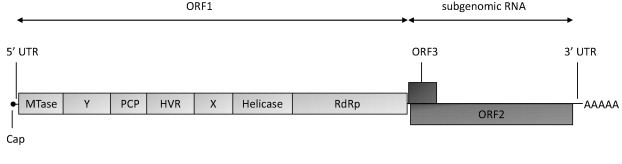
Organization of the HEV genome. Non-structural proteins are translated from ORF1 while the ORF2 and ORF3 structural proteins are translated from a single subgenomic RNA. UTR, untranslated region; Y, Y-domain; PCP, papain-like cysteine protease; HVR, hypervariable region; X, macro domain; RdRp, RNA-dependent RNA polymerase.
Fig. 2
Fig. 2
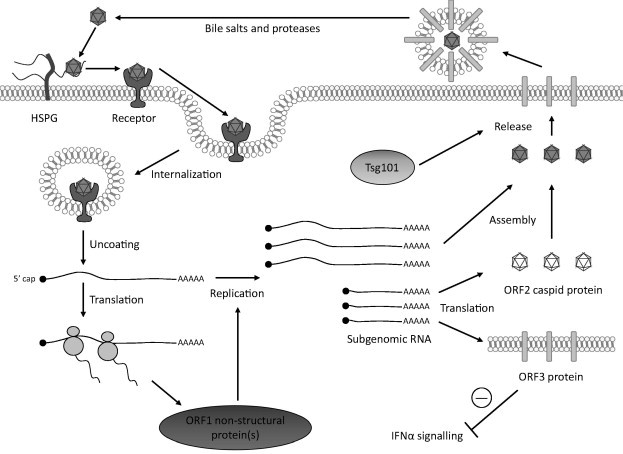
HEV replication cycle. HEV particles first bind to heparan sulphate proteoglycans (HSPG) and are consequently transferred to an unknown functional receptor, thus mediating cellular uptake through clathrin-mediated endocytosis. Following uncoating, the viral RNA genome is released into the cytoplasm and translated into non-structural proteins. These proteins form a replication complex that produces new full-length and subgenomic viral RNA. The latter is translated into capsid protein (ORF2) and the membrane associated ORF3 protein that is known to interfere with interferon-α signaling. Viral RNA is packaged into capsid protein and released from the cell with help of the host factor Tumor susceptibility gene 101 (Tsg101). The released particles are associated with lipids and ORF3 proteins; both are consequently removed through the bile acids and digestive proteases respectively.
Fig. 3
Fig. 3
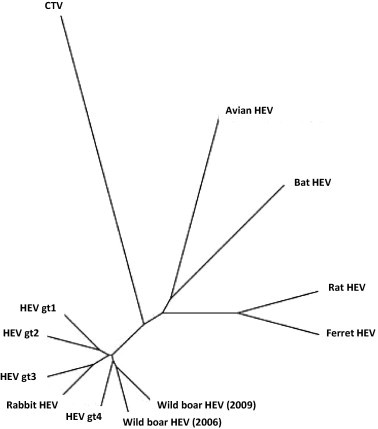
HEV species and genotypes. The phylogenetic relationship of different human HEV genotypes and the reported animal strains was plotted with the Virus Pathogen Database and Analysis Resource (ViPR, Pickett et al., 2012) based on following sequences: HEV gt1 (GenBank accession No. M80581), HEV gt2 (M74506), HEV gt3 (HQ389543), rabbit HEV (FJ906895), HEV gt4 (AB220973), wild boar HEV 2006 (AB602441), wild boar HEV 2009 (AB573435), ferret HEV (JN998606), rat HEV (GU345043), bat HEV (JQ001749), avian HEV (AY535004), CTV (HQ731075). CTV, cutthroat trout virus; gt, genotype.
Fig. 4
Fig. 4
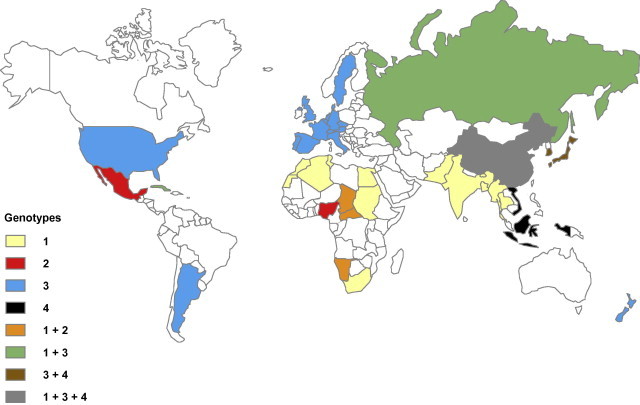
Geographic distribution of HEV genotypes 1–4. Countries with confirmed human infections are color-coded according to the detected genotype. This is probably an incomplete picture as there are no data available for many countries and genotyping is not always performed and/or reported.

References

    1. Adedeji A.O., Singh K., Calcaterra N.E., DeDiego M.L., Enjuanes L., Weiss S., Sarafianos S.G. Severe acute respiratory syndrome coronavirus replication inhibitor that interferes with the nucleic acid unwinding of the viral helicase. Antimicrob. Agents Chemother. 2012;56:4718–4728. - PMC - PubMed
    1. Agrawal S., Gupta D., Panda S.K. The 3′ end of hepatitis E virus (HEV) genome binds specifically to the viral RNA-dependent RNA polymerase (RdRp) Virology. 2001;282:87–101. - PubMed
    1. Ahmed J.A., Moturi E., Spiegel P., Schilperoord M., Burton W., Kassim N.H., Mohamed A., Ochieng M., Nderitu L., Navarro-Colorado C., Burke H., Cookson S., Handzel T., Waiboci L.W., Montgomery J.M., Teshale E., Marano N. Hepatitis E outbreak, Dadaab refugee camp, Kenya, 2012. Emerg. Infect. Dis. 2013;19:1010–1012. - PMC - PubMed
    1. Ali M.M., Karasneh G.A., Jarding M.J., Tiwari V., Shukla D. A 3-O-sulfated heparan sulfate binding peptide preferentially targets herpes simplex virus 2-infected cells. J. Virol. 2012;86:6434–6443. - PMC - PubMed
    1. Alric L., Bonnet D., Laurent G., Kamar N., Izopet J. Chronic hepatitis E virus infection: successful virologic response to pegylated interferon-alpha therapy. Ann. Intern. Med. 2010;153:135–136. - PubMed

Publication types

MeSH terms