. 2014 Mar;22(3):668-674.
doi: 10.1038/mt.2013.284. Epub 2013 Dec 30.

Clinical assessment of a novel recombinant simian adenovirus ChAdOx1 as a vectored vaccine expressing conserved Influenza A antigens

Affiliations

Clinical assessment of a novel recombinant simian adenovirus ChAdOx1 as a vectored vaccine expressing conserved Influenza A antigens

Richard D Antrobus et al. Mol Ther. 2014 Mar.

Abstract

Adenoviruses are potent vectors for inducing and boosting cellular immunity to encoded recombinant antigens. However, the widespread seroprevalence of neutralizing antibodies to common human adenovirus serotypes limits their use. Simian adenoviruses do not suffer from the same drawbacks. We have constructed a replication-deficient chimpanzee adenovirus-vectored vaccine expressing the conserved influenza antigens, nucleoprotein (NP), and matrix protein 1 (M1). Here, we report safety and T-cell immunogenicity following vaccination with this novel recombinant simian adenovirus, ChAdOx1 NP+M1, in a first in human dose-escalation study using a 3+3 study design, followed by boosting with modified vaccinia virus Ankara expressing the same antigens in some volunteers. We demonstrate ChAdOx1 NP+M1 to be safe and immunogenic. ChAdOx1 is a promising vaccine vector that could be used to deliver vaccine antigens where strong cellular immune responses are required for protection.


Figures
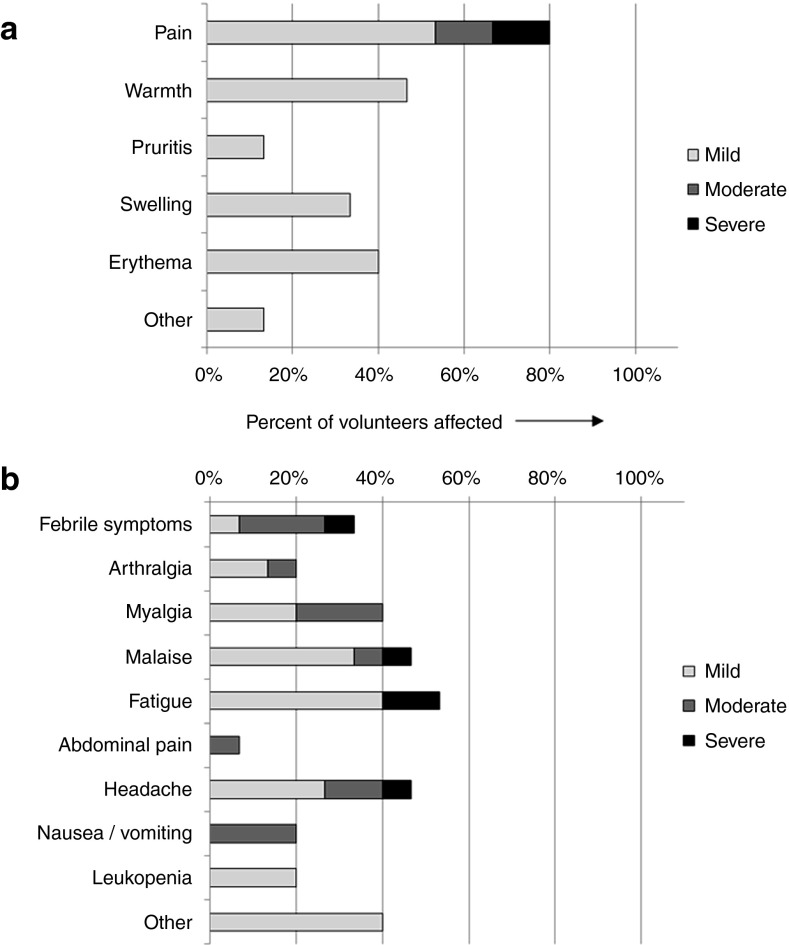
Figure 1
Figure 1
Safety data for ChAdOx1 NP+M1: the frequency of adverse reactions following vaccination with ChAdOx1 NP+M1 is shown, with severity indicated by shading. (a) Local adverse reactions and (b) systemic adverse reactions. Data represent adverse reactions from all 15 volunteers across all four doses. A breakdown of adverse reactions by dose is provided in the supplementary information. M1, matrix protein 1; NP, nucleoprotein.
Figure 2
Figure 2
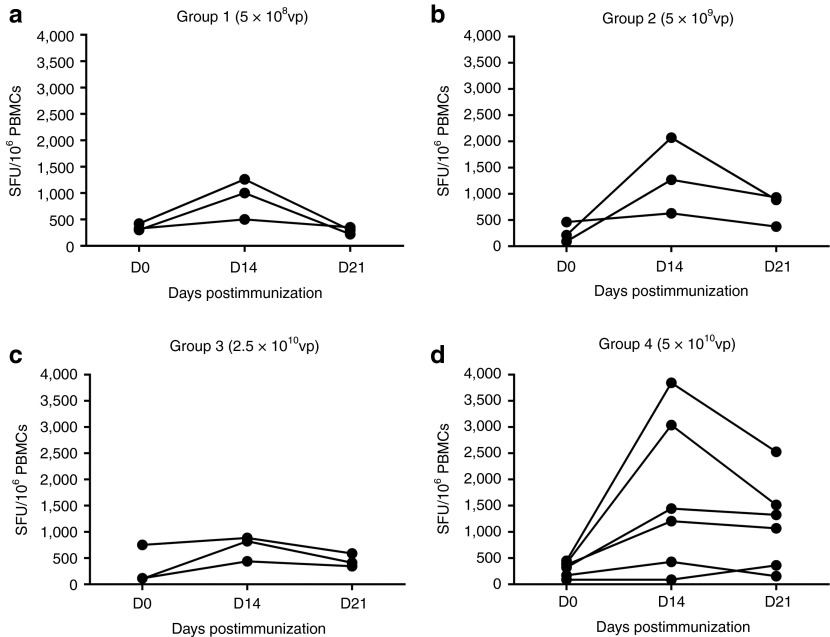
Ex vivo interferon-γ (IFN-γ) enzyme-linked immunospot (ELISpot) responses to influenza vaccine antigen NP+M1 following vaccination with increasing doses of ChAdOx1 NP+M1. Individual ex vivo IFN-γ ELISpot responses from vaccinated volunteers at baseline day (D) 0, D14, and D21. Volunteers were vaccinated with a single dose of ChAdOx1 NP+M1 intramuscularly at a dose of (a) 5 × 108, (b) 5 × 109, (c) 2.5 × 1010, or (d) 5 × 1010 viral particles (vp). Controls included cells stimulated with PHA/SEB, PPD, or irrelevant peptide TRAP33 (data not shown). Negative control was cells stimulated with media alone (data not shown). M1, matrix protein 1; NP, nucleoprotein; PBMC, peripheral blood mononuclear cell; PHA, phytohaemagglutinin; PPD, tuberculin purified protein derivative; SEB, staphylococcal enterotoxin B; SFU, spot forming unit.
Figure 3
Figure 3
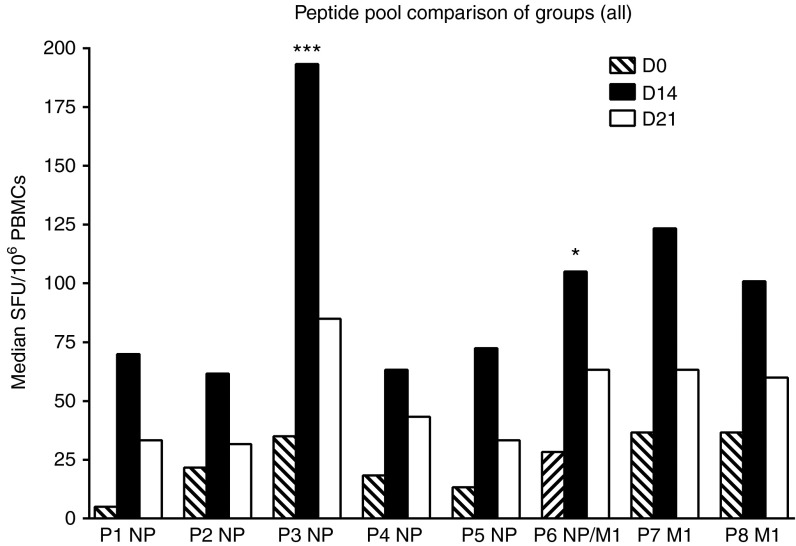
Breadth of ex vivo interferon-γ (IFN-γ) enzyme-linked immunospot (ELISpot) responses to NP+M1 peptide pools following vaccination with ChAdOx1NP+M1. Median and ex vivo IFN-γ ELISpot responses from all vaccinated volunteers at day (D) 0, D14, and D21. P1–8 indicate NP+M1 peptide pools 1–8, composed of 10 peptides per pool. M1, matrix protein 1; NP, nucleoprotein.
Figure 4
Figure 4
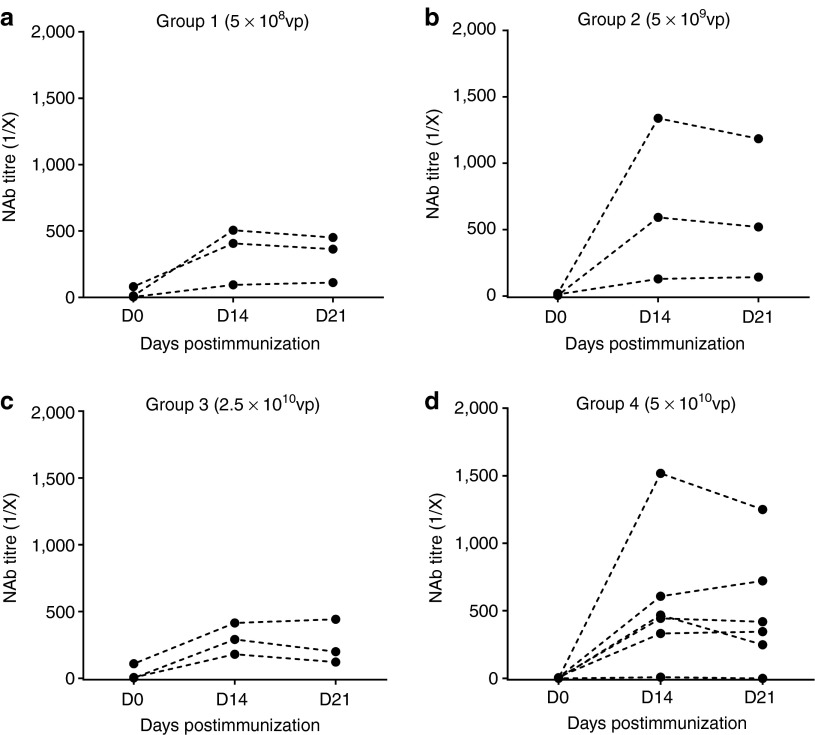
Neutralizing antibody (NAb) responses to adenoviral vectors in ChAdOx1 NP+M1 vaccinated cohorts. NAb titers in volunteer sera against ChAdOx1 NP+M1 (ad) were determined pre- and postvaccination (day (D) 0, D14, and D21) for each group in the dose-escalation vaccination study. NAb titers were expressed as the reciprocal of the serum dilution required to reduce secreted alkaline phosphatase expression by 50% 24 hours posttransduction. 1/X, 1/dilution; M1, matrix protein 1; NP, nucleoprotein.
Figure 5
Figure 5
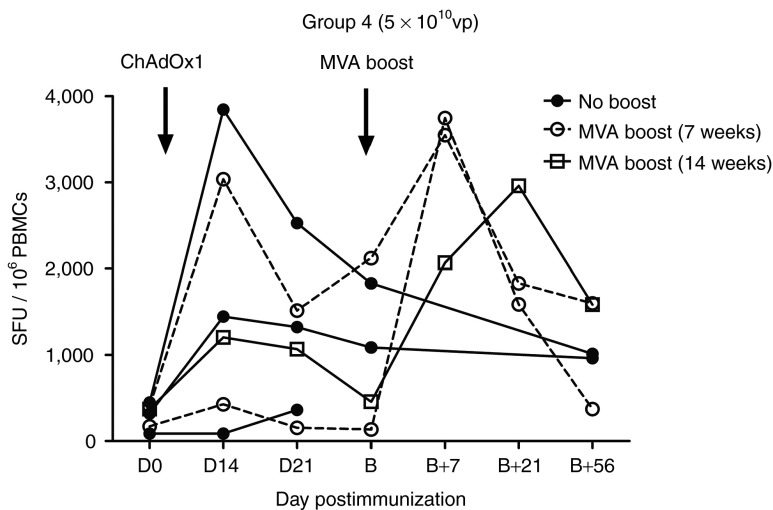
Median ex vivo interferon-γ (IFN-γ) enzyme-linked immunospot (ELISpot) responses to influenza vaccine antigen NP+M1 in a ChAdOx1 NPM1 prime, MVA-NP+M1 boost regime. Individual ex vivo summed IFN-γ ELISpot responses to NP+M1 at baseline day (D) 0, D14, and D21 in vaccinated volunteers receiving a single dose of 5 × 1010 viral particles (vp) of ChAdOx1 NP+M1. Arrows indicate the time points for prime (D0) and MVA-NP+M1 boost (B) vaccinations. Three volunteers were boosted by intramuscular injection of 1.5 × 108 PFUs MVA-NP+M1 at 7 or 14 weeks (B) post-ChAdOx1 NP+M1 prime and followed up on D7, D21, and D56 post-boost (B+7, B+21, and B+56). Two volunteers who did not receive the MVA-NP+M1 boost were followed at B and B+56 time points. Vector names are abbreviated to ChAdOx1 and MVA on the graph. M1, matrix protein 1; MVA, modified vaccinia virus Ankara; NP, nucleoprotein.

References

    1. Molinari NA, Ortega-Sanchez IR, Messonnier ML, Thompson WW, Wortley PM, Weintraub E, et al. The annual impact of seasonal influenza in the US: measuring disease burden and costs. Vaccine. 2007;25:5086–5096. - PubMed
    1. Lambert LC, Fauci AS. Influenza vaccines for the future. N Engl J Med. 2010;363:2036–2044. - PubMed
    1. Jefferson T, Di Pietrantonj C, Al-Ansary LA, Ferroni E, Thorning S, Thomas RE. Vaccines for preventing influenza in the elderly. Cochrane Database Syst Rev. 2010. p. CD004876. - PubMed
    1. Jefferson T, Rivetti A, Harnden A, Di Pietrantonj C, Demicheli V. Vaccines for preventing influenza in healthy children. Cochrane Database Syst Rev. 2008. p. CD004879. - PubMed
    1. Lambe T, Carey JB, Li Y, Spencer AJ, van Laarhoven A, Mullarkey CE, et al. Immunity against heterosubtypic influenza virus induced by adenovirus and MVA expressing nucleoprotein and matrix protein-1. Sci Rep. 2013;3:1443. - PMC - PubMed

Publication types

MeSH terms