


Cigarette smokers' use of unconventional tobacco products and associations with quitting activity: findings from the ITC-4 U.S. cohort
- PMID: 24376276
- PMCID: PMC4015089
- DOI: 10.1093/ntr/ntt212
Cigarette smokers' use of unconventional tobacco products and associations with quitting activity: findings from the ITC-4 U.S. cohort
Abstract
Introduction: The purpose of this study was to evaluate the prevalence and correlates of use of nicotine-containing tobacco products such as cigars, pipe tobacco, and cigarettes that promise less exposure to toxins; e-cigarettes; and smokeless tobacco products among a cohort of conventional cigarette smokers followed over the past decade. We also evaluated associations between use of such products and cigarette quitting.
Methods: Participants were 6,110 adult smokers in the United States, who were interviewed as part of the International Tobacco Control Four Country Survey between 2002 and 2011. Respondents reported their concurrent use of other smoked tobacco products (including cigars, pipe tobacco, and cigarillos), smokeless tobacco products (including chewing tobacco, snus, and snuff), unconventional cigarettes (including Omni, Accord, and Eclipse), and electronic cigarettes. Prevalence and correlates of use and associations between use and cigarette quitting were assessed using regression analyses via generalized estimating equations.
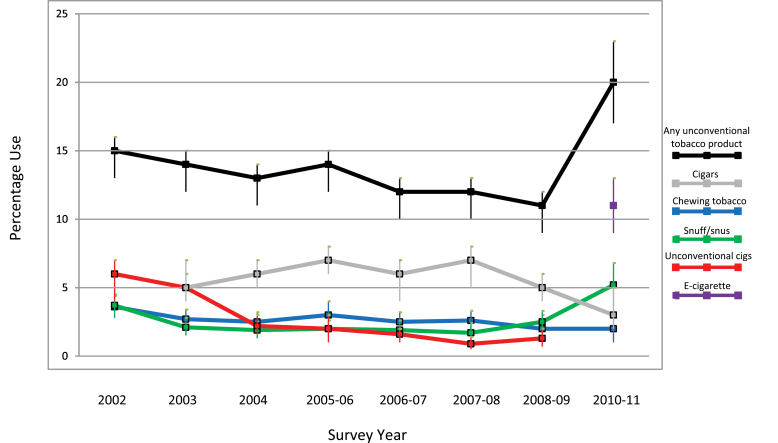
Results: Most cigarette smokers did not use unconventional tobacco products, although use of any of these products started to rise at the end of the study period (2011). For each type of tobacco product evaluated, use was most prevalent among those aged 18-24 years. Smokers who did use unconventional tobacco products did not experience a clear cessation advantage.
Conclusions: During the past decade, relatively few cigarette smokers reported also using other tobacco products. Those that did use such products were no more likely to stop using conventional cigarettes compared with those who did not use such products.
Figures
References
-
- Bombard J. M., Pederson L. L., Nelson D. E., Malarcher A. M. (2007). Are smokers only using cigarettes? Exploring current polytobacco use among an adult population. Addictive Behaviors, 32, 2411–2419. 10.1016/j.addbeh.2007.04.001 - PubMed
-
- Bombard J. M., Rock V. J., Pederson L. L., Asman K. J. (2008). Monitoring polytobacco use among adolescents: Do cigarette smokers use other forms of tobacco? Nicotine & Tobacco Research, 10, 1581–1589. 10.1080/14622200802412887 - PubMed
-
- Cooper J., Borland R., Yong H. -H., McNeill A., Murray R. L., O’Connor R. J., Cummings K. M. (2010). To what extent do smokers make spontaneous quit attempts and what are the implications for smoking cessation maintenance? Findings from the International Tobacco Control Four country survey. Nicotine & Tobacco Research, 12(Suppl. 1), S51–S57. 10.1093/ntr/ntq052 - PMC - PubMed
Publication types
MeSH terms
Grants and funding
LinkOut - more resources
Full Text Sources
Other Literature Sources
Medical
Miscellaneous
