


Persistent difficulties in switching to second-line ART in sub-saharan Africa--a systematic review and meta-analysis
- PMID: 24376570
- PMCID: PMC3871158
- DOI: 10.1371/journal.pone.0082724
Persistent difficulties in switching to second-line ART in sub-saharan Africa--a systematic review and meta-analysis
Erratum in
- PLoS One. 2014;9(4):e95820
Abstract
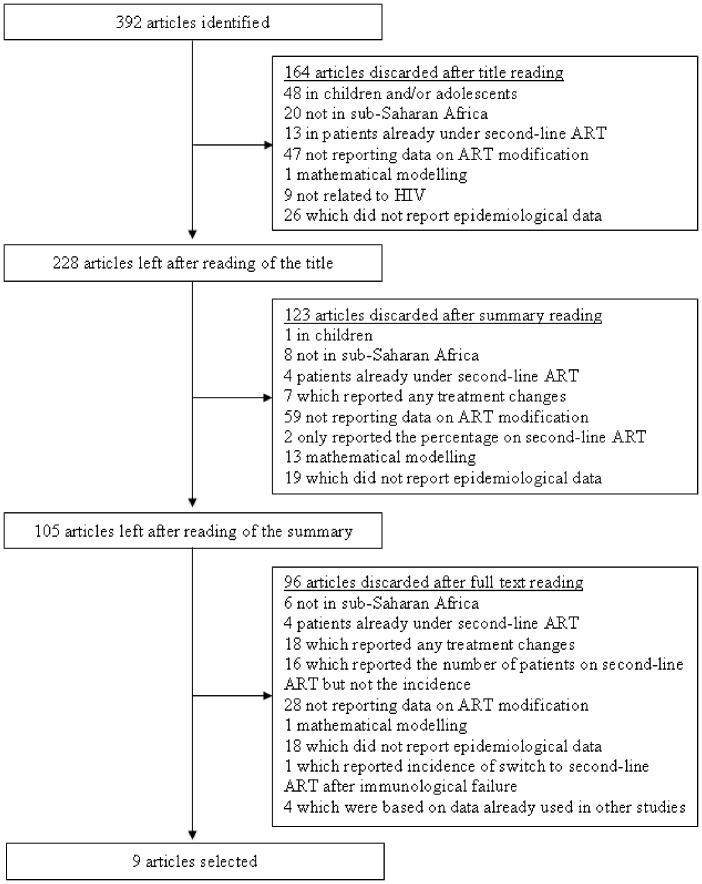
Objectives: Switching to second-line antiretroviral therapy (ART) largely depends on careful clinical assessment and access to biological measurements. We performed a systematic review and meta-analysis to estimate the incidence of switching to second-line ART in sub-Saharan Africa and its main programmatic determinants.
Methods: We searched 2 databases for studies reporting the incidence rate of switching to second-line ART in adults living in sub-Saharan Africa. Data on the incidence rate of switching were pooled, and random-effect models were used to evaluate the effect of factors measured at the programme level on this incidence rate.
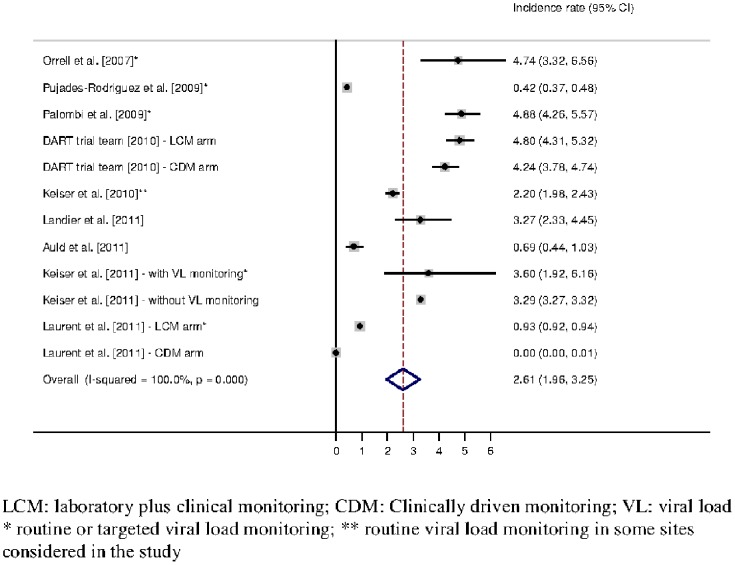
Results: Nine studies (157,340 patients) in 21 countries were included in the meta-analysis. All studies considered patients under first-line ART and conditions to initiate ART were similar across studies. Overall, 3,736 (2.4%) patients switched to second-line ART. Incidence rate of switch was in mean 2.65 per 100 person-years (PY) (95% confidence interval: 2.01-3.30); it ranged from 0.42 to 4.88 per 100 PY and from 0 to 4.80 per 100 PY in programmes with and without viral load monitoring, respectively. No factors measured at the programme level were associated with the incidence rate of switching to second-line ART.
Conclusion: The low incidence rate of switching to second-line ART suggests that the monitoring of patients under ART is challenging and that access to second-line ART is ineffective; efforts should be made to increase access to second-line ART to those in need by providing monitoring tools, education and training, as well as a more convenient regimen.
Conflict of interest statement
Figures
References
-
- (2012) WHO HIV drug resistance report 2012. Available: http://www.who.int/hiv/pub/drugresistance/report2012/en/index.html.
-
- (2013) Panel on Antiretroviral Guidelines for Adults and Adolescents. Guidelines for the use of antiretroviral agents in HIV-1-infected adults and adolescents. Department of Health and Human Services. Available: http://aidsinfo.nih.gov/contentfiles/lvguidelines/AdultandAdolescentGL.pdf. Accessed 2013 Feb 18.
-
- Hosseinipour MC, van Oosterhout JJ, Weigel R, Phiri S, Kamwendo D, et al. (2009) The public health approach to identify antiretroviral therapy failure: high-level nucleoside reverse transcriptase inhibitor resistance among Malawians failing first-line antiretroviral therapy. AIDS 23: 1127–1134. - PMC - PubMed
-
- van Oosterhout JJ, Brown L, Weigel R, Kumwenda JJ, Mzinganjira D, et al. (2009) Diagnosis of antiretroviral therapy failure in Malawi: poor performance of clinical and immunological WHO criteria. Trop Med Int Health 14: 856–861. - PubMed
Publication types
MeSH terms
LinkOut - more resources
Full Text Sources
Other Literature Sources
Medical
