. 2013 Dec 20;8(12):e83290.
doi: 10.1371/journal.pone.0083290. eCollection 2013.

Combination of Entner-Doudoroff pathway with MEP increases isoprene production in engineered Escherichia coli

Affiliations

Combination of Entner-Doudoroff pathway with MEP increases isoprene production in engineered Escherichia coli

Huaiwei Liu et al. PLoS One. .

Abstract

Embden-Meyerhof pathway (EMP) in tandem with 2-C-methyl-D-erythritol 4-phosphate pathway (MEP) is commonly used for isoprenoid biosynthesis in E. coli. However, this combination has limitations as EMP generates an imbalanced distribution of pyruvate and glyceraldehyde-3-phosphate (G3P). Herein, four glycolytic pathways-EMP, Entner-Doudoroff Pathway (EDP), Pentose Phosphate Pathway (PPP) and Dahms pathway were tested as MEP feeding modules for isoprene production. Results revealed the highest isoprene production from EDP containing modules, wherein pyruvate and G3P were generated simultaneously; isoprene titer and yield were more than three and six times higher than those of the EMP module, respectively. Additionally, the PPP module that generates G3P prior to pyruvate was significantly more effective than the Dahms pathway, in which pyruvate production precedes G3P. In terms of precursor generation and energy/reducing-equivalent supply, EDP+PPP was found to be the ideal feeding module for MEP. These findings may launch a new direction for the optimization of MEP-dependent isoprenoid biosynthesis pathways.


Conflict of interest statement

Competing Interests: The authors have declared that no competing interests exist.

Figures

Figure 1
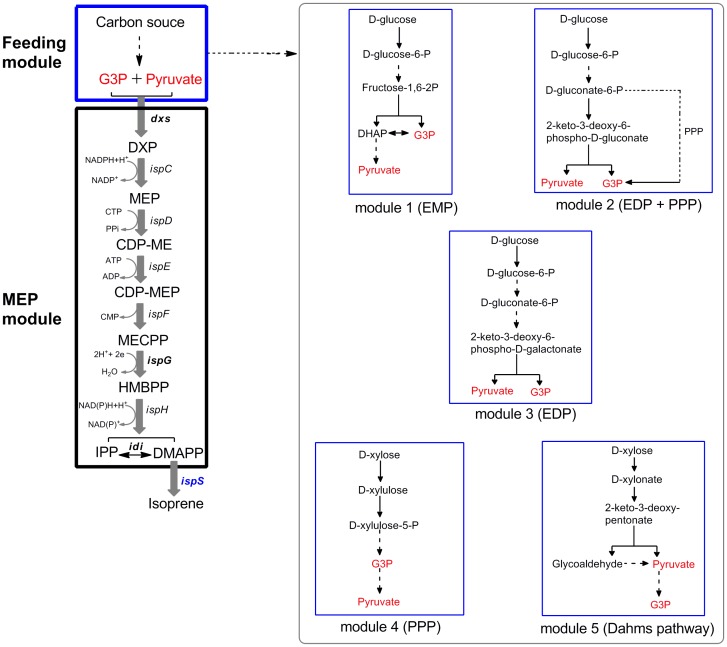
Figure 1. Participation of MEP-dependent isoprene biosynthesis pathway into two modules.
Gene symbols and the enzymes they encode (all genes were from E. coli except where noted): dxs, DXP synthase; ispC, DXP reductionisomerase; ispD, DXP-ME synthase; ispE, CDP-ME kinase; ispF, MECPP synthase; ispG, HMBPP synthase; ispH, HMBPP reductase; idi, IPP isomerase; ispS, isoprene synthase (P. alba). Pathway intermediates: G3P, glyceraldehyde-3-phosphate; DXP, 1-deoxy-D-xylulose 5-phosphate; MEP, 2-C-methyl-D-erythritol 4-phosphate; CDP-ME, 4-diphosphocytidyl-2-C-methyl-D-erythritol; CDP-MEP, 4-diphosphocytidyl-2-C-methyl-D-erythritol 2-phosphate; MECPP, 2-C-methyl-D-erythritol 2,4-cyclopyrophosphate; HMBPP, 1-hydroxy-2-methyl-2-(E)-butenyl 4-pyrophosphate; IPP, isopentenyl pyrophosphate; DMAPP, dimethylallyl pyrophosphate; DHAP, dihydroxyacetone 3-phosphate.
Figure 2
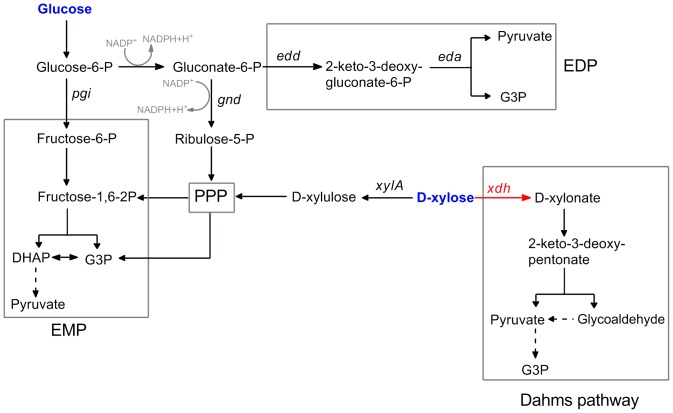
Figure 2. Four glycolytic pathways present in E. coli.
EMP, Embden-Meyerhof pathway; PPP, pentose phosphate pathway; EDP, Entner-Doudoroff pathway.
Figure 3
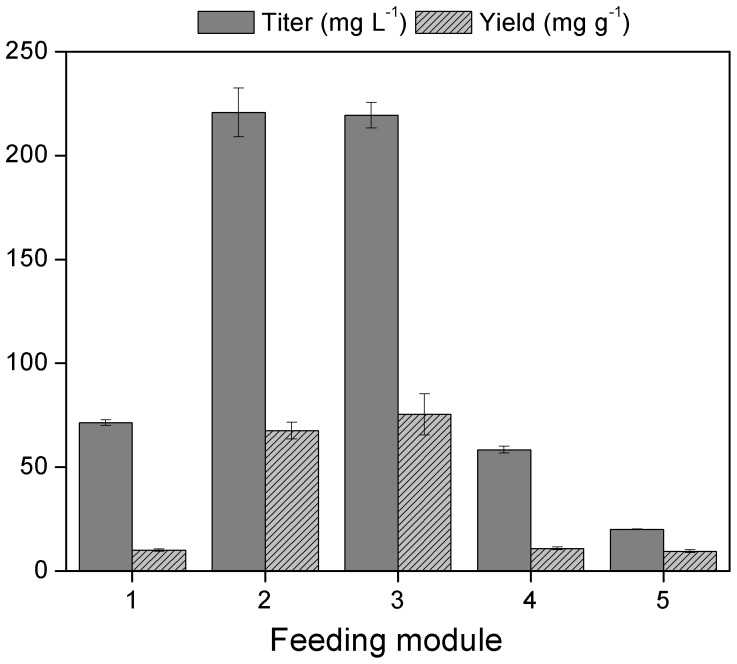
Figure 3. Isoprene titers and yields from different feeding modules.
Module 1, EMP of strain FMIS 1; Module 2, EDP+PPP of strain FMIS 2; Module 3, EDP of strain FMIS 3, these three strains used glucose as carbon source. Module 4, PPP of strain FMIS 4; Module 5, Dahms pathway of strain FMIS 5, these two strains used D-xylose as carbon source. All strains are listed in Table S1 in File S1. A 160 mL serum bottle containing 40 mL of semi-defined medium, consisted of M9 salts, 5 g L−1 yeast extract, 10 g L−1 required carbon source and 1 mM thiamine pyrophosphate (TPP), was used for the cultivation of the strains for isoprene production.
Figure 4
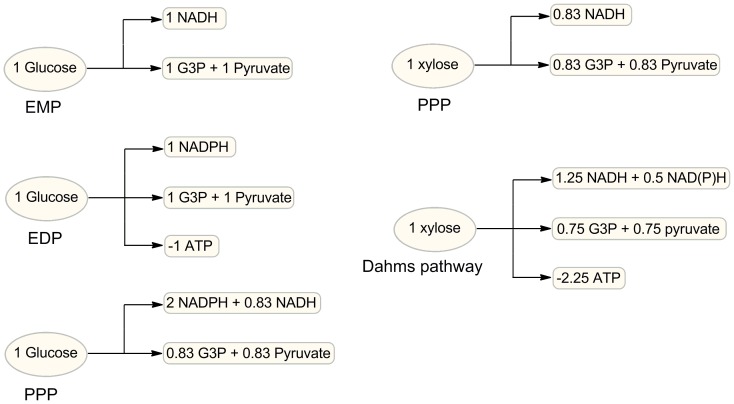
Figure 4. Pyruvate and G3P generation, energy and reducing equivalents production of different glycolytic pathways.

References

    1. Ajikumar PK, Xiao WH, Tyo KE, Wang Y, Simeon F, et al. (2010) Isoprenoid pathway optimization for Taxol precursor overproduction in Escherichia coli . Science 330: 70–74. - PMC - PubMed
    1. Danner H, Boeckler GA, Irmisch S, Yuan JS, Chen F, et al. (2011) Four terpene synthases produce major compounds of the gypsy moth feeding-induced volatile blend of Populus trichocarpa . Phytochemistry 72: 897–908. - PubMed
    1. Martin VJ, Pitera DJ, Withers ST, Newman JD, Keasling JD (2003) Engineering a mevalonate pathway in Escherichia coli for production of terpenoids. Nat Biotechnol 21: 796–802. - PubMed
    1. Ro DK, Paradise EM, Ouellet M, Fisher KJ, Newman KL, et al. (2006) Production of the antimalarial drug precursor artemisinic acid in engineered yeast. Nature 440: 940–943. - PubMed
    1. Westfall PJ, Pitera DJ, Lenihan JR, Eng D, Woolard FX, et al. (2012) Production of amorphadiene in yeast, and its conversion to dihydroartemisinic acid, precursor to the antimalarial agent artemisinin. Proc Natl Acad Sci USA 109: E111–8. - PMC - PubMed

Publication types