


Identification of novel QTLs for isolate-specific partial resistance to Plasmodiophora brassicae in Brassica rapa
- PMID: 24376876
- PMCID: PMC3869933
- DOI: 10.1371/journal.pone.0085307
Identification of novel QTLs for isolate-specific partial resistance to Plasmodiophora brassicae in Brassica rapa
Abstract
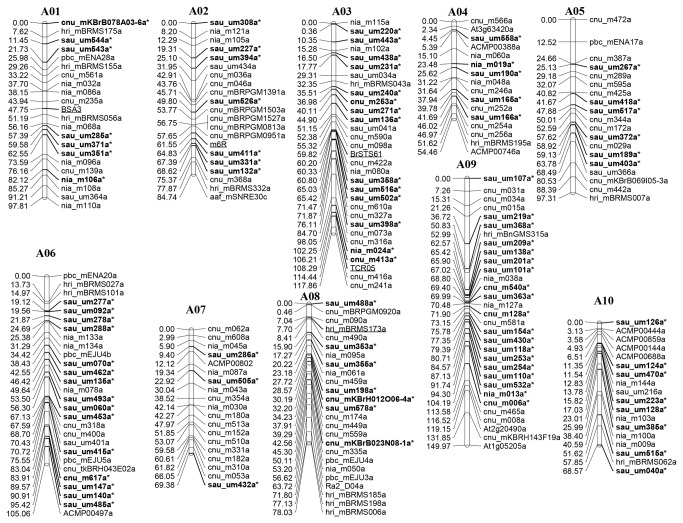
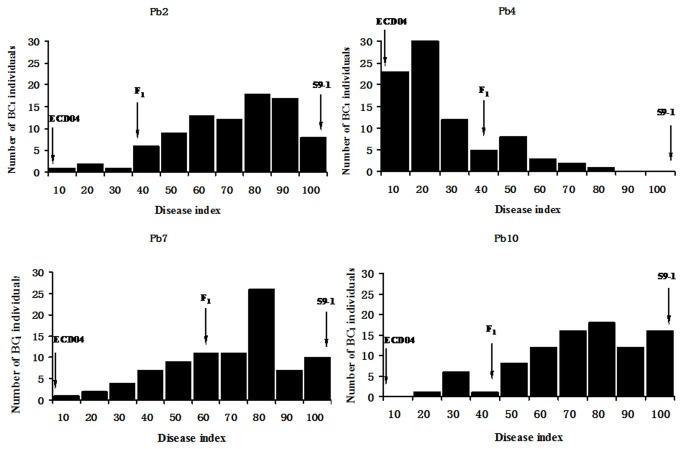
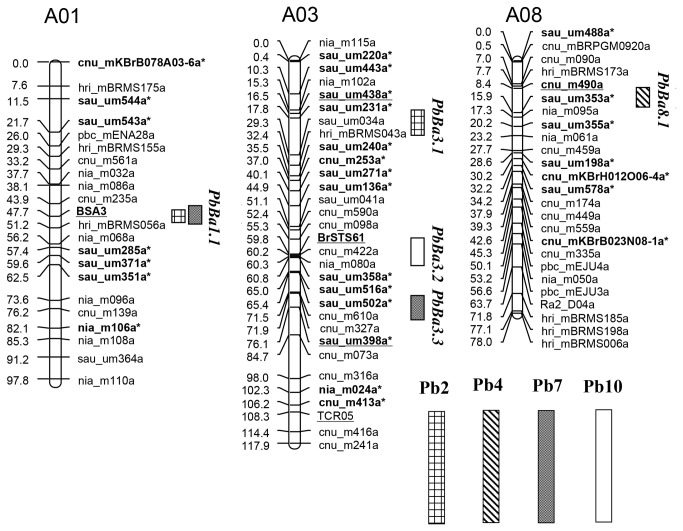
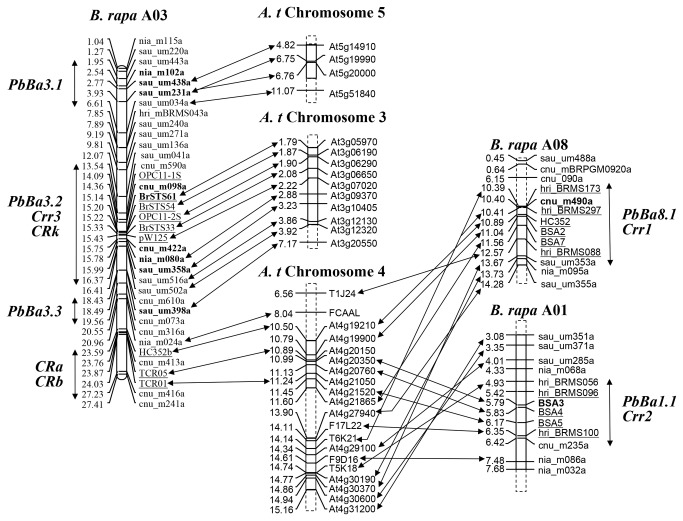
Plasmodiophora brassicae, the causal agent of clubroot disease of the Brassica crops, is widespread in the world. Quantitative trait loci (QTLs) for partial resistance to 4 different isolates of P. brassicae (Pb2, Pb4, Pb7, and Pb10) were investigated using a BC1F1 population from a cross between two subspecies of Brassica rapa, i.e. Chinese cabbage inbred line C59-1 as a susceptible recurrent parent and turnip inbred line ECD04 as a resistant donor parent. The BC1F2 families were assessed for resistance under controlled conditions. A linkage map constructed with simple sequence repeats (SSR), unigene-derived microsatellite (UGMS) markers, and specific markers linked to published clubroot resistance (CR) genes of B. rapa was used to perform QTL mapping. A total of 6 QTLs residing in 5 CR QTL regions of the B. rapa chromosomes A01, A03, and A08 were identified to account for 12.2 to 35.2% of the phenotypic variance. Two QTL regions were found to be novel except for 3 QTLs in the respective regions of previously identified Crr1, Crr2, and Crr3. QTL mapping results indicated that 1 QTL region was common for partial resistance to the 2 isolates of Pb2 and Pb7, whereas the others were specific for each isolate. Additionally, synteny analysis between B. rapa and Arabidopsis thaliana revealed that all CR QTL regions were aligned to a single conserved crucifer blocks (U, F, and R) on 3 Arabidopsis chromosomes where 2 CR QTLs were detected in A. thaliana. These results suggest that some common ancestral genomic regions were involved in the evolution of CR genes in B. rapa.
Conflict of interest statement
Figures
References
-
- Karling JS (1968) The Plasmodiophorales: including a complete host index, bibliography, and a description of diseases caused by species of this order, 2nd Edn. Hafner, New York.
-
- Manzanares-Dauleux MJ, Delourme R, Baron F, Thomas G (2000) Mapping of one major gene and of QTLs involved in resistance to clubroot in Brassica napus . Theor Appl Genet 101: 885-891. doi: 10.1007/s001220051557. - DOI
-
- Yoshikawa H (1993) Studies on breeding of clubroot resistance in cole crops. Bull Natl ResInst Veg Ornam Plants Tea Jpn Ser A, 7: 1-165.
-
- Kuginuki Y, Yoshigawa H, Hirai M (1999) Variation in virulence of Plasmodiophora brassicae in Japan tested with clubroot resistant cultivars of Chinese cabbage. Eur J Plant Pathol 105: 327-332. doi: 10.1023/A:1008705413127. - DOI
Publication types
MeSH terms
LinkOut - more resources
Full Text Sources
Other Literature Sources
