


Comparison between intensity modulated radiotherapy (IMRT) and 3D tangential beams technique used in patients with early-stage breast cancer who received breast-conserving therapy
- PMID: 24376929
- PMCID: PMC3863162
- DOI: 10.1016/j.rpor.2010.06.002
Comparison between intensity modulated radiotherapy (IMRT) and 3D tangential beams technique used in patients with early-stage breast cancer who received breast-conserving therapy
Abstract
Background: The most often found complications in patients with breast cancer who received radiotherapy are cardiac and pulmonary function disorders and development of second malignancies.
Aim: To compare the intensity modulated radiotherapy with the 3D tangential beams technique in respect of dose distribution in target volume and critical organs they generate in patients with early-stage breast cancer who received breast-conserving therapy.
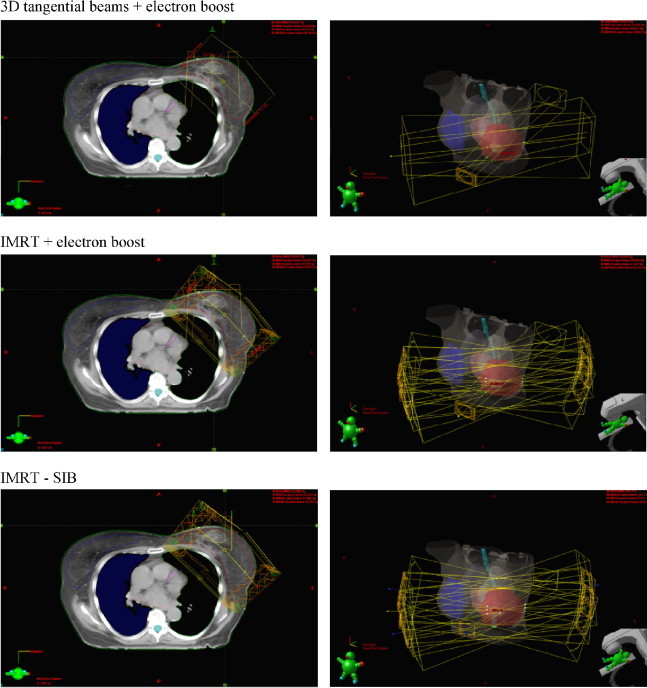
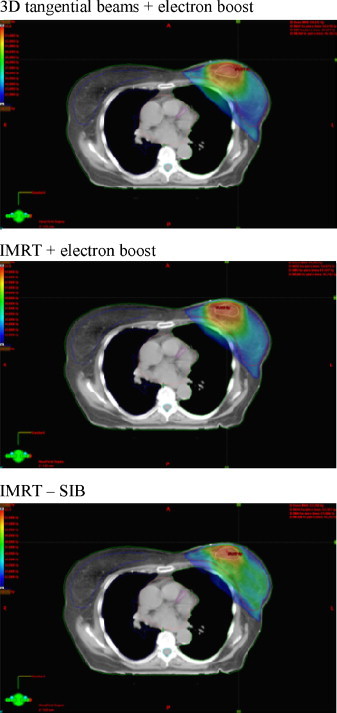
Materials and methods: A dosimetric analysis was performed to assess the three radiotherapy techniques used in each of 10 consecutive patients with early-stage breast cancer treated with breast-conserving therapy. Radiotherapy was planned with the use of all the three techniques: 3D tangential beams with electron boost, IMRT with electron boost, and intensity modulated radiotherapy with simultaneous integrated boost.
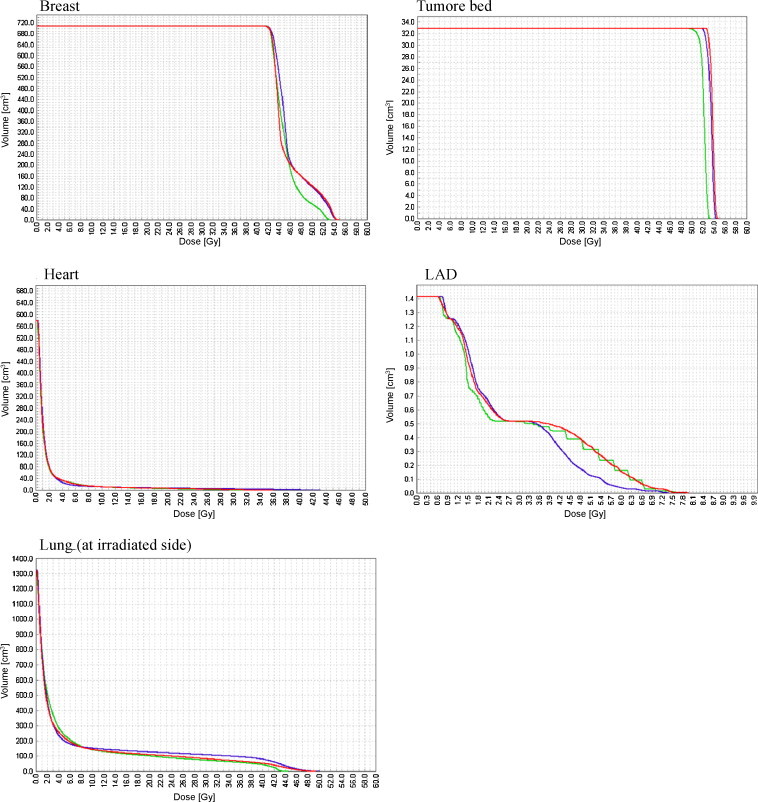
Results: The use of the IMRT techniques enables more homogenous dose distribution in target volume. The range of mean and median dose to the heart and lung was lower with the IMRT techniques in comparison to the 3D tangential beams technique. The range of mean dose to the heart amounted to 0.3-3.5 Gy for the IMRT techniques and 0.4-4.3 for the tangential beams technique. The median dose to the lung on the irradiated side amounted to 4.9-5 Gy for the IMRT techniques and 5.6 Gy for the 3D tangential beams technique.
Conclusion: The application of the IMRT techniques in radiotherapy patients with early-stage breast cancer allows to obtain more homogenous dose distribution in target volume, while permitting to reduce the dose to critical organs.
Keywords: Breast-conserving therapy; Early-stage breast cancer; Intensity modulated radiotherapy; Radiotherapy; Tangential beams technique.
Figures
References
-
- Perez C.A., Taylor M.E., Bradley J., Mansur D., Sanchez-Aragon M.M. In: Principles and practice of radiation oncology. Perez C.A., Brady L.W., Halperin E.C., Schmidt-Ullirich R.K., editors. Lippincott Williams &Wilkins; Philadelphia: 2004. pp. 1331–1345. Breast tumors.
-
- Early Breast Cancer Trialists’ Collaborative Group Favourable and unfavourable effects on long-term survival of radiotherapy for early breast cancer: an overview of the randomized trialsLancet. 2000;355:1757–1770. - PubMed
-
- Senkus-Konefka E., Jassem J. Complications of breast-cancer radiotherapy. Clin Oncol. 2006;18:229–235. - PubMed
-
- Korreman S.S., Pedersen A.N., Aarup L.R., Nottrup T.J., Specht L., Nystrom H. Reduction of cardiac and pulmonary complication probabilities after breathing adapted radiotherapy for breast cancer. Int J Radiat Oncol Biol Phys. 2006;65(5):1375–1380. - PubMed
-
- Early Breast Cancer Trialists’ Collaborative Group (EBCTCG) Effects of radiotherapy and of differences in the extent of surgery for early breast cancer on local recurrence and 15-year survival: an overview of the randomized trials. Lancet. 2005;366:2087–2106. - PubMed
LinkOut - more resources
Full Text Sources
