


Nasopharyngeal carcinoma in Slovenia, 1990-2003 (results of treatment with conventional two-dimensional radiotherapy)
- PMID: 24377003
- PMCID: PMC3863176
- DOI: 10.1016/j.rpor.2012.01.002
Nasopharyngeal carcinoma in Slovenia, 1990-2003 (results of treatment with conventional two-dimensional radiotherapy)
Abstract
Aim: To review the treatment results and identify prognostic factors for disease control and survival in a cohort of nasopharyngeal carcinoma (NPC) patients from a non-endemic population in Slovenia, diagnosed between 1990 and 2003.
Background: In Caucasians, nasopharyngeal carcinoma is a rare malignant tumor. Its diagnosis and treatment are complex and have been dramatically impacted by recent technological advances.
Materials and methods: In the Cancer Registry of Slovenia database, a total of 126 patients with NPC were identified, 93 of whom were available for analysis. All patients were treated with conventional two-dimensional radiotherapy (RT) and 29.3% underwent chemotherapy (ChT).
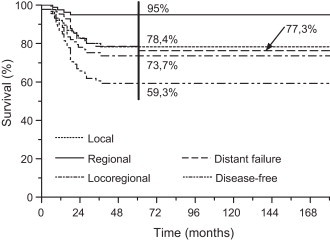
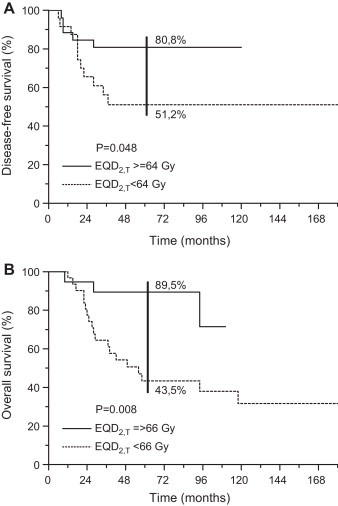
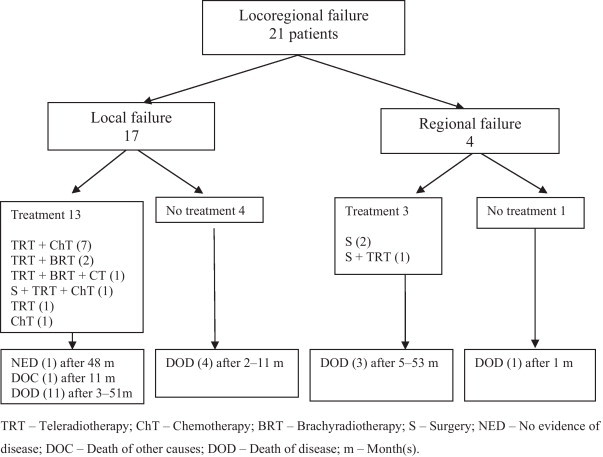
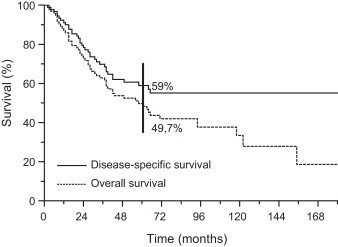
Results: The median follow-up time for those alive at the last follow-up examination was 74.5 months. Disease recurred locally in 17 patients, regionally in 4 patients and at distant sites in 18 patients, resulting in 5-year locoregional control (LRC), distant failure-free survival (DFFS) and disease-free survival (DFS) of 73.7%, 78.6% and 59.3%, respectively. Disease-specific survival at 5 years was 59% and overall survival (OS) was 49.7%. In a multivariate analysis, LRC was favorably affected (P < 0.05) by an undifferentiated histology (hazard ratio [HR] = 2.86), DFFS through the absence of neck metastases (HR = 0.28), DFS by younger age (HR = 0.46), and more intensive RT (expressed as the isoeffective dose, EQD2,T ; HR = 2.08). The independent prognosticator for OS was age (≤55 years vs. >55 years, HR = 0.39); in the ≤55 years subgroup, an improved OS was connected to a more intensive RT regimen of EQD2,T ≥ 66 Gy (HR = 4.17).
Conclusions: Our results confirm an independent and favorable effect from an undifferentiated histology, the absence of neck metastases, a younger patient age at diagnosis, and more intensive RT regimens for disease control and survival.
Keywords: Chemotherapy; Nasopharyngeal carcinoma; Prognostic factors; Radiotherapy; Survival.
Figures
References
-
- Hu K.S., Chan A.T.C., Costantino P., Harrison L.B. Cancer of the nasopharynx. In: Harrison L.B., Sessions R.B., Hong W.K., editors. Head and neck cancer: a multidisciplinary approach. 3rd ed. Williams & Wilkins/Wolters Kluwer; Lippincott/Philadelphia: 2009. pp. 502–529.
-
- Cancer Registry of Slovenia. Cancer in Slovenia 1990–2003. Reports no. 32-45. Ljubljana: Institute of Oncology & Cancer Registry of Republic of Slovenia; 1993–2006.
-
- Chan A.T.C., Felip E., on behalf of the ESMO guidelines working group Nasopharyngeal cancer: ESMO clinical recommendations for diagnosis, treatment and follow-up. Ann Oncol. 2009;20(Suppl. 4):iv123–iv125. - PubMed
-
- Chan J.K.C., Bray F., McCarron P. Nasopharyngeal carcinoma. In: Barnes L., Eveson J.W., Reichart P., Sidransky D., editors. Pathology and genetics of head and neck tumors. IARC Press; Lyon: 2005. pp. 81–97.
-
- Sobin L.H., Wittekind C., editors. TNM classification of malignant tumours. 6th ed. Wiley Liss; New York: 2002. pp. 27–33.
LinkOut - more resources
Full Text Sources
