A historical perspective of influenza A(H1N2) virus
- PMID: 24377419
- PMCID: PMC3884707
- DOI: 10.3201/eid2001.121848
A historical perspective of influenza A(H1N2) virus
Abstract
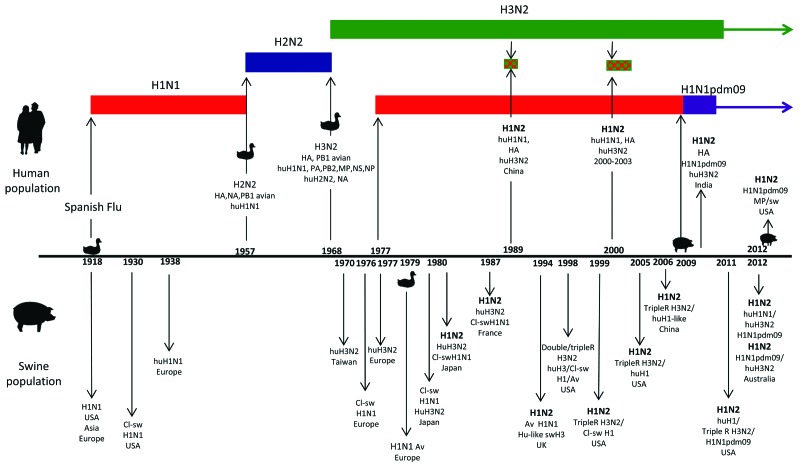
The emergence and transition to pandemic status of the influenza A(H1N1)A(H1N1)pdm09) virus in 2009 illustrated the potential for previously circulating human viruses to re-emerge in humans and cause a pandemic after decades of circulating among animals. Within a short time of the initial emergence of A(H1N1)pdm09 virus, novel reassortants were isolated from swine. In late 2011, a variant (v) H3N2 subtype was isolated from humans, and by 2012, the number of persons infected began to increase with limited person-to-person transmission. During 2012 in the United States, an A(H1N2)v virus was transmitted to humans from swine. During the same year, Australia recorded its first H1N2 subtype infection among swine. The A(H3N2)v and A(H1N2)v viruses contained the matrix protein from the A(H1N1)pdm09 virus, raising the possibility of increased transmissibility among humans and underscoring the potential for influenza pandemics of novel swine-origin viruses. We report on the differing histories of A(H1N2) viruses among humans and animals.
Keywords: H1N2 subtype; Influenza A virus; influenza; pandemic; reassortant; swine; viruses; zoonoses.
Figures
References
-
- Update: Influenza activity-United States and worldwide, May 20-September 22 2012. MMWR Morb Mortal Wkly Rep. 2012;61:785–9 . - PubMed
-
- PROMED-mail. Influenza (85): United States of America (Minnesota) swine H1N2 Influenza, human cases. PROMED-mail. 2012 Sep 11 [cited 2013 May 8].http://www.promedmail.org, archive no. 20120911.1290389.
-
- Mukherjee TR, Agrawal AS, Chakrabarti S, Chawla-Sarkar M. Full genomic analysis of an influenza A (H1N2) virus identified during 2009 pandemic in Eastern India: evidence of reassortment event between co-circulating A(H1N1)pdm09 and A/Brisbane/10/2007-like H3N2 strains. Virol J. 2012;9:233. 10.1186/1743-422X-9-233 - DOI - PMC - PubMed
Publication types
MeSH terms
LinkOut - more resources
Full Text Sources
Other Literature Sources
Medical