


doi: 10.1021/ja411547j.
Epub 2014 Jan 8.
In vivo targeting of hydrogen peroxide by activatable cell-penetrating peptides
Affiliations
- PMID: 24377760
- PMCID: PMC3929323
- DOI: 10.1021/ja411547j
Item in Clipboard
In vivo targeting of hydrogen peroxide by activatable cell-penetrating peptides
J Am Chem Soc.
.
Abstract
A hydrogen peroxide (H2O2)-activated cell-penetrating peptide was developed through incorporation of a boronic acid-containing cleavable linker between polycationic cell-penetrating peptide and polyanionic fragments. Fluorescence labeling of the two ends of the molecule enabled monitoring its reaction with H2O2 through release of the highly adhesive cell-penetrating peptide and disruption of fluorescence resonance energy transfer. The H2O2 sensor selectively reacts with endogenous H2O2 in cell culture to monitor the oxidative burst of promyelocytes and in vivo to image lung inflammation. Targeting H2O2 has potential applications in imaging and therapy of diseases related to oxidative stress.
Figures
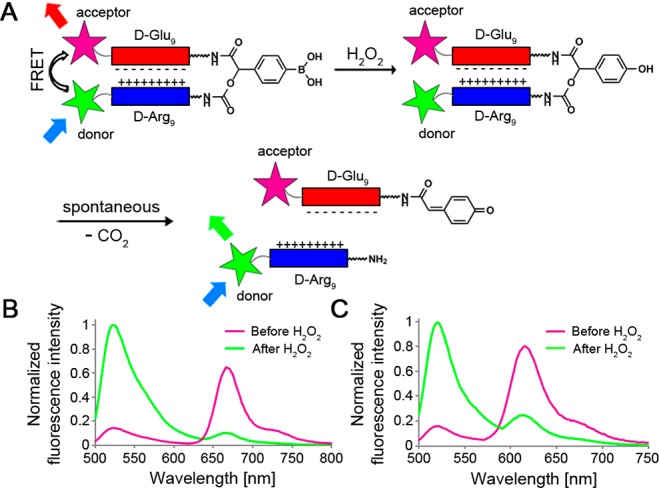
Schematic
illustration of H2O2-ACPP structure
and its H2O2-triggered fragmentation process.
(A) Fluorescence labeling of H2O2-ACPP peptide
domains enables visualization of its cleavage through FRET disruption.
Shown are the fluorescence emissions of (B) ACPP 1 and
(C) ACPP 2 (1 μM each) before (purple) and 20 min
after (green) reaction with H2O2 (2 mM).
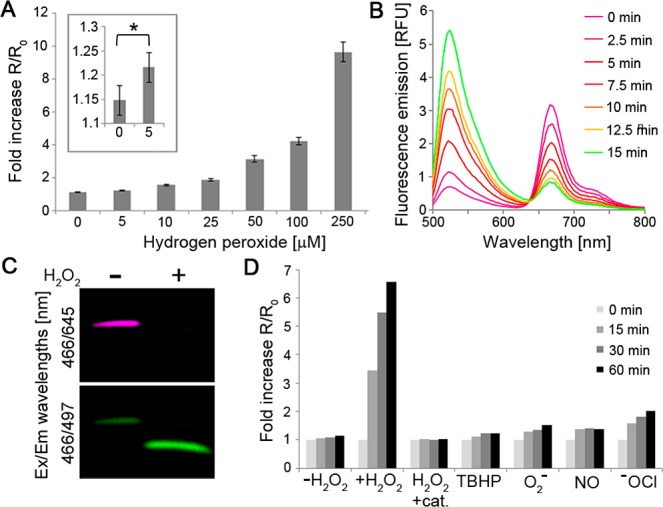
Selective and concentration-dependent
cleavage of ACPP 1 by H2O2. (A)
Fold increase in fluorescein/Cy5
emission ratio (524/672 nm) after 20 min incubation of ACPP 1 (1 μM) with indicated concentrations of H2O2. Error bars represent ± standard deviation. *p < 0.05. (B) Time course fluorescence emission spectra
of ACPP 1 (1 μM) in the presence of H2O2 (1 mM). (C) H2O2-dependent cleavage
of ACPP 1 (1 μM) after 30 min incubation with 1
mM H2O2. (D) Fold increase in fluorescein/Cy5
emission ratio at indicated times of ACPP 1 (1 μM)
with indicated ROS or their donors (100 μM, catalase 0.5 mg/mL).
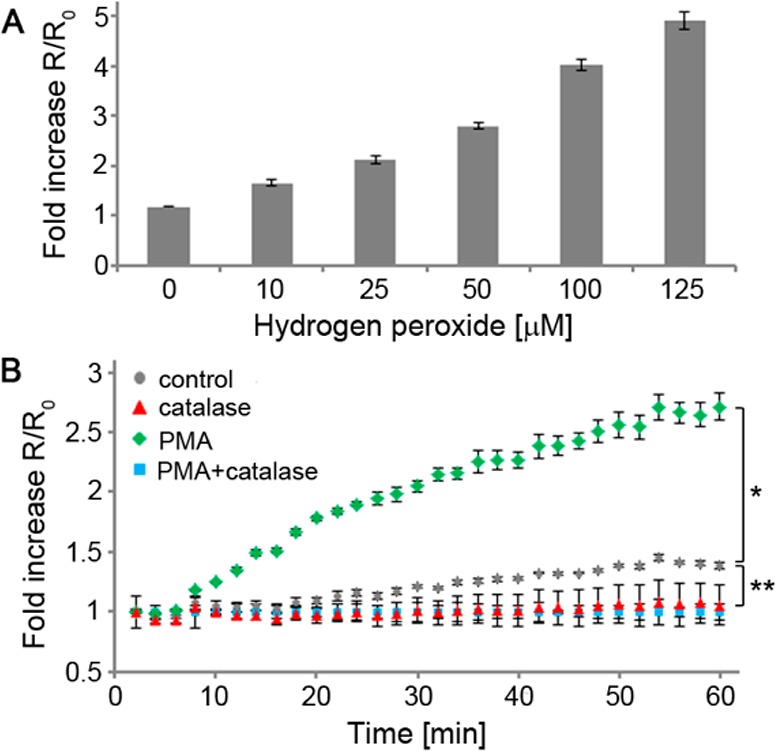
Detection of H2O2 by ACPP 1 in
cellular environment. (A) Fold increase in fluorescein/Cy5 emission
ratio (524/672 nm) after 30 min of ACPP 1 (1 μM)
upon exogenous addition of H2O2 at indicated
concentration in the presence of HL-60 cells. Error bars represent
± standard deviation. (B) Time course of fold increase in fluorescein/Cy5
emission ratio (524/672 nm) of ACPP 1 (1 μM) incubated
with HL-60 cells at the indicated conditions (catalase 0.5 mg/mL,
PMA 0.5 μM). Error bars represent ± standard deviation.
*p < 1 × 10⁻¹⁰, **p < 1 × 10⁻⁴.
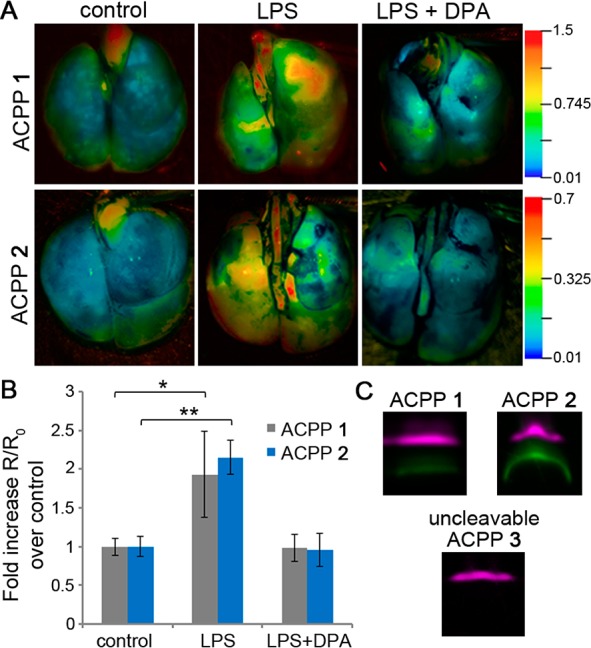
In vivo targeting of H2O2 by ACPPs 1 and 2. (A) Representative ratiometric fluorescent
images of fluorescein/Cy5 (ACPP 1) or Alexa488/594 (ACPP 2) emission ratios of mouse lungs in the indicated conditions
treated with ACPP 1 (10 nmol) or ACPP 2 (5
nmol) for 6 h. Right: scales of appropriate emission ratios. (B) Mean
change in ratios of images presented in (A) with additional animals
(n = 5). Error bars represent ± standard deviation.
*p < 0.05, **p < 0.005. (C)
SDS-PAGE analysis of lung extracts from LPS-mice treated with ACPPs 1–3 for 6 h. Bands were pseudocolored
according to their emission spectra (Figure S9
(SI)): intact ACPP (purple) or cleaved ACPP (green).
References
-
- D’Autreaux B.; Toledano M. B. Nat. Rev. Mol. Cell Biol. 2007, 8, 813. - PubMed
-
- Veal E. A.; Day A. M.; Morgan B. A. Mol. Cell 2007, 26, 1. - PubMed
-
- Houstis N.; Rosen E. D.; Lander E. S. Nature 2006, 440, 944. - PubMed
-
- Touyz R. M.; Schiffrin E. L. Histochem. Cell Biol. 2004, 122, 339. - PubMed
-
- Cai H. Cardiovasc. Res. 2005, 68, 26. - PubMed
Publication types
MeSH terms
Substances
Grants and funding
LinkOut - more resources
Full Text Sources
Other Literature Sources
