


Hippocampus atrophy and the longitudinal course of late-life depression
- PMID: 24378256
- PMCID: PMC4031313
- DOI: 10.1016/j.jagp.2013.11.004
Hippocampus atrophy and the longitudinal course of late-life depression
Abstract
Objectives: Smaller hippocampal volumes are observed in depression but it remains unclear how antidepressant response and persistent depression relate to changes in hippocampal volume. We examined the longitudinal relationship between hippocampal atrophy and course of late-life depression.
Setting: Academic medical center.
Participants: Depressed and never-depressed cognitively intact subjects age 60 years or older.
Measurements: Depression severity was measured every three months with the Montgomery-Asberg Depression Rating Scale (MADRS). Participants also completed cranial 1.5-T magnetic resonance imaging every 2 years. We compared 2-year change in hippocampal volume based on remission status, then in expanded analyses examined how hippocampal volumes predicted MADRS score.
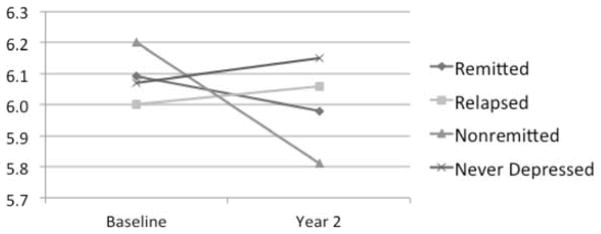
Results: In analyses of 92 depressed and 70 never-depressed subjects, over 2 years the cohort whose depression never remitted exhibited greater hippocampal atrophy than the never-depressed cohort. In expanded analyses of a broader sample of 152 depressed elders, depression severity was significantly predicted by a hippocampus × time interaction where smaller hippocampus volumes over time were associated with greater depression severity.
Conclusions: Hippocampal atrophy is associated with greater and persistent depression severity. Neuropathological studies are needed to determine if this atrophy is related to the toxic effects of persistent depression or related to underlying Alzheimer disease.
Keywords: Geriatrics; MRI; depression; hippocampus; longitudinal; neuroimaging.
Copyright © 2014 American Association for Geriatric Psychiatry. Published by Elsevier Inc. All rights reserved.
Conflict of interest statement
The authors report no financial conflicts of interest.
Figures
References
-
- Arnone D, McIntosh AM, Ebmeier KP, et al. Magnetic resonance imaging studies in unipolar depression: systematic review and meta-regression analyses. Eur Neuropsychopharmacol. 2012;22:1–16. - PubMed
-
- Sheline YI, Gado MH, Kraemer HC. Untreated depression and hippocampal volume loss. Am J Psychiatry. 2003;160:1516–1518. - PubMed
-
- Sapolsky RM, Krey LC, McEwen BS. The neuroendocrinology of stress and aging: the glucocorticoid cascade hypothesis. Endocr Rev. 1986;7:284–301. - PubMed
Publication types
MeSH terms
Substances
Grants and funding
LinkOut - more resources
Full Text Sources
Other Literature Sources
