


Clinical risk-scoring algorithm to forecast scrub typhus severity
- PMID: 24379733
- PMCID: PMC3872011
- DOI: 10.2147/RMHP.S55305
Clinical risk-scoring algorithm to forecast scrub typhus severity
Abstract
Purpose: To develop a simple risk-scoring system to forecast scrub typhus severity.
Patients and methods: Seven years' retrospective data of patients diagnosed with scrub typhus from two university-affiliated hospitals in the north of Thailand were analyzed. Patients were categorized into three severity groups: nonsevere, severe, and dead. Predictors for severity were analyzed under multivariable ordinal continuation ratio logistic regression. Significant coefficients were transformed into item score and summed to total scores.
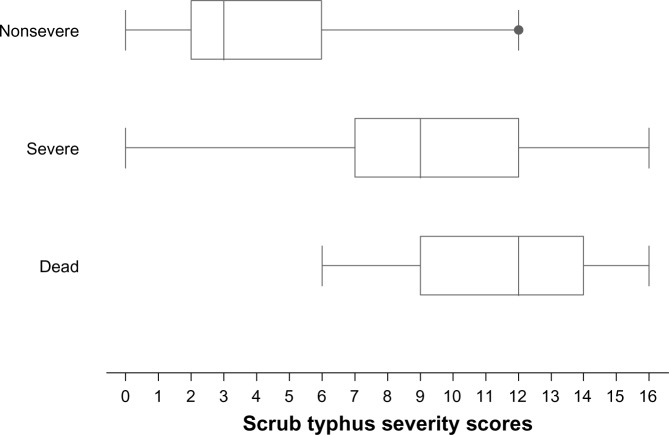
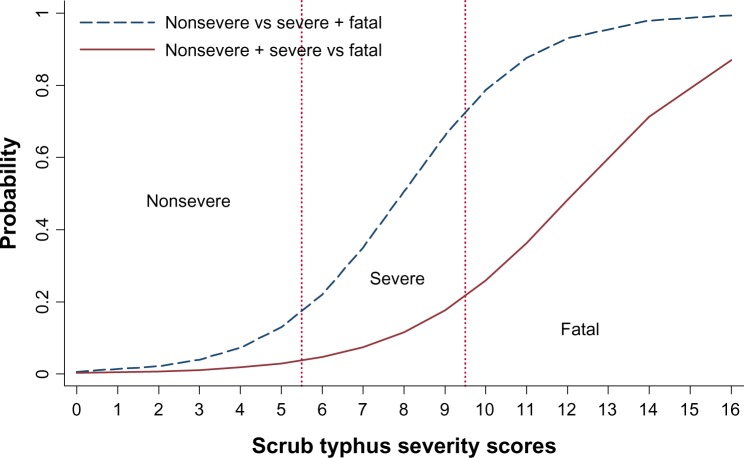
Results: Predictors of scrub typhus severity were age >15 years, (odds ratio [OR] =4.09), pulse rate >100/minute (OR 3.19), crepitation (OR 2.97), serum aspartate aminotransferase >160 IU/L (OR 2.89), serum albumin ≤3.0 g/dL (OR 4.69), and serum creatinine >1.4 mg/dL (OR 8.19). The scores which ranged from 0 to 16, classified patients into three risk levels: non-severe (score ≤5, n=278, 52.8%), severe (score 6-9, n=143, 27.2%), and fatal (score ≥10, n=105, 20.0%). Exact severity classification was obtained in 68.3% of cases. Underestimations of 5.9% and overestimations of 25.8% were clinically acceptable.
Conclusion: The derived scrub typhus severity score classified patients into their severity levels with high levels of prediction, with clinically acceptable under- and overestimations. This classification may assist clinicians in patient prognostication, investigation, and management. The scoring algorithm should be validated by independent data before adoption into routine clinical practice.
Keywords: clinical prediction rule; prognostic predictors; risk-scoring system; severe scrub typhus.
Figures
References
-
- Leelarasamee A, Chupaprawan C, Chenchittikul M, Udompanthurat S. Etiologies of acute undifferentiated febrile illness in Thailand. J Med Assoc Thai. 2004;87(5):464–472. - PubMed
-
- Suttinont C, Losuwanaluk K, Niwatayakul K, et al. Causes of acute, undifferentiated, febrile illness in rural Thailand: results of a prospective observational study. Ann Trop Med Parasitol. 2006;100(4):363–370. - PubMed
-
- Moron CG, Popov VL, Feng HM, Wear D, Walker DH. Identification of the target cells of Orientiatsutsugamushi in human cases of scrub typhus. Mod Pathol. 2001;14(8):752–759. - PubMed
-
- Watt G, Kantipong P. Orientia tsutsugamushi and scrub typhus. In: Ruoult D, Parola P, editors. Rickettsial Diseases. New York: Information Healthcare; 2007. pp. 236–256.
-
- Jeong YJ, Kim S, Wook YD, Lee JW, Kim KI, Lee SH. Scrub typhus: clinical, pathologic, and imaging findings. Radiographics. 2007;27(1):161–172. - PubMed
LinkOut - more resources
Full Text Sources
Other Literature Sources
