


A validation of the application of D(2)O stable isotope tracer techniques for monitoring day-to-day changes in muscle protein subfraction synthesis in humans
- PMID: 24381002
- PMCID: PMC3948971
- DOI: 10.1152/ajpendo.00650.2013
A validation of the application of D(2)O stable isotope tracer techniques for monitoring day-to-day changes in muscle protein subfraction synthesis in humans
Abstract
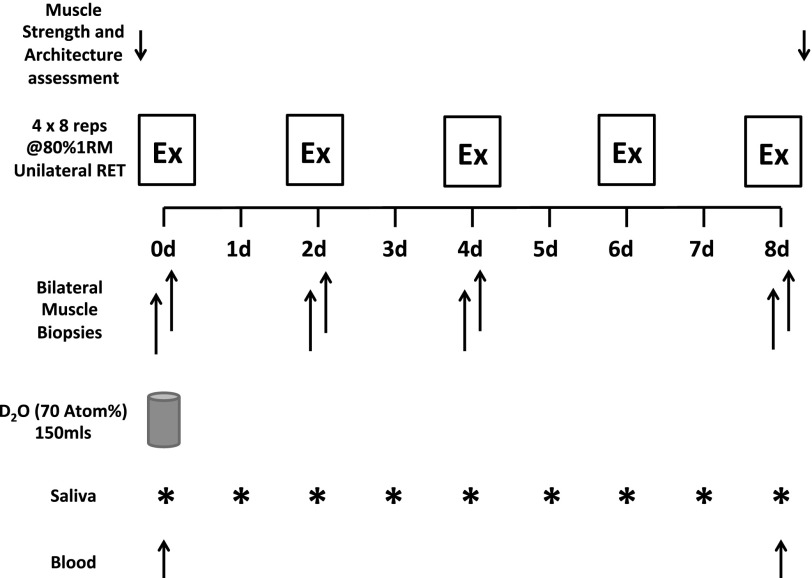
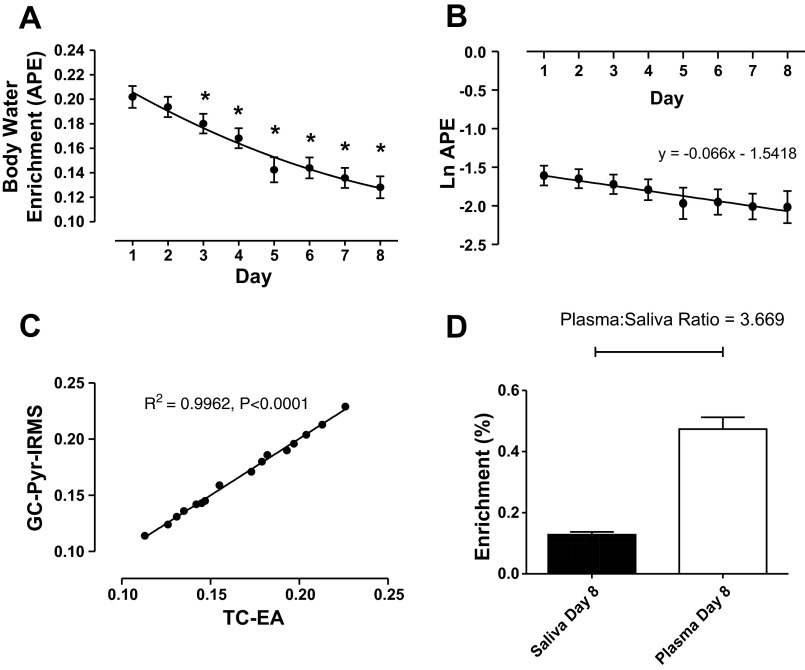
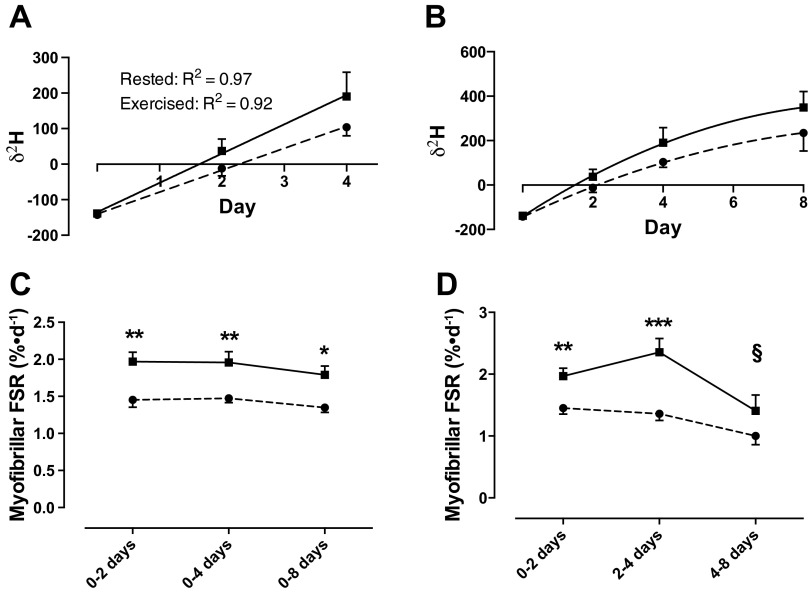
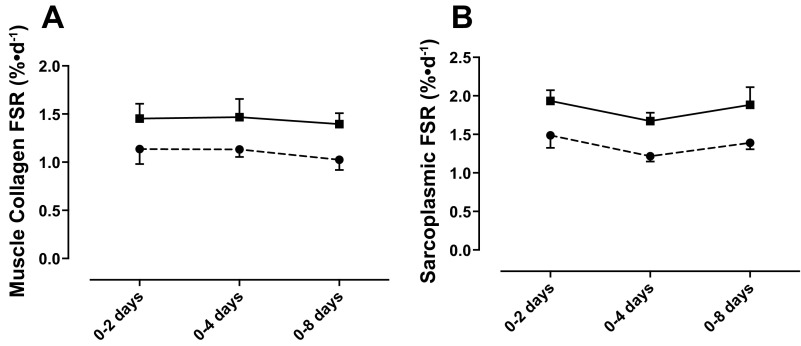
Quantification of muscle protein synthesis (MPS) remains a cornerstone for understanding the control of muscle mass. Traditional [(13)C]amino acid tracer methodologies necessitate sustained bed rest and intravenous cannulation(s), restricting studies to ~12 h, and thus cannot holistically inform on diurnal MPS. This limits insight into the regulation of habitual muscle metabolism in health, aging, and disease while querying the utility of tracer techniques to predict the long-term efficacy of anabolic/anticatabolic interventions. We tested the efficacy of the D2O tracer for quantifying MPS over a period not feasible with (13)C tracers and too short to quantify changes in mass. Eight men (22 ± 3.5 yr) undertook one-legged resistance exercise over an 8-day period (4 × 8-10 repetitions, 80% 1RM every 2nd day, to yield "nonexercised" vs. "exercise" leg comparisons), with vastus lateralis biopsies taken bilaterally at 0, 2, 4, and 8 days. After day 0 biopsies, participants consumed a D2O bolus (150 ml, 70 atom%); saliva was collected daily. Fractional synthetic rates (FSRs) of myofibrillar (MyoPS), sarcoplasmic (SPS), and collagen (CPS) protein fractions were measured by GC-pyrolysis-IRMS and TC/EA-IRMS. Body water initially enriched at 0.16-0.24 APE decayed at ~0.009%/day. In the nonexercised leg, MyoPS was 1.45 ± 0.10, 1.47 ± 0.06, and 1.35 ± 0.07%/day at 0-2, 0-4, and 0-8 days, respectively (~0.05-0.06%/h). MyoPS was greater in the exercised leg (0-2 days: 1.97 ± 0.13%/day; 0-4 days: 1.96 ± 0.15%/day, P < 0.01; 0-8 days: 1.79 ± 0.12%/day, P < 0.05). CPS was slower than MyoPS but followed a similar pattern, with the exercised leg tending to yield greater FSRs (0-2 days: 1.14 ± 0.13 vs. 1.45 ± 0.15%/day; 0-4 days: 1.13 ± 0.07%/day vs. 1.47 ± 0.18%/day; 0-8 days: 1.03 ± 0.09%/day vs. 1.40 ± 0.11%/day). SPS remained unchanged. Therefore, D2O has unrivaled utility to quantify day-to-day MPS in humans and inform on short-term changes in anabolism and presumably catabolism alike.
Keywords: deuterium oxide; protein synthesis; skeletal muscle.
Figures
References
-
- Alegre LM, Jiménez F, Gonzalo-Orden JM, Martín-Acero R, Aguado X. Effects of dynamic resistance training on fascicle length and isometric strength. J Sports Sci 24: 501–508, 2006 - PubMed
-
- Atherton PJ, Etheridge T, Watt PW, Wilkinson D, Selby A, Rankin D, Smith K, Rennie MJ. Muscle full effect after oral protein: time-dependent concordance and discordance between human muscle protein synthesis and mTORC1 signaling. Am J Clin Nutr 92: 1080–1088, 2010 - PubMed
-
- Babraj JA, Cuthbertson DJ, Smith K, Langberg H, Miller B, Krogsgaard MR, Kjaer M, Rennie MJ. Collagen synthesis in human musculoskeletal tissues and skin. Am J Physiol Endocrinol Metab 289: E864–E869, 2005 - PubMed
Publication types
MeSH terms
Substances
Grants and funding
LinkOut - more resources
Full Text Sources
Other Literature Sources
Research Materials
Miscellaneous
