


Comment
doi: 10.1073/pnas.1321248111.
Epub 2013 Dec 31.
Role for terminal complement activation in amyotrophic lateral sclerosis disease progression
Affiliations
- PMID: 24381160
- PMCID: PMC3890900
- DOI: 10.1073/pnas.1321248111
Item in Clipboard
Comment
Role for terminal complement activation in amyotrophic lateral sclerosis disease progression
Proc Natl Acad Sci U S A.
.
No abstract available
Conflict of interest statement
The authors declare no conflict of interest.
Figures
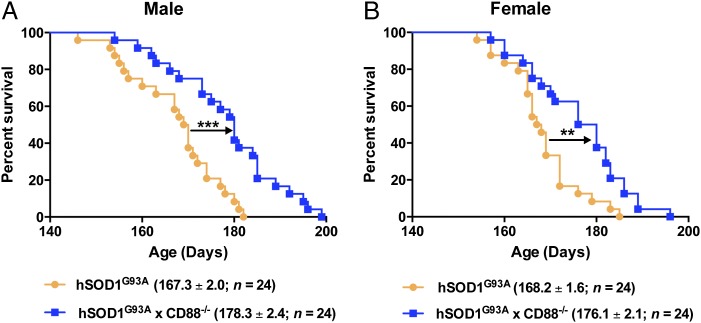
The C5a receptor CD88 contributes to disease progression in the SOD1G93A genetic model of ALS. Kaplan–Meier plot of ages (in days) in which SOD1G93A mice with normal (CD88+/+, orange line) or fully deleted (CD88−/−, blue line) CD88 reached end-stage of disease (complete hindlimb paralysis and an inability to right itself once placed on its back) in males (A) and females (B). Average (±SEM) ages of the disease end stages are also shown. SOD1G93A mice lacking C5a signaling via CD88 show a significant extension in survival compared with control SOD1G93A mice in both sexes, demonstrating a pathogenic role for C5a in this mutant ALS mouse model. n = 24 mice per group: P = 0.0002 (A) and P = 0.002 (B), log-rank test.
Comment in
-
Reply to Woodruff et al.: C1q and C3-dependent complement pathway activation does not contribute to disease in SOD1 mutant ALS mice.Proc Natl Acad Sci U S A. 2014 Jan 7;111(1):E5. doi: 10.1073/pnas.1321606111. Proc Natl Acad Sci U S A. 2014. PMID: 24555201 Free PMC article. No abstract available.
Comment on
-
C1q induction and global complement pathway activation do not contribute to ALS toxicity in mutant SOD1 mice.Proc Natl Acad Sci U S A. 2013 Nov 12;110(46):E4385-92. doi: 10.1073/pnas.1318309110. Epub 2013 Oct 29. Proc Natl Acad Sci U S A. 2013. PMID: 24170856 Free PMC article.
References
-
- Huber-Lang M, et al. Generation of C5a in the absence of C3: A new complement activation pathway. Nat Med. 2006;12(6):682–687. - PubMed
-
- Pavlovski D, et al. Generation of complement component C5a by ischemic neurons promotes neuronal apoptosis. FASEB J. 2012;26(9):3680–3690. - PubMed
-
- Woodruff TM, et al. The complement factor C5a contributes to pathology in a rat model of amyotrophic lateral sclerosis. J Immunol. 2008;181(12):8727–8734. - PubMed
Publication types
MeSH terms
Substances
LinkOut - more resources
Full Text Sources
Other Literature Sources
Medical
Molecular Biology Databases
