Review
. 2013 Dec 8:2013:512103.
doi: 10.1155/2013/512103.

The enigmatic cytokine oncostatin m and roles in disease

Affiliations
Review

The enigmatic cytokine oncostatin m and roles in disease

Carl D Richards. ISRN Inflamm. .

Abstract

Oncostatin M is a secreted cytokine involved in homeostasis and in diseases involving chronic inflammation. It is a member of the gp130 family of cytokines that have pleiotropic functions in differentiation, cell proliferation, and hematopoetic, immunologic, and inflammatory networks. However, Oncostatin M also has activities novel to mediators of this cytokine family and others and may have fundamental roles in mechanisms of inflammation in pathology. Studies have explored Oncostatin M functions in cancer, bone metabolism, liver regeneration, and conditions with chronic inflammation including rheumatoid arthritis, lung and skin inflammatory disease, atherosclerosis, and cardiovascular disease. This paper will review Oncostatin M biology in a historical fashion and focus on its unique activities, in vitro and in vivo, that differentiate it from other cytokines and inspire further study or consideration in therapeutic approaches.


Figures
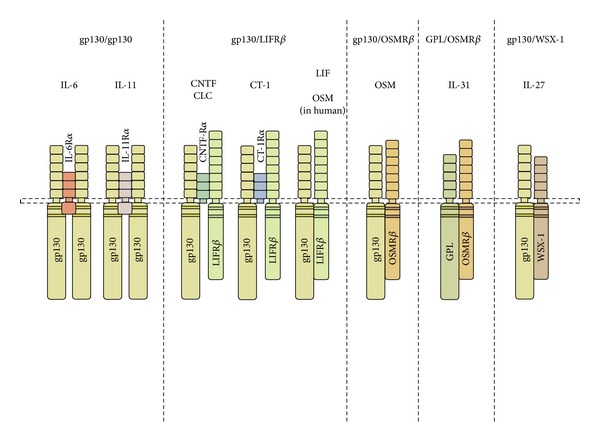
Figure 1
Figure 1
Schematic diagram of the gp130 cytokine receptor complexes. Members of the gp130 cytokine family engage in receptor complexes that include the gp130 signal transduction chain with the exception of IL-31, which engages a complex that utilizes gp130-like (GPL or IL31α) chain. The family may be subdivided further according to the signaling chains utilized: gp130/gp130; gp130/LIFR; gp130/OSMRβ; GPL/OSMRβ, and gp130/WSX-1, (modified from Fritz [39]).
Figure 2
Figure 2
OSM receptors and signaling. A schematic representation of signal transduction initiated through the OSMR/gp130 receptor complex. While several gp130-utilizing cytokines activate JAK/STAT and MAPK signaling pathways in connective tissue cells, we observe that OSM uniquely activates additional signaling intermediates including STAT5, STAT6, the PI3′K/Akt pathway, and the novel PKC isoform PKC delta (PKCd) in fibroblasts. OSM induces IL-4Ralpha and IL-1R (modified from Fritz [39]).
Figure 3
Figure 3
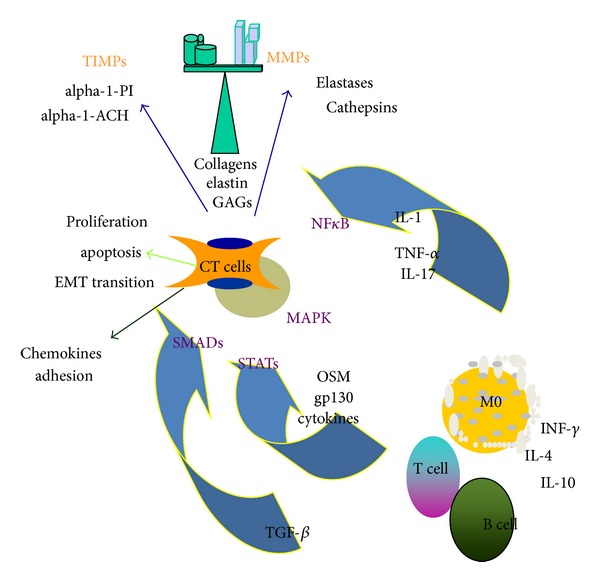
Schematic diagram of OSM and extracellular matrix remodeling. OSM and other gp130 cytokines are produced by macrophages and T cells and can be regulated by Th1 and Th2 cytokines. OSM, catabolic cytokines (IL-1, TNF, and IL-17), and fibrogenic TGFβ are potent regulators of connective tissue cells (CT cells, which here include fibroblasts, chondrocytes, osteoblasts, smooth muscle cells, and epithelial cells) through cell signaling molecules STATs, SMADs, NFkB, and MapKinases (shown in purple). Products expressed include matrix metalloproteinases (MMPs), their inhibitors (TIMPs) other enzymes, and components of the ECM. CT cells also express chemokines and adhesion molecules that contribute to inflammatory processes and can be regulated through proliferative, apoptotic, and EMT transition to alter tissue pathology in inflammatory diseases.
Figure 4
Figure 4
Postulated roles of OSM in allergen induced airway inflammation. Repeated exposure of allergens (Ragweed or House Dust Mite (HDM)) in airways leads to activation of the adaptive immune response resulting in secretion of Th2-associated immunoglobulins (IgE and IgG1) and cytokines (IL-4/IL-13). Local production of OSM by activated inflammatory cells regulates various responses synergistically in combination with IL-4, IL-13, (through regulation of the IL-4R) or IL-17A to influence cell infiltration and tissue remodeling. OSM reduces concentrations of IL-4, IL-13, and IL-17A required to elicit robust local inflammatory and lung remodeling responses.

References

    1. Tanaka M, Miyajima A. Oncostatin M, a multifunctional cytokine. Reviews of Physiology, Biochemistry and Pharmacology. 2003;149:39–52. - PubMed
    1. Chen S-H, Benveniste EN. Oncostatin M: a pleiotropic cytokine in the central nervous system. Cytokine and Growth Factor Reviews. 2004;15(5):379–391. - PubMed
    1. Silver JS, Hunter CA. gp130 at the nexus of inflammation, autoimmunity, and cancer. Journal of Leukocyte Biology. 2010;88(6):1145–1156. - PMC - PubMed
    1. Sims NA, Walsh NC. GP130 cytokines and bone remodelling in health and disease. BMB Reports. 2010;43(8):513–523. - PubMed
    1. Zarling JM, Shoyab M, Marquardt H. Oncostatin M: a growth regulator produced by differentiated histiocytic lymphoma cells. Proceedings of the National Academy of Sciences of the United States of America. 1986;83(24):9739–9743. - PMC - PubMed