


Review
doi: 10.1172/JCI69737.
Epub 2014 Jan 2.
Predicting response to epigenetic therapy
- PMID: 24382389
- PMCID: PMC3871230
- DOI: 10.1172/JCI69737
Item in Clipboard
Review
Predicting response to epigenetic therapy
J Clin Invest.
2014 Jan.
Abstract
Drugs targeting the epigenome are new promising cancer treatment modalities; however, not all patients receive the same benefit from these drugs. In contrast to conventional chemotherapy, responses may take several months after the initiation of treatment to occur. Accordingly, identification of good pretreatment predictors of response is of great value. Many clinical parameters and molecular targets have been tested in preclinical and clinical studies with varying results, leaving room for optimization. Here we provide an overview of markers that may predict the efficacy of FDA- and EMA-approved epigenetic drugs.
Figures
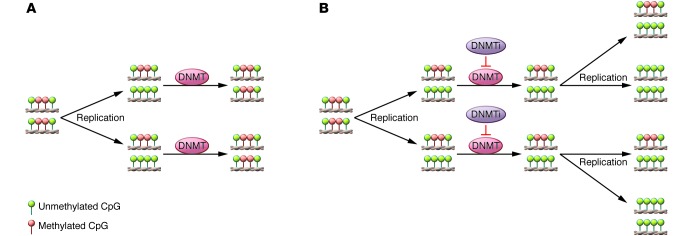
(A) Under normal circumstances, the DNMTs copy the methylation
pattern of the parental DNA strand after replication, ensuring that methylation
patterns are maintained during cell division. (B) During treatment,
DNMTis are incorporated into DNA and RNA, where they covalently bind and thus
inactivate DNMTs. After successive cell divisions, the original DNA methylation
pattern is lost.
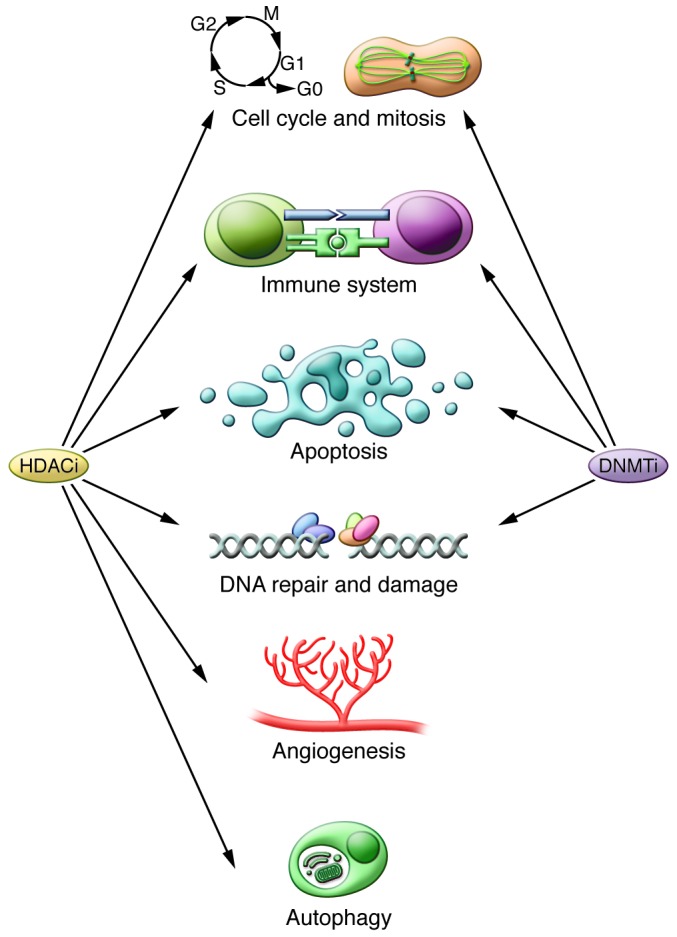
DNA methylation and acetylation of histone and proteins play important roles in
multiple cellular pathways, which may be affected by DNMTis and HDACis.
Accordingly, the inhibition of HDACs or DNMTs can lead to miscellaneous responses,
each of which may require a different biomarker.
References
-
- Diamandis M, White NM, Yousef GM. Personalized medicine: marking a new epoch in cancer patient management. Mol Cancer Res. 2010;8(9):1175–1187. - PubMed
-
- McShane LM, et al. Reporting recommendations for tumor marker prognostic studies. J Clin Oncol. 2005;23(36):9067–9072. - PubMed
-
- Fenaux P, et al. Azacitidine prolongs overall survival compared with conventional care regimens in elderly patients with low bone marrow blast count acute myeloid leukemia. J Clin Oncol. 2010;28(4):562–569. - PubMed
Publication types
MeSH terms
Substances
LinkOut - more resources
Full Text Sources
Other Literature Sources
Molecular Biology Databases
Research Materials
