. 2014 Aug 1;135(3):585-97.
doi: 10.1002/ijc.28701. Epub 2014 Jan 14.

Epigenetic determinants of ovarian clear cell carcinoma biology

Affiliations

Epigenetic determinants of ovarian clear cell carcinoma biology

Ken Yamaguchi et al. Int J Cancer. .

Abstract

Targeted approaches have revealed frequent epigenetic alterations in ovarian cancer, but the scope and relation of these changes to histologic subtype of disease is unclear. Genome-wide methylation and expression data for 14 clear cell carcinoma (CCC), 32 non-CCC and four corresponding normal cell lines were generated to determine how methylation profiles differ between cells of different histological derivations of ovarian cancer. Consensus clustering showed that CCC is epigenetically distinct. Inverse relationships between expression and methylation in CCC were identified, suggesting functional regulation by methylation, and included 22 hypomethylated (UM) genes and 276 hypermethylated (HM) genes. Categorical and pathway analyses indicated that the CCC-specific UM genes were involved in response to stress and many contain hepatocyte nuclear factor (HNF) 1-binding sites, while the CCC-specific HM genes included members of the estrogen receptor alpha (ERalpha) network and genes involved in tumor development. We independently validated the methylation status of 17 of these pathway-specific genes, and confirmed increased expression of HNF1 network genes and repression of ERalpha pathway genes in CCC cell lines and primary cancer tissues relative to non-CCC specimens. Treatment of three CCC cell lines with the demethylating agent Decitabine significantly induced expression for all five genes analyzed. Coordinate changes in pathway expression were confirmed using two primary ovarian cancer datasets (p < 0.0001 for both). Our results suggest that methylation regulates specific pathways and biological functions in CCC, with hypomethylation influencing the characteristic biology of the disease while hypermethylation contributes to the carcinogenic process.

Keywords: ERalpha; HNF1; epigenetic characterization; methylation; ovarian clear cell carcinoma.


Figures

Fig. 1
Fig. 1
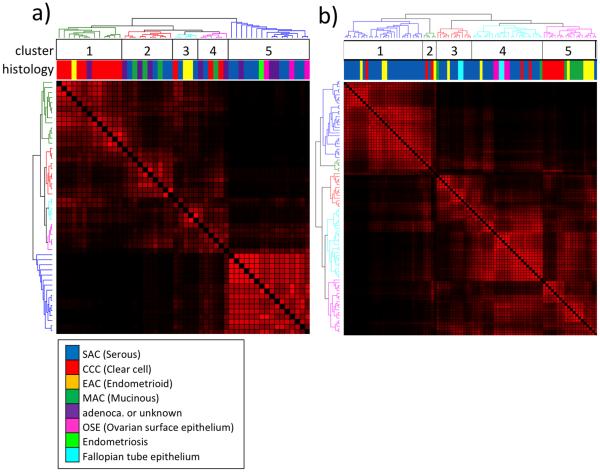
Consensus clustering of DNA methylation profiles for 46 ovarian cancer and four non-cancerous cell lines (A), and 83 clinical ovarian cancer specimens and eight normal counterparts (B). Red-black coloration represents the similarity of methylation profiles between samples, from similar to divergent methylation patterns, respectively. The same specimens are ordered identically in the individual rows and columns. The colored dendogram indicates the five different clusters and the color bar indicates the histological subtype derivation of each specimen.
Fig. 2
Fig. 2
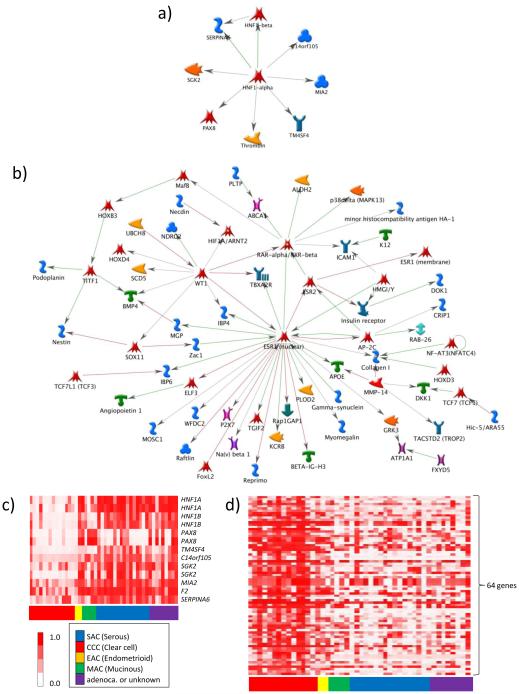
MetaCore pathway analyses of the 22 CCC-specific UM genes (A) and the 276 CCC-specific HM genes (B), and heatmaps showing methylation profiles of nine HNF1 pathway genes (C) and 64 ERalpha network genes (D) in 46 ovarian cancer cell lines. Of the 22 CCC-specific UM genes for which expression and methylation are inversely correlated, nine were identified as members of the HNF1 transcriptional network (A). Of 276 CCC-specific HM genes for which expression and methylation are inversely correlated, 65 were members of the ERalpha (encoded by ESR1) network (B). In the heatmaps, red-white coloration represents the Infinium beta-value, from completely methylated to completely unmethylated, respectively. Genes within the HNF1 pathway (C) and ERalpha network (D) show synchronous hypomethylation and hypermethylation, respectively, in CCC versus non-CCC cell lines.
Fig. 3
Fig. 3
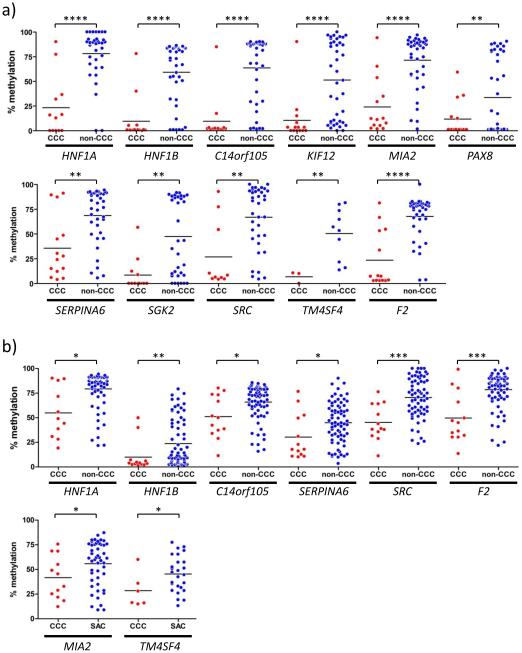
Quantitative methylation analyses of 11 HNF1 network genes (HNF1A, HNF1B, C14orf105, KIF12, MIA2, PAX8, SERPINA6, SGK2, SRC, TM4SF4 and F2) in cell lines by bisulfite pyrosequencing shows lower levels of methylation in CCC versus non-CCC, supporting the results from the Infinium BeadChip (A). For clinical specimens, six of eleven HNF1 network genes show significantly decreased methylation in CCC compared to non-CCC. When CCC is compared with SAC in clinical samples, eight genes (HNF1A, p=0.0007; HNF1B, p=0.0002; C14orf105, p=0.0073; SERPINA6, p=0.0071; SRC, p<0.0001 and F2, p<0.0001 included in data shown in 4B, top; MIA2, p=0.0480 and TM4SF4, p=0.0452 are shown below) are significantly hypomethylated in CCC relative to SAC (B). *p ≤ 0.05, **p ≤ 0.01, ***p ≤ 0.001, ****p ≤ 0.0001
Fig. 4
Fig. 4
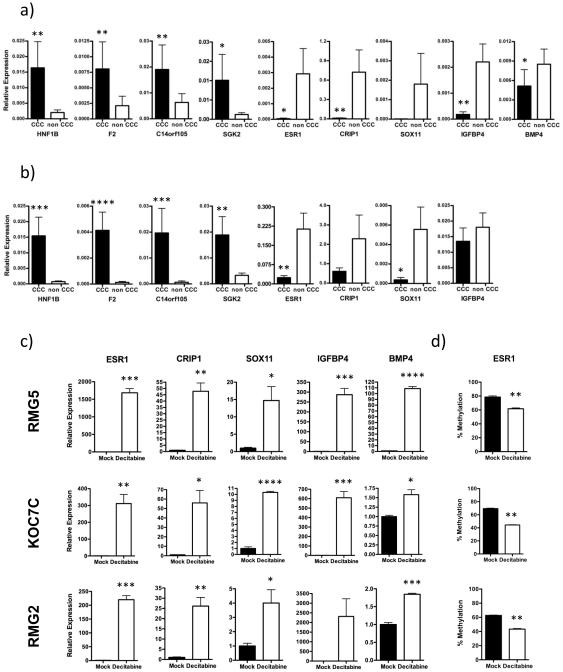
Validation of altered expression of HNF1 network and ERalpha pathway genes in CCC and reactivation and demethylation of ERalpha pathway genes with Decitabine treatment. Quantitative RT-PCR of HNF1 network genes (HNF1A, F2, C14orf105 and SGK2) and ERalpha pathway genes (ESR1, CRIP1, SOX11, IGFBP4 and BMP4) using cell lines (A) and clinical samples (B). The expression of ERalpha pathway genes (ESR1, CRIP1, SOX11, IGFBP4 and BMP4) is markedly induced by demethylating agent 5-aza-2'-deoxycytidine, (Decitabine) in three CCC cell lines (RMG-5, KOC-7C, RMG-2) (C). Methylation at the ESR1 promoter is decreased in response to Decitabine treatment (D). *p ≤ 0.05, **p ≤ 0.01, ***p ≤ 0.001, ****p ≤ 0.0001.

References

    1. Barton CA, Hacker NF, Clark SJ, O'Brien PM. DNA methylation changes in ovarian cancer: implications for early diagnosis, prognosis and treatment. Gynecol Oncol. 2008;109:129–39. - PubMed
    1. Gomez-Raposo C, Mendiola M, Barriuso J, Hardisson D, Redondo A. Molecular characterization of ovarian cancer by gene-expression profiling. Gynecol Oncol. 2010;118:88–92. - PubMed
    1. Cho KR, Shih Ie M. Ovarian cancer. Annu Rev Pathol. 2009;4:287–313. - PMC - PubMed
    1. Mandai M, Yamaguchi K, Matsumura N, Baba T, Konishi I. Ovarian cancer in endometriosis: molecular biology, pathology, and clinical management. Int J Clin Oncol. 2009;14:383–91. - PubMed
    1. Skirnisdottir I, Seidal T, Karlsson MG, Sorbe B. Clinical and biological characteristics of clear cell carcinomas of the ovary in FIGO stages I-II. Int J Oncol. 2005;26:177–83. - PubMed

Publication types

Substances