


An estimate of asthma prevalence in Africa: a systematic analysis
- PMID: 24382846
- PMCID: PMC3893990
- DOI: 10.3325/cmj.2013.54.519
An estimate of asthma prevalence in Africa: a systematic analysis
Abstract
Aim: To estimate and compare asthma prevalence in Africa in 1990, 2000, and 2010 in order to provide information that will help inform the planning of the public health response to the disease.
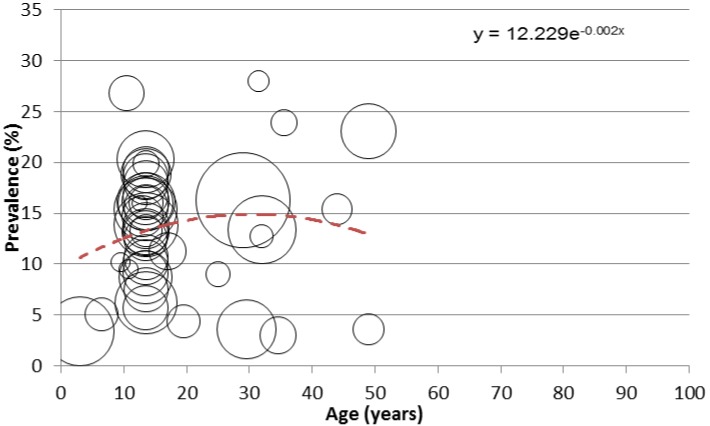
Methods: We conducted a systematic search of Medline, EMBASE, and Global Health for studies on asthma published between 1990 and 2012. We included cross-sectional population based studies providing numerical estimates on the prevalence of asthma. We calculated weighted mean prevalence and applied an epidemiological model linking age with the prevalence of asthma. The UN population figures for Africa for 1990, 2000, and 2010 were used to estimate the cases of asthma, each for the respective year.
Results: Our search returned 790 studies. We retained 45 studies that met our selection criteria. In Africa in 1990, we estimated 34.1 million asthma cases (12.1%; 95% confidence interval [CI] 7.2-16.9) among children <15 years, 64.9 million (11.8%; 95% CI 7.9-15.8) among people aged <45 years, and 74.4 million (11.7%; 95% CI 8.2-15.3) in the total population. In 2000, we estimated 41.3 million cases (12.9%; 95% CI 8.7-17.0) among children <15 years, 82.4 million (12.5%; 95% CI 5.9-19.1) among people aged <45 years, and 94.8 million (12.0%; 95% CI 5.0-18.8) in the total population. This increased to 49.7 million (13.9%; 95% CI 9.6-18.3) among children <15 years, 102.9 million (13.8%; 95% CI 6.2-21.4) among people aged <45 years, and 119.3 million (12.8%; 95% CI 8.2-17.1) in the total population in 2010. There were no significant differences between asthma prevalence in studies which ascertained cases by written and video questionnaires. Crude prevalences of asthma were, however, consistently higher among urban than rural dwellers.
Conclusion: Our findings suggest an increasing prevalence of asthma in Africa over the past two decades. Due to the paucity of data, we believe that the true prevalence of asthma may still be under-estimated. There is a need for national governments in Africa to consider the implications of this increasing disease burden and to investigate the relative importance of underlying risk factors such as rising urbanization and population aging in their policy and health planning responses to this challenge.
Figures

References
-
- IUATLD. The Global Asthma Report 2011. Paris: The International Union Against Tuberculosis and Lung Disease; 2011.
-
- Bousquet J, Mantzouranis E, Cruz AA, Ait-Khaled N, Baena-Cagnani CE, Bleecker ER, et al. Uniform definition of asthma severity, control, and exacerbations: document presented for the World Health Organization Consultation on Severe Asthma. J Allergy Clin Immunol. 2010;126:926–38. doi: 10.1016/j.jaci.2010.07.019. - DOI - PubMed
MeSH terms
LinkOut - more resources
Full Text Sources
Other Literature Sources
Medical
Miscellaneous
