Review
. 2013:2013:325318.
doi: 10.1155/2013/325318. Epub 2013 Dec 8.

Chemokines in chronic liver allograft dysfunction pathogenesis and potential therapeutic targets

Affiliations
Review

Chemokines in chronic liver allograft dysfunction pathogenesis and potential therapeutic targets

Bin Liu et al. Clin Dev Immunol. 2013.

Abstract

Despite advances in immunosuppressive drugs, long-term success of liver transplantation is still limited by the development of chronic liver allograft dysfunction. Although the exact pathogenesis of chronic liver allograft dysfunction remains to be established, there is strong evidence that chemokines are involved in organ damage induced by inflammatory and immune responses after liver surgery. Chemokines are a group of low-molecular-weight molecules whose function includes angiogenesis, haematopoiesis, mitogenesis, organ fibrogenesis, tumour growth and metastasis, and participating in the development of the immune system and in inflammatory and immune responses. The purpose of this review is to collect all the research that has been done so far concerning chemokines and the pathogenesis of chronic liver allograft dysfunction and helpfully, to pave the way for designing therapeutic strategies and pharmaceutical agents to ameliorate chronic allograft dysfunction after liver transplantation.


Figures
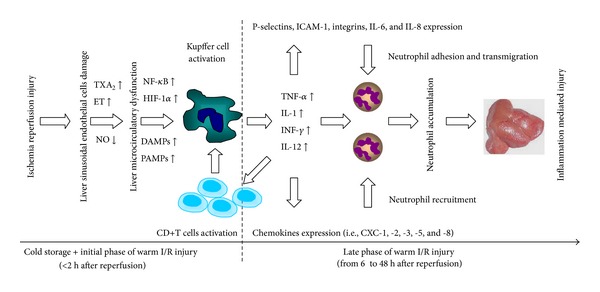
Figure 1
Figure 1
The inflammatory pathways of hepatic ischemia/reperfusion (I/R) injury. Liver sinusoidal endothelial cells (LSEC) damage, which occurs during cold preservation, represents the initial factor leading to liver I/R injury. Kupffer cell (KC) and LSEC edema, together with the imbalance between nitric oxide (NO) (↓) and thromboxane A2 (TXA2) (↑) and endothelin (ET) (↑), contributes to liver microcirculatory dysfunction. KC activation is promoted by damage-associated molecular patterns (DAMPs) (↑) and pathogen-associated molecular patterns (PAMPs) (↑) produced by neighbouring hepatic cells. Then activated KCs increase their release of ROS and proinflammatory cytokines including tumour necrosis factor-a (TNF-a), interleukin-1 (IL-1), interferon- (INF), interleukin-12 (IL-12), which induces the expression of P-selectin, intracellular adhesion molecule-1 (ICAM-1), integrins, IL-6, IL-8 in LSEC and the release of chemokines (i.e., CXC-1,-2,-3,-5, and -8). Additionally, IL-1 and TNF-a recruit and activate CD4+ T-lymphocytes, which amplify KC activation and promote neutrophil recruitment and adherence into the liver sinusoids and finally execute liver inflammation and injury.

References

    1. Yang J, Xu MQ, Yan LN, Chen XB, Liu J. Zinc finger protein A20 protects rats against chronic liver allograft dysfunction. World Journal of Gastroenterology. 2012;18(27):3537–3550. - PMC - PubMed
    1. Pappo O, Ramos H, Starzl TE, Fung JJ, Demetris AJ. Structural integrity and identification of causes of liver allograft dysfunction occurring more than 5 years after transplantation. American Journal of Surgical Pathology. 1995;19(2):192–206. - PMC - PubMed
    1. Neuberger J. Chronic allograft dysfunction: diagnosis and management. Is it always progressive? Liver Transplantation. 2005;11(11, supplement 2):S63–S68. - PubMed
    1. Friedman BH, Wolf JH, Wang L, et al. Serum cytokine profiles associated with early allograft dysfunction in patients undergoing liver transplantation. Liver Transplantation. 2012;18(2):166–176. - PMC - PubMed
    1. Khettry U, Backer A, Ayata G, Lewis WD, Jenkins RL, Gordon FD. Centrilobular histopathologic changes in liver transplant biopsies. Human Pathology. 2002;33(3):270–276. - PubMed

Publication types

MeSH terms

LinkOut - more resources
