. 2014 Jan 2:14:2.
doi: 10.1186/1471-2180-14-2.

Laboratory divergence of Methylobacterium extorquens AM1 through unintended domestication and past selection for antibiotic resistance

Affiliations

Laboratory divergence of Methylobacterium extorquens AM1 through unintended domestication and past selection for antibiotic resistance

Sean Michael Carroll et al. BMC Microbiol. .

Abstract

Background: A common assumption of microorganisms is that laboratory stocks will remain genetically and phenotypically constant over time, and across laboratories. It is becoming increasingly clear, however, that mutations can ruin strain integrity and drive the divergence or "domestication" of stocks. Since its discovery in 1960, a stock of Methylobacterium extorquens AM1 ("AM1") has remained in the lab, propagated across numerous growth and storage conditions, researchers, and facilities. To explore the extent to which this lineage has diverged, we compared our own "Modern" stock of AM1 to a sample archived at a culture stock center shortly after the strain's discovery. Stored as a lyophilized sample, we hypothesized that this Archival strain would better reflect the first-ever isolate of AM1 and reveal ways in which our Modern stock has changed through laboratory domestication or other means.

Results: Using whole-genome re-sequencing, we identified some 29 mutations - including single nucleotide polymorphisms, small indels, the insertion of mobile elements, and the loss of roughly 36 kb of DNA - that arose in the laboratory-maintained Modern lineage. Contrary to our expectations, Modern was both slower and less fit than Archival across a variety of growth substrates, and showed no improvement during long-term growth and storage. Modern did, however, outperform Archival during growth on nutrient broth, and in resistance to rifamycin, which was selected for by researchers in the 1980s. Recapitulating selection for rifamycin resistance in replicate Archival populations showed that mutations to RNA polymerase B (rpoB) substantially decrease growth in the absence of antibiotic, offering an explanation for slower growth in Modern stocks. Given the large number of genomic changes arising from domestication (28), it is somewhat surprising that the single other mutation attributed to purposeful laboratory selection accounts for much of the phenotypic divergence between strains.

Conclusions: These results highlight the surprising degree to which AM1 has diverged through a combination of unintended laboratory domestication and purposeful selection for rifamycin resistance. Instances of strain divergence are important, not only to ensure consistency of experimental results, but also to explore how microbes in the lab diverge from one another and from their wild counterparts.


Figures
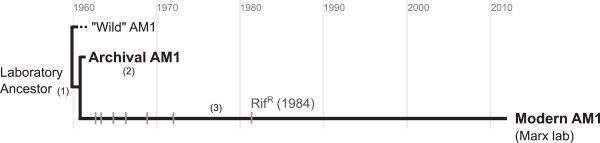
Figure 1
Figure 1
Two distinct lineages of Methylobacterium extorquens AM1. Shortly after its discovery in 1960 (1), a sample of M. extorquens AM1 (“AM1”) was deposited to a culture stock center for storage and distribution (2; Archival AM1). Many researchers, however, use instead a working stock of AM1 that was maintained over fifty years in the lab (3; Modern AM1), and was at one point selected for rifamycin resistance (RifR) [45]. We hypothesized that these conditions may have fostered the accumulation of mutations and unintended evolutionary divergence in the Modern AM1 lineage, and sought to compare our Modern AM1 to the Archival strain. Dashes represent the accumulation of mutations in the Modern lineage.
Figure 2
Figure 2
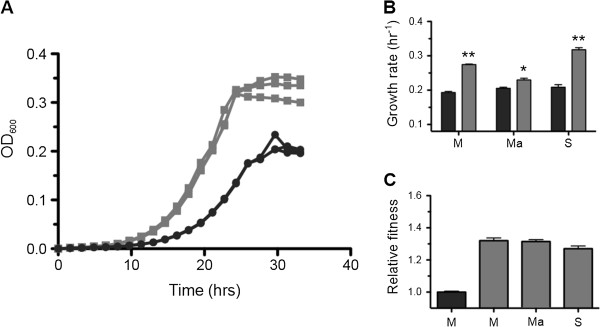
Archival outperforms Modern AM1 under standard growth conditions. A) Representative growth curves showing the increase in OD600 over time of Modern (black circles) and Archival AM1 (gray squares) cultured using 3.5 mM succinate in 48-well plates. B) Growth rates calculated from the exponential phase of cultures grown on methanol (M), methylamine (Ma), or succinate (S) as a carbon source. Significant growth differences between Modern and Archival were calculated using a two-tailed, unpaired t test, and are marked by single (p < 0.05) and double asterisks (p < 0.01). C) Fitness of Archival AM1 measured via a head-to-head competition mixed in co-culture with a fluorescently labeled Modern reference. A control growth consisted of unlabeled Modern (black) versus the fluorescent Modern reference grown on M. All other bars (gray) show Archival fitness relative to Modern grown M, Ma, and S. Values are the mean plus SEM of growth rates or fitness values calculated from three or more biological replicates (see Methods).
Figure 3
Figure 3
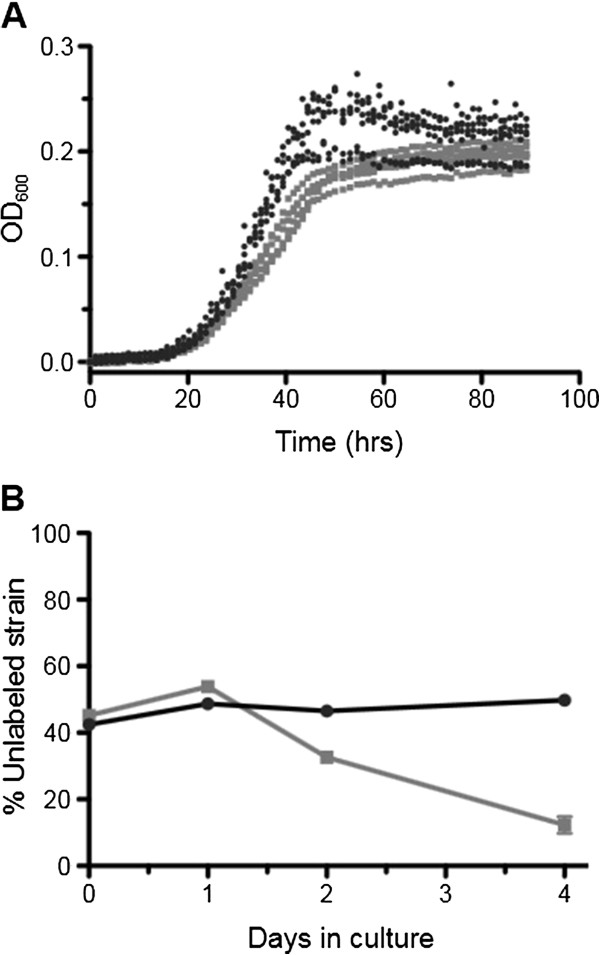
Modern outperforms Archival AM1 when grown on nutrient broth. A) Representative growth curves of Modern (black circles) and Archival (gray squares) AM1 grown on nutrient broth (NB). Note that growth - particularly for the Archival strain - slows considerably during late exponential phase, signifying density-dependent growth inhibition. B) Change in the proportion of either Modern or Archival AM1 mixed in co-culture with a fluorescently labeled Modern reference as measured by flow cytometry. Values represent the mean plus SEM of at least three biological replicates grown in 48-well plates (A) or flasks (B).
Figure 4
Figure 4
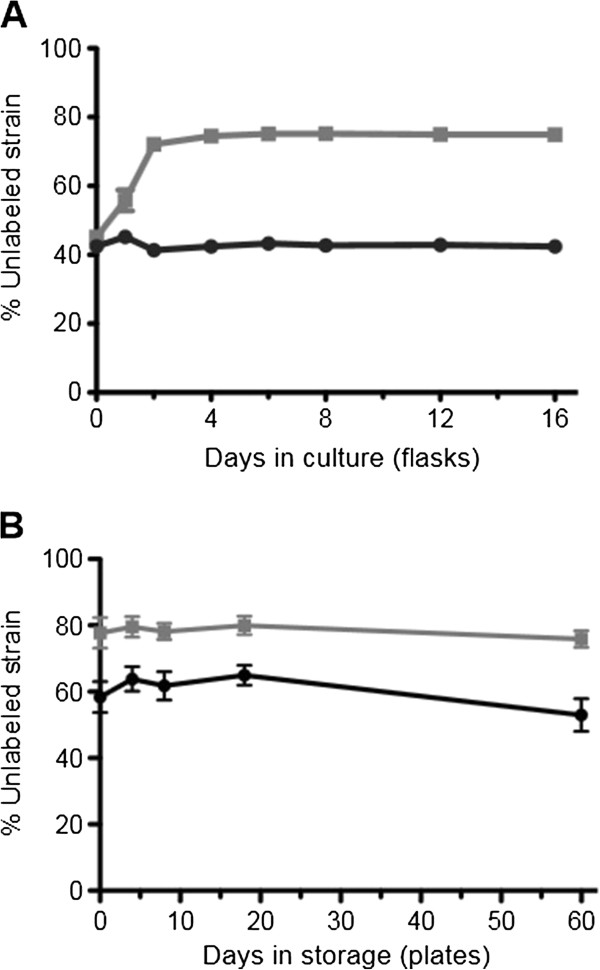
Equivalence of AM1 strains during tests of long-term growth and survival. Co-cultures were created by mixing either Modern (black circles) or Archival AM1 (gray squares) with a fluorescently labeled Modern reference, and the change in unlabeled versus fluorescent cells was monitored over time using flow cytometry. A) In continually shaken flasks with succinate, the Archival strain increased in frequency over the first two days of growth and maintained this advantage over Modern over time. B) Similarly, Archival increased in frequency during four days of growth on methylamine agar plates (not shown), and maintained this frequency during long-term storage at 4°C. Values represent the mean plus SEM of the percent unlabeled cells measured in three replicate co-cultures.
Figure 5
Figure 5
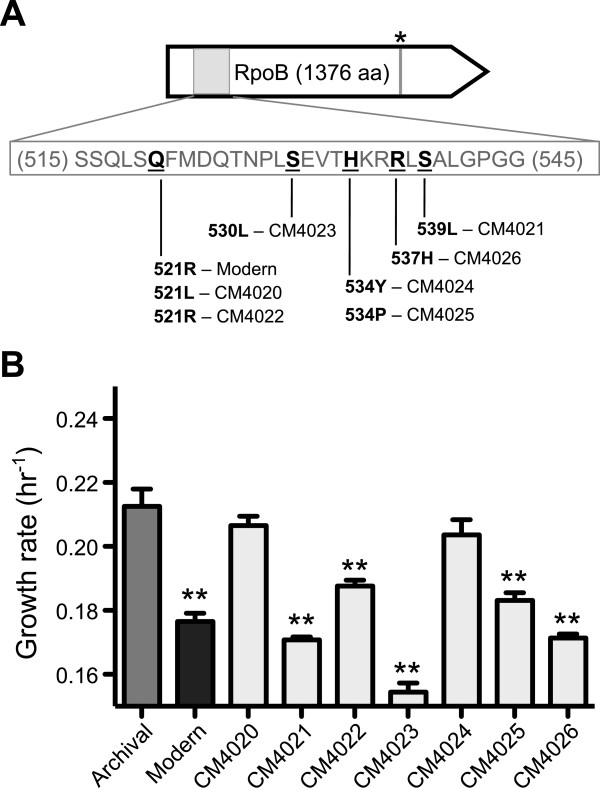
Mutations associated with rifamycin resistance hinder AM1 growth. A) Spectrum of mutations to the RNA polymerase beta subunit (RpoB) during past and current selection for rifamycin resistance (RifR). Modern AM1 was selected for RifR in 1984 [45] and acquired two mutations to RpoB: Q521R, and Q1081R (denoted by an asterisk). By recapitulating selection for RifR in replicate Archival populations, we identified a number of other RpoB mutations putatively associated with RifR. B) The effect of RifR mutations on growth rate in the absence of antibiotic. Values represent the mean plus SEM of four biological replicates grown in 48-well plates with succinate. Strains that were significantly slower than Archival are marked with asterisks (p < 0.01, one-way ANOVA with Tukey post-hoc test).

References

    1. Stanley NR, Lazazzera BA. Defining the genetic differences between wild and domestic strains of Bacillus subtilis that affect poly-gamma-dl-glutamic acid production and biofilm formation. Mol Microbiol. 2005;57:1143–1158. doi: 10.1111/j.1365-2958.2005.04746.x. - DOI - PubMed
    1. Kearns DB, Losick R. Swarming motility in undomesticated Bacillus subtilis. Mol Microbiol. 2003;49:581–590. - PubMed
    1. Branda SS, González-Pastor JE, Ben-Yehuda S, Losick R, Kolter R. Fruiting body formation by Bacillus subtilis. Proc Natl Acad Sci U S A. 2001;98:11621–11626. doi: 10.1073/pnas.191384198. - DOI - PMC - PubMed
    1. Eisenstark A. Genetic diversity among offspring from archived Salmonella enterica ssp. enterica Serovar Typhimurium (Demerec Collection): In search of survival strategies. Annu Rev Microbiol. 2010;64:277–292. doi: 10.1146/annurev.micro.091208.073614. - DOI - PubMed
    1. Liu G-R, Edwards K, Eisenstark A, Fu Y-M, Liu W-Q, Sanderson KE, Johnston RN, Liu S-L. Genomic diversification among archival strains of Salmonella enterica serovar typhimurium LT7. J Bacteriol. 2003;185:2131–2142. doi: 10.1128/JB.185.7.2131-2142.2003. - DOI - PMC - PubMed

Publication types

MeSH terms