


Sucrose-conditioned flavor preferences in sweet ageusic T1r3 and Calhm1 knockout mice
- PMID: 24384370
- PMCID: PMC3944641
- DOI: 10.1016/j.physbeh.2013.12.003
Sucrose-conditioned flavor preferences in sweet ageusic T1r3 and Calhm1 knockout mice
Abstract
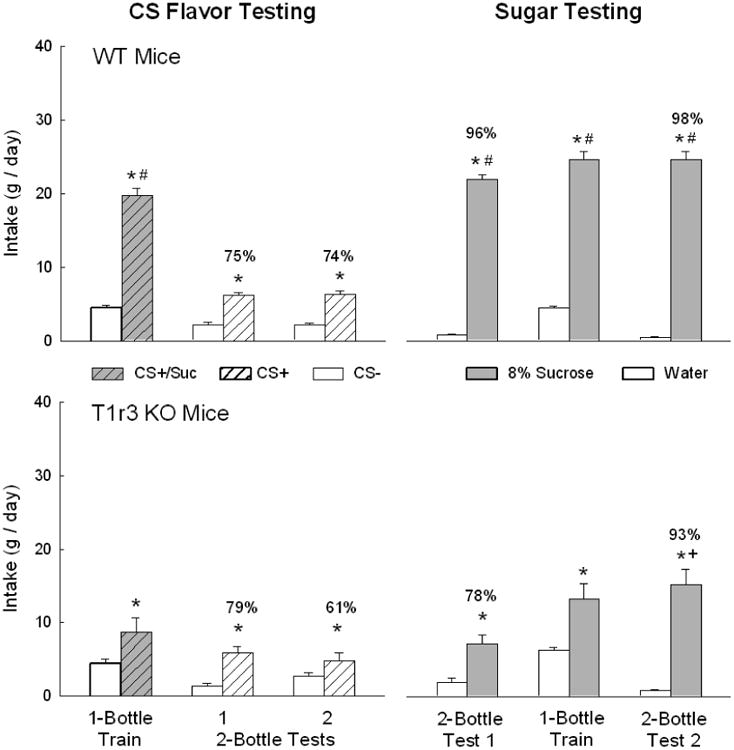
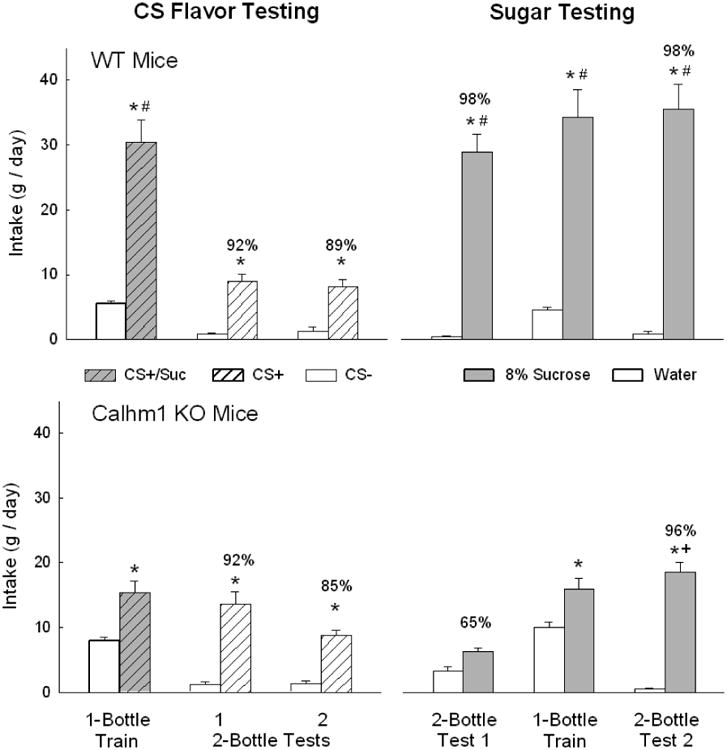
The present study compared the ability of sweet ageusic T1r3 knockout (KO) and Calhm1 KO mice to acquire preferences for a sucrose-paired flavor as well as for unflavored sucrose. The KO and wildtype (WT) mice were given 24-h one-bottle access to 8% sucrose containing one flavor CS+, e.g., grape) and to water containing a different flavor (CS-, e.g., cherry) over 4 training days. In subsequent two-bottle tests with the flavors in water only, the T1r3 KO and Calhm1 KO mice, like WT mice, preferred the CS+ to the CS-. After training with flavored solutions, both KO groups also preferred unflavored 8% sucrose to water although Calhm1 KO mice required more sugar experience to match the preference of the T1r3 KO mice. These findings demonstrate that Calhm1 KO mice, like T1r3 KO mice and WT mice, are sensitive to the post-oral preference conditioning actions of sucrose and can discriminate sugar from water. Yet, despite their acquired sucrose preferences, the Calhm1 KO and T1r3 KO mice consumed only half as much sugar per day as did WT mice. Thus, sweet taste signaling elements are not needed in the gut for sugar conditioning, but sweet taste signaling in the mouth is essential for the full expression of sugar appetite.
Keywords: 24-h tests; Oral sugar conditioning; Post-oral sugar reward.
Copyright © 2013 Elsevier Inc. All rights reserved.
Figures
References
-
- Ackroff K, Sclafani A. Flavor preference conditioned by oral monosodium glutamate in mice. Chem Senses. 2013;38:745–758. - PubMed
-
- Ackroff K, Sclafani A. Flavor preferences conditioned by intragastric monosodium glutamate in mice. Chem Senses. 2013;38:759–769. - PubMed
-
- Damak S, Rong M, Yasumatsu K, Kokrashvili Z, Varadarajan V, Zou S, Jiang P, Ninomiya Y, Margolskee RF. Detection of sweet and umami taste in the absence of taste receptor T1r3. Science. 2003;301:850–853. - PubMed
Publication types
MeSH terms
Substances
Grants and funding
LinkOut - more resources
Full Text Sources
Other Literature Sources
Molecular Biology Databases
Research Materials
