


Relationship of demographic and health factors to cognition in older adults in the ACTIVE study
- PMID: 24385633
- PMCID: PMC4116102
- DOI: 10.1177/0898264313498415
Relationship of demographic and health factors to cognition in older adults in the ACTIVE study
Abstract
Objective: Examine the relationship of demographics and health conditions, alone and in combination, on objective measures of cognitive function in a large sample of community-dwelling older adults.
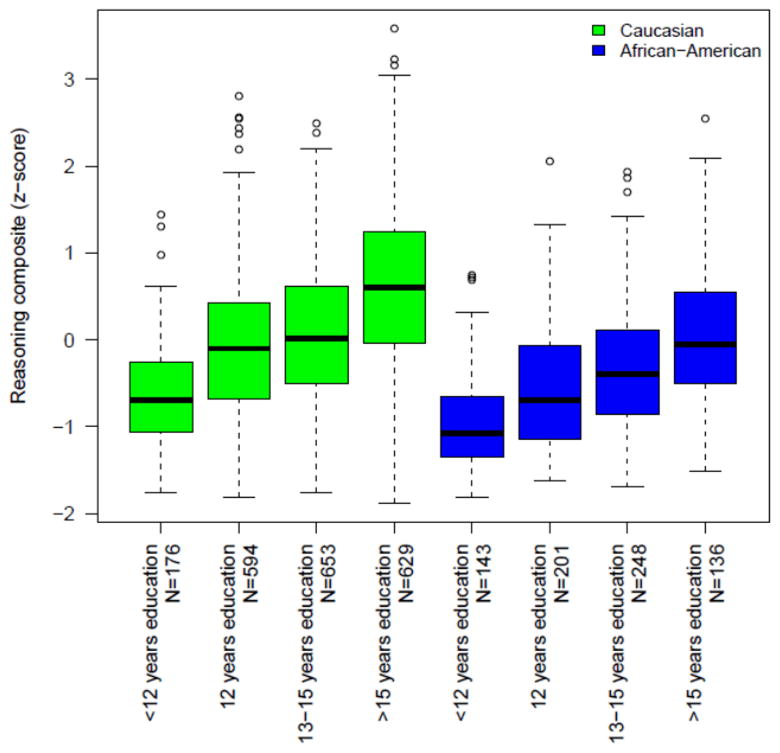
Method: Baseline data from 2,782 participants in the Advanced Cognitive Training in Independent and Vital Elderly (ACTIVE) study were used to examine relationships of demographics and health conditions with composite scores of memory, reasoning, and speed of processing.
Results: Younger age, increased education, and White race were independently associated with better performance in each cognitive domain after adjusting for gender and health conditions. Male gender, diabetes, and suspected clinical depression were associated with poorer cognitive functioning; suspected clinical depression was associated with lower reasoning and diabetes and history of stroke with slower speed of processing.
Discussion: Age, education, and race are consistently associated with cognitive performance in this sample of older community-dwelling adults. Diabetes, stroke, and suspected clinical depression had independent but weaker effects on cognition.
Keywords: cognitive aging; cognitive functioning; memory; older adults; reasoning; speed.
Figures
References
-
- Arvanitakis Z, Wilson RS, Bienias JL, Evans DA, Bennett DA. Diabetes mellitus and risk of Alzheimer disease and decline in cognitive function. Archives of Neurology. 2004;61(5):661–666. - PubMed
-
- Baumeister H, Kriston L, Bengel J, Haerter M. High agreement of self-report and physician-diagnosed somatic conditions yields limited bias in examining mental-physical comorbidity. Journal of Clinical Epidemiology. 2010;63(5):558–565. - PubMed
-
- Beckett M, Weinstein M, Goldman N, Lin YH. Do health interview surveys yield reliable data on chronic illness among older respondents? American Journal of Epidemiology. 2000;151(3):315–323. - PubMed
-
- Benson VMMA. Current estimates from the National Health Interview Survey 1995 1998 - PubMed
Publication types
MeSH terms
Grants and funding
- U01 AG14260/AG/NIA NIH HHS/United States
- U01 AG014260/AG/NIA NIH HHS/United States
- U01 AG14289/AG/NIA NIH HHS/United States
- U01 NR004507/NR/NINR NIH HHS/United States
- U01 NR04508/NR/NINR NIH HHS/United States
- U01 AG14263/AG/NIA NIH HHS/United States
- U01 NR004508/NR/NINR NIH HHS/United States
- R01 AG026096/AG/NIA NIH HHS/United States
- U01 AG014282/AG/NIA NIH HHS/United States
- U01 NR04507/NR/NINR NIH HHS/United States
- U01 AG014276/AG/NIA NIH HHS/United States
- P30 AG028740/AG/NIA NIH HHS/United States
- U01 AG014263/AG/NIA NIH HHS/United States
- U01 AG014289/AG/NIA NIH HHS/United States
- U01 AG14282/AG/NIA NIH HHS/United States
LinkOut - more resources
Full Text Sources
Other Literature Sources
Medical
