


doi: 10.1177/0898264313518133.
The ACTIVE study: study overview and major findings
Affiliations
- PMID: 24385638
- PMCID: PMC3934012
- DOI: 10.1177/0898264313518133
Item in Clipboard
The ACTIVE study: study overview and major findings
J Aging Health.
2013 Dec.
No abstract available
Figures

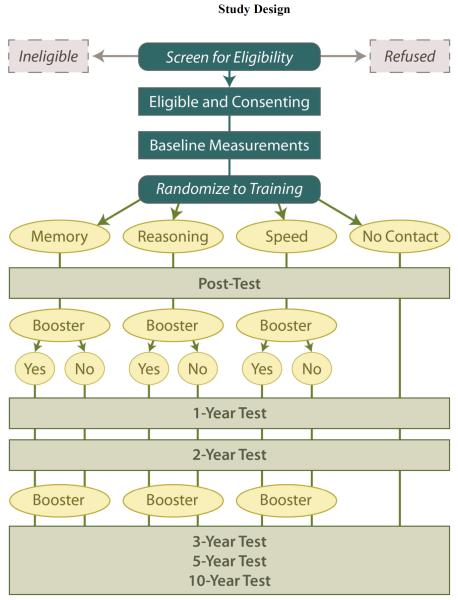
Hypothesized mode of effects in ACTIVE trial. Influence of intervention on primary and secondary outcomes is mediated through trained abilities. Bold lines represent specific effects of training. Dashed lines represent non-specific effects of training on related abilities, e.g., through social contact or general cognitive arousal.
References
-
- Backman L, Hill RD. Cognitive performance and everyday functioning: Patterns in normal aging and dementia. In: Woods RT, editor. Handbook of the Clinical Psychology of Ageing. John Wiley & Sons, Ltd.; West Sussex: 1996. pp. P73–92.
-
- Ball K. Enhancing mobility in the elderly: Attentional interventions for driving. In: Dollinger C, DiLalla L, editors. Assessment and Intervention Issues across the Lifespan. Lawrence Erlbaum Associates; Mahwah, NJ: 1997.
Publication types
MeSH terms
Grants and funding
- U01 NR004508/NR/NINR NIH HHS/United States
- U01AG14260/AG/NIA NIH HHS/United States
- U01 AG014282/AG/NIA NIH HHS/United States
- U01AG14282/AG/NIA NIH HHS/United States
- U01AG14289/AG/NIA NIH HHS/United States
- U01NR04508/NR/NINR NIH HHS/United States
- U01 AG014289/AG/NIA NIH HHS/United States
- U01AG014282/AG/NIA NIH HHS/United States
- R03 AG023078/AG/NIA NIH HHS/United States
- U01AG14276/AG/NIA NIH HHS/United States
- U01 AG014260/AG/NIA NIH HHS/United States
- U01AG14263/AG/NIA NIH HHS/United States
- U01 AG014276/AG/NIA NIH HHS/United States
- U01 AG014263/AG/NIA NIH HHS/United States
- U01NR04507/NR/NINR NIH HHS/United States
- U01 NR004507/NR/NINR NIH HHS/United States
LinkOut - more resources
Full Text Sources
Other Literature Sources
Medical
